Connect with us

News

Senate reverses controversial eligibility rule for presiding officers

Published

on

ADVERTISEMENT
Zoom Ad
ADVERTISEMENT
Zoom Ad

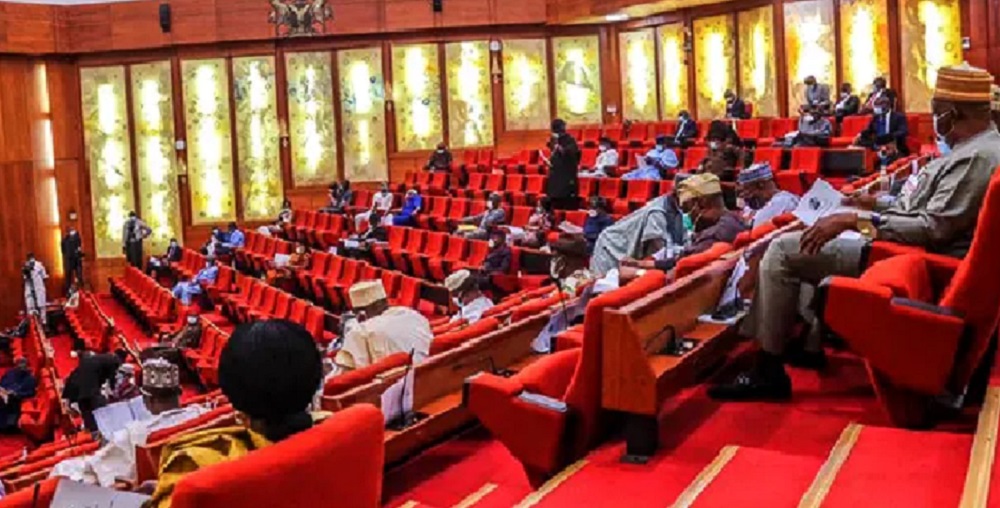
The Senate yesterday rescinded controversial amendments to its Standing Orders relating to the election of its presiding officers, following mounting concerns over constitutional inconsistencies in the new provisions.


The Senate also passed for second reading a bill seeking to reform the handling of pre-election disputes by redefining the jurisdiction of courts in electoral matters, while separately approving the N2.285 trillion 2026 Federal Capital Territory (FCT) budget, with N1.741 trillion earmarked for capital projects aimed at accelerating infrastructure development in Abuja and satellite communities.

The reversal of the controversial amendments took place during plenary in the absence of Senate President, Godswill Akpabio, who reportedly arrived in the chamber after the motion had already been adopted.

The Senate had earlier amended its rules to provide that only senators who had served at least one four-year term would be eligible to contest for the offices of Senate President and Deputy Senate President.

Advertisement

The amended provision stated: “A Senator vying for the office of the President of the Senate and Deputy President of the Senate must have served at least one term of four (4) years in the Senate as a Senator of the Federal Republic of Nigeria.”

Another amendment had provided that senators could only participate in the election of presiding officers after being sworn in.

However, the Senate yesterday deleted the provisions after lawmakers raised concerns that they conflicted with the 1999 Constitution.

The motion for rescission was sponsored by Senate Leader, Opeyemi Bamidele, and seconded by Senator Enyinnaya Abaribe.

Advertisement

Presenting the motion, Bamidele said the amendments needed to be withdrawn to ensure conformity with constitutional provisions.

Citing Section 1(3) of the Constitution, he said: “If any other law is inconsistent with the provisions of this Constitution, this Constitution shall prevail, and that other law, to the extent of its inconsistency, be void.”

He also referred to Section 52(1) of the Constitution, which allows lawmakers-elect to participate in the election of presiding officers before taking the oath of office.

“In other words, Mr President and distinguished colleagues, election of the officers will have to take place, as it had always been, before the swearing-in of senators,” he said.

Advertisement

The motion noted that the Senate Standing Orders had been amended on Tuesday, May 5, 2026, but that “upon further legislative and constitutional review, certain provisions introduced under Order 2(2) and Order 3(1) may give rise to constitutional inconsistencies and unintended tensions” with the Constitution.

It added that the Senate possessed the parliamentary authority to revisit and rescind previous decisions to preserve the integrity of its proceedings.

Deputy Senate President, Barau Jibrin, who presided over the session, put the motion to a voice vote without debate.

“I thank the Leader for being observant and up to the game as Leader of the Senate by making this observation. We don’t need any debate on this,” he said.

Advertisement

However, Senator Adams Oshiomhole raised a point of order, arguing that debate should have been allowed on the matter.

“So when we are making a law, we should accommodate diverse views. That way, what one person forgot, the other person will remember,” Oshiomhole said.

“The only point I want to make is that next time we should allow debate. That’s it.”

Responding, Bamidele defended the decision to dispense with debate, saying recent disagreements over the amendments had generated unnecessary controversy.

Advertisement

“Yesterday, I saw the kind of drama that went on. It was unnecessary,” he said.

“But the unfortunate thing about that drama was that, regardless of what was done in this hallowed chamber yesterday, what became the news out of this chamber was that unnecessary drama. And we are not going to allow this to continue.”

He added that any senator dissatisfied with previous decisions ought to bring a substantive motion before the chamber rather than disrupt proceedings.

“We cannot allow this kind of drama to go on in the Senate. We must put a stop to it,” Bamidele said.

Advertisement

Also, the Senate passed for second reading a bill seeking to amend the Electoral Act, 2026, with provisions aimed at redefining the jurisdiction of courts in pre-election disputes and streamlining the handling of electoral cases in the country.

The proposed legislation, sponsored by former Plateau State governor and Senator, Simon Bako Lalong, seeks to establish a clearer legal framework for the adjudication of electoral disputes and reduce conflicting court judgments, forum shopping and delays in litigation.

Under the bill, pre-election matters relating to National Assembly, governorship and State Houses of Assembly elections would originate at the Federal High Court, with appeals proceeding to the Court of Appeal.

Disputes involving presidential and vice-presidential elections, however, would commence directly at the Court of Appeal, which would exercise original jurisdiction, while final appeals would be determined by the Supreme Court.

Advertisement

Leading debate on the bill during plenary, Lalong said the proposed amendment was designed to eliminate ambiguity in the existing legal framework, where overlapping interpretations of jurisdiction have resulted in conflicting judgments by courts of coordinate authority.

He said persistent uncertainty over jurisdiction in pre-election matters had contributed to delays, abuse of court processes and constitutional tensions within the judiciary.

According to him, although Section 285(14) of the 1999 Constitution recognises pre-election matters, inconsistencies in interpretation have continued to undermine efficiency in adjudication.

“Democracy thrives not merely on the conduct of elections, but also on the credibility, certainty and predictability of the legal processes that precede those elections,” he said.

Advertisement

Lalong explained that assigning original jurisdiction over presidential election disputes to the Court of Appeal would ensure faster resolution of sensitive national cases, while empowering the Federal High Court to handle other electoral disputes would promote specialisation and consistency.

The bill also seeks to curb the practice of filing multiple suits across different jurisdictions in search of favourable rulings, a trend lawmakers said has weakened public confidence in the electoral process.

It further proposes that no court should entertain pre-election matters outside the procedures outlined in the proposed new Section 29A of the Electoral Act.

Senators who supported the bill described it as timely and necessary for strengthening Nigeria’s democratic and judicial systems, noting that electoral disputes are time-sensitive and require prompt resolution to avoid constitutional uncertainty.

Advertisement

Following debate on its general principles, the Senate approved the bill for second reading, paving the way for further legislative consideration.

In another development, the Senate approved the N2.285 trillion 2026 Statutory Appropriation Bill for the Federal Capital Territory (FCT), with N1.741 trillion allocated to capital projects aimed at accelerating infrastructure development in Abuja and satellite communities.

The approval followed the adoption of the harmonised report of the Senate and House of Representatives Committees on the FCT during plenary.

Presenting the report on behalf of the Chairman of the Senate Committee on the FCT, Ibrahim Bomai, the committee’s Vice Chairman, Austin Akobundu, said the budget was based on a projected revenue framework of N2.385 trillion for the 2026 fiscal year.

Advertisement

According to him, N165.7 billion was allocated for personnel costs, N378.2 billion for overheads, while N1.741 trillion was earmarked for capital expenditure.

Continue Reading
Advertisement

News

NUT Condemns Attacks On Schools, Warns Of Possible Strike

Published

on

By

ADVERTISEMENT
Zoom Ad
ADVERTISEMENT
Zoom Ad

The Nigeria Union of Teachers has condemned the recent attacks on schools, teachers and students in parts of the country, describing the incidents as barbaric and inhuman.

In a statement jointly signed by the National President of the union, Audu Amba, and the Secretary General, Clinton Ikpitibo, the union said schools, which should serve as safe spaces for teaching and learning, have become targets of attacks by armed bandits and terrorists.

The union said the development has created fear, panic and emotional trauma among teachers, students, parents and members of affected communities.

The statement followed attacks on Local Authority Primary School, Ahoro-Esinele, Community High School, Ahoro-Esinele, and Baptist Nursery and Primary School, Yawota, all in Oriire Local Government Area of Oyo State on May 15, 2026.

Advertisement

According to the union, the attacks led to the abduction of a school principal, seven teachers and more than 30 pupils and students, while one teacher was shot dead during the incident.

The NUT said it was particularly painful that the slain teacher was wearing his union attire at the time he was killed, describing him as committed to the teaching profession and the advancement of education.

The union also expressed concern over reports that one of the abducted teachers was later beheaded by the attackers.

It further noted that on the same day, more than 40 pupils and students were reportedly abducted by armed bandits from Mussa Primary and Junior Secondary Schools in Askira-Uba Local Government Area of Borno State.

Advertisement

The NUT said it stands in solidarity with the affected schools, the families of the murdered teachers, the abducted principal, teachers, pupils and students.

The union called on security agencies to intensify rescue operations to secure the safe release of all abducted victims without delay.

It also urged the Federal Government and affected state governments to strengthen security around schools and adopt proactive measures to prevent future attacks.

According to the union, the continued attacks on schools pose a major threat to the education sector and the future of children and the country at large.

Advertisement

“Teachers cannot effectively discharge their duties in an atmosphere of fear and insecurity, where they are subjected to inhuman acts of kidnapping, maiming and killing,” the statement said.

The NUT warned that teachers may be forced to withdraw their services if attacks on schools continue unabated.

The union called on governments at all levels to take urgent action to stop attacks on schools and ensure the safety of teachers, learners and host communities.

Advertisement
Continue Reading

News

FG begins payment of arrears of BEA scholars abroad

Published

on

By

ADVERTISEMENT
Zoom Ad
ADVERTISEMENT
Zoom Ad

The Federal Government has commenced the payment of approved outstanding 2025 allowances to beneficiaries of the Bilateral Education Agreement (BEA) scholarship abroad.

The government announced this in a statement signed by Boriowo Folasade, Director, Press and Public Relations, Federal Ministry of Education.

“The Federal Ministry of Education wishes to inform the general public, particularly Nigerian scholars under the BEA Scholarship Programme, that the Central Bank of Nigeria (CBN) has successfully remitted the approved funds to Nigerian Embassies and Missions for immediate disbursement to eligible beneficiaries,” the statement said.

The Minister of Education, Dr. Maruf Tunji Alausa, disclosed that the released funds represented 50 per cent of the approved outstanding obligations for 2025, while efforts are ongoing to facilitate the release of the balance in due course.

Advertisement

According to the Minister, the funds have already reached the respective embassy accounts, and the affected embassies are expected to commence immediate payment to eligible scholars.

The government advised beneficiaries to monitor their accounts as payments are expected to begin reflecting accordingly.

Alausa noted that the development reflected the unwavering commitment of President Bola Tinubu to the welfare, academic progress and wellbeing of Nigerian students abroad, in line with the Renewed Hope Agenda of the present administration.

The minister appreciated the patience, understanding and resilience demonstrated by the affected scholars, stressing that the federal government remained resolute in ensuring that no Nigerian student pursuing academic excellence under government scholarship schemes was left unsupported.

Advertisement

He reiterated the commitment of the government to fulfilling all legitimate obligations to Nigerian scholars and sustaining policies and interventions that promote access to quality education, student welfare and national development through strategic human capital advancement.

The minister reassured all stakeholders of the continued dedication of the government to supporting Nigerian students globally and ensuring the effective implementation of all government scholarship programmes.

Continue Reading

News

Tinubu orders MDAs to end manual processes

Published

on

By

ADVERTISEMENT
Zoom Ad
ADVERTISEMENT
Zoom Ad

President Bola Ahmed Tinubu has directed all Ministries, Departments and Agencies (MDAs) to fully embrace digitisation, declaring that the era of manual inefficiency in Nigeria’s public service must come to an end.

Tinubu gave the directive on Wednesday at the opening of the International Civil Service Conference 2026 in Abuja, where he said the Federal Government was repositioning the Civil Service to deliver faster, transparent and citizen-focused services.

Represented by the Secretary to the Government of the Federation, George Akume, the President said the public service under his Renewed Hope Agenda was shifting from policy formulation to measurable results.

He disclosed that 38 Ministries and Extra-Ministerial Departments had already transitioned to fully paperless and secure electronic workflow systems, describing the development as a major milestone in governance reform.

Advertisement

“When we spoke of digitalisation in 2025, some may have considered it an ambition for the distant future. Today, with 38 Ministries and Extra-Ministerial Departments operating on a secure, paperless and end-to-end electronic workflow system, we are sending a clear message: Nigeria is building a public service that enables progress,” he said.

Tinubu stressed that bureaucracy must no longer serve as a bottleneck to development but as a driver of efficiency, innovation and inclusive growth.

He also revealed that the ongoing Personnel Audit and Skills Gap Analysis initiated after the previous conference was nearing completion, noting that the exercise would help identify competency gaps and reposition civil servants for modern governance demands.

“We are identifying gaps, strengthening competencies and ensuring that the right people are placed in the right roles, equipped with the digital skills and professional discipline required for 21st-century governance,” he stated.

Advertisement

The President linked the reforms to the Federal Government’s Project BRIDGE initiative — Building Resilient Digital Infrastructure for Growth — which he said would improve connectivity, create jobs and strengthen service delivery nationwide.

He consequently directed all MDAs to sustain and expand digital processes across their operations.

“The era of manual inefficiency must give way to a culture of speed, transparency, data-driven decision-making and citizen-centred service,” Tinubu declared.

The President further urged participants at the conference to ensure that ongoing reforms translate into tangible and lasting outcomes, insisting that Nigerians expect efficient service delivery and accountability from public institutions.

Advertisement

He added that the Civil Service must continue to justify public confidence through improved performance and institutional resilience before officially declaring the conference open.

The Head of the Civil Service of the Federation, Didi Esther Walson-Jack, in her remarks, said reforms under the Federal Civil Service Strategy and Implementation Plan 2021–2025 had significantly transformed operations across the service.

According to her, the reforms have strengthened institutional performance, improved service delivery and introduced innovative digital tools reshaping governance processes.

Walson-Jack cited the introduction of platforms such as Service-Wise GPT as evidence of the Civil Service’s commitment to innovation, efficiency and technology-driven governance.

Advertisement

She added that collaboration among MDAs had played a key role in sustaining the momentum of reforms and assured that the Civil Service would continue evolving into a more agile and professional institution capable of meeting Nigeria’s development needs.

Continue Reading

Trending

Copyright © 2024 Naija Blitz News