Foreign
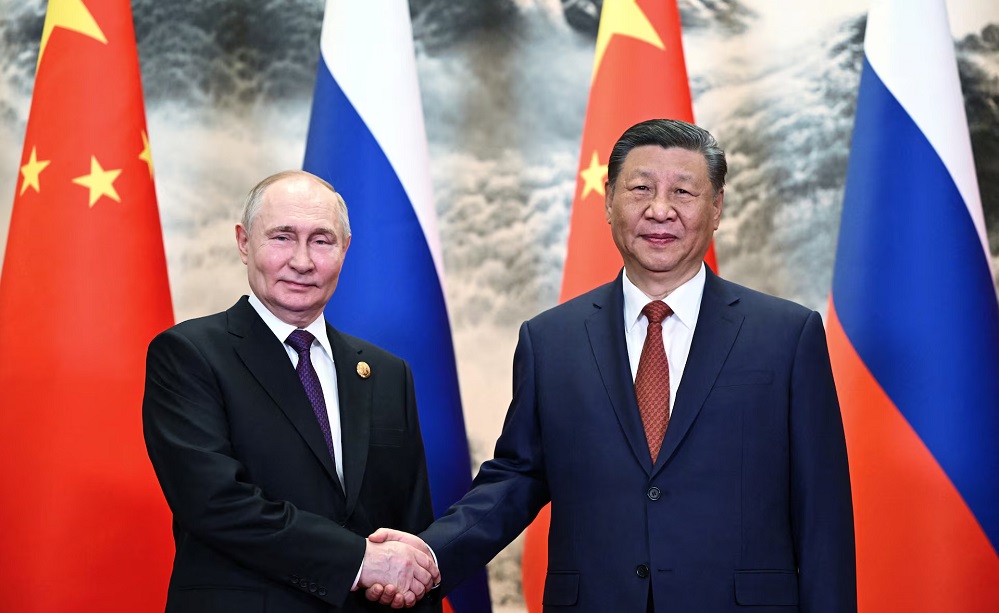
Xi, Putin signal united front against US in Beijing talks
- /home/naijuinz/public_html/wp-content/plugins/mvp-social-buttons/mvp-social-buttons.php on line 27
https://naijablitznews.com/wp-content/uploads/2026/05/Xi-and-Putin-999x600.jpg&description=Xi, Putin signal united front against US in Beijing talks', 'pinterestShare', 'width=750,height=350'); return false;" title="Pin This Post">
- Share
- Tweet /home/naijuinz/public_html/wp-content/plugins/mvp-social-buttons/mvp-social-buttons.php on line 72
https://naijablitznews.com/wp-content/uploads/2026/05/Xi-and-Putin-999x600.jpg&description=Xi, Putin signal united front against US in Beijing talks', 'pinterestShare', 'width=750,height=350'); return false;" title="Pin This Post">
Chinese leader Xi Jinping and visiting Russian President Vladimir Putin have signalled a united front against Washington during a summit in Beijing, warning against a global return to the “law of the jungle”.

In a joint statement, China and Russia took aim at US President Donald Trump’s plans for a $175bn “Golden Dome” defence system, which would create a new missile field in the Midwest.
The duo also criticised the expiry of the last US-Russia arms control treaty, which fell to the wayside in February when Trump failed to respond to Moscow’s proposal to extend it by a year.

Wednesday’s summit – which came a week after Xi hosted Trump in Beijing – kicked off with fanfare in the Chinese capital, complete with a red carpet and a military band playing both the Chinese and Russian national anthems.
In their opening remarks, the leaders emphasised strengthening ties and cooperation between Russia and China amid an increasingly fractured world order.
“Even against the backdrop of unfavourable external factors, our interaction and economic cooperation demonstrate strong momentum,” Russian media reported Putin telling Xi.
Xi meanwhile lauded the “unyielding relationship” between China and Russia.
“We have been able to continuously deepen our political mutual trust and strategic coordination with a resilience that remains unyielding despite trials and tribulations,” Xi said.
The Chinese leader also addressed the United States-Israeli war on Iran, telling his Russian counterpart that further conflict was “inadvisable” and a ceasefire was necessary.
“A comprehensive ceasefire is of utmost urgency, resuming hostilities is even more inadvisable and maintaining negotiations is particularly important,” Xi said.
A separate joint statement advised that “there is a danger of fragmentation of the international community and a return to the ‘law of the jungle’”.
“Attempts by a number of states to unilaterally manage global affairs, impose their interests on the entire world, and limit the sovereign development of other countries, in the spirit of the colonial era, have failed,” the statement added.
Energy talks
Among the chief topics of discussion was the energy sector, which Putin called the “driving force of economic cooperation” in Russian-Chinese relations.
China asserted itself as a major buyer of Russian oil and trading partner after Western countries largely cut economic ties with Moscow in response to Russia’s full-scale invasion of Ukraine.
Al Jazeera’s Katrina Yu, reporting from Beijing, said that while the two leaders planned to sign some 40 agreements covering everything from the economy and tourism to education, energy security remained Putin’s priority.
“Since the war in Ukraine, any gas sales that were previously heading to Europe, that is all dried up, and Russia is in desperate need of revenue to replace that,” she said.
The talks did not lead to a new consensus on a long-discussed gas pipeline known as Power of Siberia 2, however.
Kremlin spokesperson Dmitry Peskov told Russian media that the two sides had reached a “basic understanding” on the pipeline, including its route, but that there was no “clear timeline” for a buildout.
Xi said that cooperation in energy and resource connectivity should be the “ballast stone” between the two countries, but did not mention the pipeline.
‘Sovereign foreign policy’
Although they received the same red-carpet welcome ceremony, Putin’s visit has so far contrasted sharply with Trump’s trip last week
The Russian president is marking 25 years of the Sino-Russian friendship and has visited China dozens of times, meeting with Xi on more than 40 other occasions.
“So this visit will really be about deepening existing coordination and cooperation,” Al Jazeera’s Yu said.
Putin pledged on Wednesday that Russia and China would pursue an “independent and sovereign” foreign policy programme together to play a “stabilising role on the global stage”.
Xi, for his part, said Beijing and Moscow had deepened “political mutual trust and strategic cooperation” in a world that is “increasingly chaotic” and where “hegemony is overwhelming”.
The comments made it clear that “Beijing and Moscow share a depth of established trust that simply does not exist between China and the US”, Yu said.
At the same time, “Xi is calling for a more multipolar world, where the US has less power and influence”, she added.
Putin is being accompanied by a large delegation of Russian businesspeople and government leaders.
In a video address released before meeting Xi, Putin said Russia and China were prepared to cooperate with each other on the “core interests of the two countries, including the protection of sovereignty and national unity”.
“We are not aligning against anyone, but working for the cause of peace and universal prosperity,” Putin said.
Foreign
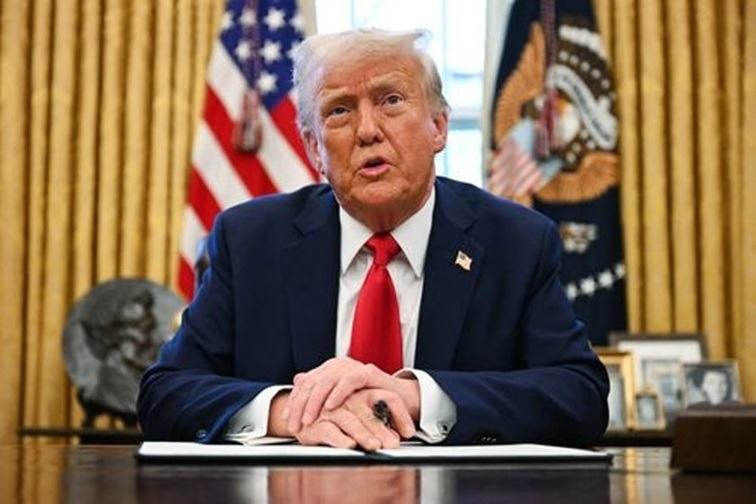
Trump stops planned Iran attack after pleadings from Arab leaders
United States President, Donald Trump, has decided to hold off on attacking Iran again at the request of leaders from Qatar, Saudi Arabia and the United Arab Emirates.
Trump disclosed this in a post on his Truth Social media account on Monday.
According to him, the strike was scheduled for Tuesday, but he was asked to hold off because serious negotiations are now taking place between the US and countries in the Middle East, and beyond.
The US leader noted that the request came from Qatari Emir Tamim bin Hamad al-Thani, Saudi Crown Prince Mohammed bin Salman and UAE President Sheikh Mohammed bin Zayed Al Nahyan.
“This Deal will include, importantly, NO NUCLEAR WEAPONS FOR IRAN!” Trump said, adding that he instructed US Defense Secretary Pete Hegseth, along with Joint Chiefs Chairman Gen. Dan Caine, and others to hold off on the attack.
“But have further instructed them to be prepared to go forward with a full, large -scale assault of Iran, on a moment’s notice, in the event that an acceptable Deal is not reached,” he said.
This is coming less than 24 hours after Trump warned that the “clock is ticking” for a deal to be made between the US and Iran, but so far, negotiations have been at a standstill for weeks since a ceasefire was implemented.
Foreign
Trump Threatens Iran With Total Destruction As Nuclear Talks Stall
United States President Donald Trump has issued a stark warning to Iran, threatening total destruction if Tehran does not move quickly to reach a deal, in a post on his Truth Social platform on Sunday.
“For Iran, the Clock is Ticking, and they better get moving, FAST, or there won’t be anything left of them. TIME IS OF THE ESSENCE!” Trump wrote.
The warning comes as nuclear negotiations between Washington and Tehran remain deadlocked, with Trump last week declaring the ceasefire with Iran “on life support” after rejecting Iran’s latest peace proposal as “totally unacceptable.”
He had earlier labelled the proposal “garbage” and accused Iranian leaders of reversing commitments they had made at the negotiating table, saying they were “very dishonorable people.”
Trump has demanded that Iran formally halt uranium enrichment and surrender its existing stockpile of an estimated 440 kilograms of highly enriched uranium.
Iran has refused, instead proposing a phased approach that would defer nuclear talks to a later stage while focusing first on ending hostilities and lifting the U.S. naval blockade on its ports.
Sunday’s post comes just hours after Trump spoke by phone with Israeli Prime Minister Benjamin Netanyahu, where the two leaders discussed the possibility of renewed military action against Iran.
Netanyahu has insisted the conflict is “not over” and that if negotiations fail to extract Iran’s nuclear material, the two allies could “re-engage them militarily.”
Foreign
Strait of Hormuz: US doesn’t need China’s help – Trump
U.S. President Donald Trump on Wednesday said Washington does not expect to need Beijing’s help to end the war with Iran and ease Tehran’s grip on the Strait of Hormuz.
Trump is in China for a high-stakes summit with President Xi Jinping.
Speaking before departing from Washington, Trump played down the role China could have in resolving the conflict, in which both sides have blocked maritime traffic through a waterway that normally carries one-fifth of the world’s oil supplies.
“I don’t think we need any help with Iran. We’ll win it one way or the other, peacefully or otherwise,” he told reporters.
More than one month after a tenuous ceasefire took effect, U.S. and Iranian demands to end the war remain far apart.
Washington has called for Tehran to scrap its nuclear programme and lift its chokehold on the strait, while Iran has demanded compensation for war damage, an end to the U.S. blockade and a halt to fighting on all fronts, including in Lebanon where Israel is battling Iran-backed Hezbollah.
Trump has dismissed those positions as “garbage.”
Iran, meanwhile, has appeared to firm up its control over the Strait of Hormuz, cutting deals with Iraq and Pakistan to ship oil and liquefied natural gas from the region, according to sources with knowledge of the matter.
A Chinese supertanker carrying two million barrels of Iraqi crude was attempting to sail through the strait, ship-tracking data showed on Wednesday.
If successful, the voyage would mark the third known passage by a Chinese oil tanker through the channel since the U.S. and Israel launched strikes on Iran on February 28.
Other countries are exploring similar shipping arrangements with Iran, sources said, potentially entrenching Tehran’s control of the waterway through which fertilisers, petrochemicals and other bulk commodities vital to global supply chains normally flow.
The Trump administration on Tuesday said senior U.S. and Chinese officials had agreed in April that no country should be able to charge tolls on traffic through the region, in an effort to project consensus on the issue ahead of the summit.
China, a major buyer of Iranian oil that maintains close ties with Tehran, did not dispute that account.
As the costs of the conflict mount, Trump said Americans’ financial struggles were not a factor in his decision-making on the war.
Data released on Tuesday showed that U.S. consumer inflation accelerated in April, with the annual rate posting its largest gain in three years as food, rent and airfares rose.
Asked to what extent the economic strain on Americans was motivating him to strike a deal, Trump replied: “Not even a little bit.”
“I don’t think about Americans’ financial situation. I think about one thing: We cannot let Iran have a nuclear weapon’’ Trump said before leaving for China.
The remarks are likely to draw scrutiny as cost-of-living concerns remain a top issue for voters ahead of November’s midterm elections.
The International Energy Agency said the conflict is weighing heavily on global energy markets with more than one billion barrels of Middle East supply already lost.
According to IEA, global oil supply will fall by around 3.9 million barrels per day across 2026 and undershoot demand due to disruptions caused by the Iran war.
Brent crude futures edged down slightly to around 107 dollars per barrel, after a three-day rally driven by the Hormuz deadlock.
U.S. Central Command said the aircraft carrier Abraham Lincoln was in the Arabian Sea enforcing a maritime blockade, redirecting 65 commercial vessels and disabling four others.
The Pentagon put the cost of the war at 29 billion so far, an increase of four billion dollars from an estimate provided in April.
Iran has demanded security guarantees for Lebanon as part of its proposal to end the wider war, but despite a U.S.-mediated ceasefire announced in April, Israel has continued to strike Hezbollah.
Israeli airstrikes on a highway south of Beirut killed eight people, including two children, according to Lebanon’s health ministry.
In Tehran, Iranian officials remained defiant.
Iran had expanded its definition of the Strait of Hormuz into a zone stretching from the coast of the city of Jask in the east to Siri Island in the west.
In the capital, where a series of small earthquakes were reported overnight, the Guards held drills centred on preparation to confront the enemy.
(Reuters/NAN)
-
News9 hours ago2027 POLL: DR. Olotu Screened, cleared for for U3 PDP Ticket
-
News15 hours agoBREAKING: NDC clears Peter Obi as sole presidential aspirant
-
News8 hours agoBREAKING: Gov Fubara, Tonye Cole pull out of Rivers APC governorship primary
-
News19 hours agoJust in: Standard Chartered dumps 7000 employees into unemployment market after embracing AI
-
Economy17 hours agoSEE Black Market Dollar To Naira Exchange Rate Today 20th May 2026
-
News17 hours agoCivil War: We Approached Soviets For Weapons After US, UK Rejection — Gowon
-
News17 hours agoNDLEA busts Nigerian-Mexican meth cartel, arrests baron, 3 Mexicans, 6 others (Photos)
-
Opinion13 hours agoZAKARI MOHAMMED: SPOTLIGHTING THE CREDENTIALS OF A SEASONED GRASSROOTS POLITICIAN