
News
Send Your Kid To School or get jailed – Gombe govt cautions parents


- /home/naijuinz/public_html/wp-content/plugins/mvp-social-buttons/mvp-social-buttons.php on line 27
https://naijablitznews.com/wp-content/uploads/2025/09/Screenshot_20250922-184935.jpg&description=Send Your Kid To School or get jailed – Gombe govt cautions parents', 'pinterestShare', 'width=750,height=350'); return false;" title="Pin This Post">
- Share
- Tweet /home/naijuinz/public_html/wp-content/plugins/mvp-social-buttons/mvp-social-buttons.php on line 72
https://naijablitznews.com/wp-content/uploads/2025/09/Screenshot_20250922-184935.jpg&description=Send Your Kid To School or get jailed – Gombe govt cautions parents', 'pinterestShare', 'width=750,height=350'); return false;" title="Pin This Post">


By Kayode Sanni-Arewa
The Gombe State government says it would send parents and guardians to jail for not sending their children to schools.
Babaji Babadidi, Chairman, Gombe State Universal Basic Education Board, SUBEB, said this on Monday at the inauguration of the 2025/2026 School Enrolment Campaign at Amada in Akko Local Government Area of the state.
He said that defaulting parents could face a two-month jail term under Section 19(2) of the SUBEB Amendment Law 2021.
Babadidi said the measure was necessary to ensure that every child has access to quality basic education.
“Every parent should ensure that his child or ward attends and completes primary, junior and senior secondary education.
“Any parent, who contravene Section 19(2) of the law commits an offence and is liable, upon conviction, to pay a fine or serve a one-month prison sentence.
“Subsequent convictions also attract a substantial fine or imprisonment for a term of two months,” he said.
Babadidi said prior to this enrolment campaign, the state government adopted a carrot approach by providing free education.
“However, if we fail to meet our target of enrolling 400,000 students into primary schools this session, we will revert to the stick approach by enforcing the law.”
The Commissioner for Education, Prof. Aishatu Maigari, said the state has over 700,000 out-of-school children.
According to Maigari, the North-East region accounts for 15 per cent of Nigeria’s 18.2 million out-of-school children.
“We cannot sit and fold our arms while our children remain out-of-school. We will ensure every child is enrolled. Every child will receive quality education, and also learn a trade, which does not necessarily mean working for the government.
“An educated person can become an employer of labour through skills and entrepreneurship acquired in school,” she said.


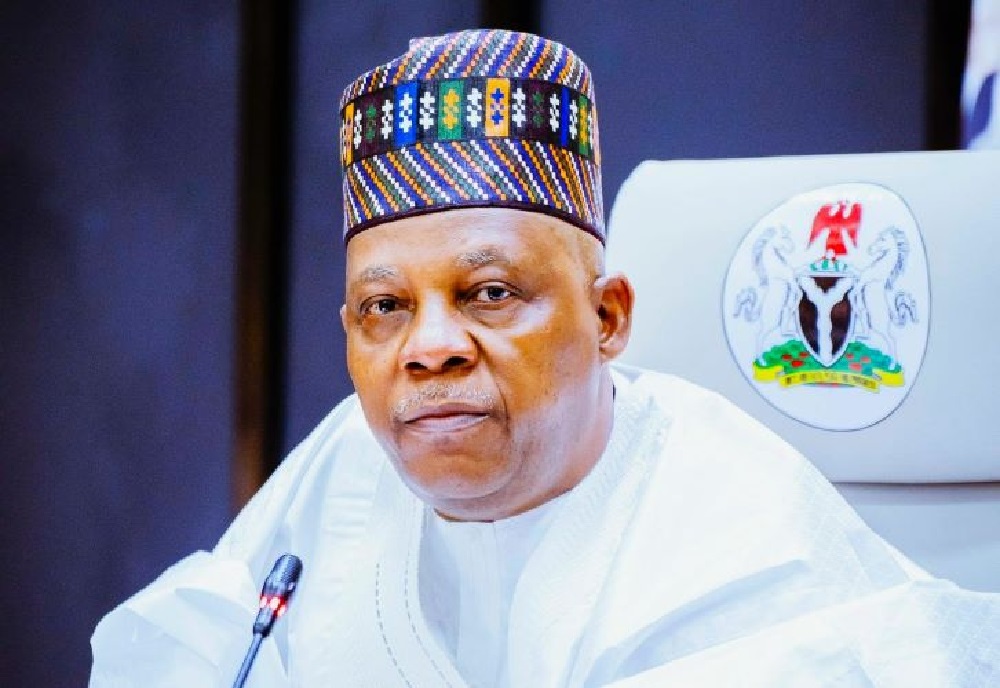
The Vice President, Kashim Shettima, has implored state governments to accelerate business-enabling reforms to unlock the full potential of the $750 million World Bank-assisted State Action on Business Enabling Reforms (SABER) programme.
This, he said, has become necessary to attract domestic and global capital, enhance local infrastructure, and drive subnational economic growth.
Shettima, who spoke on Tuesday during a stakeholder meeting on optimising the implementation of the SABER programme at the Presidential Villa, noted that a fully implemented SABER programme would help create a more predictable and transparent business environment.
He also listed other benefits of the programme to include attracting domestic and foreign investment, strengthening private-sector confidence, reducing the cost of doing business, expanding digital and physical infrastructure, improving access to land and commercial justice systems, and enhancing the competitiveness of the states.
“These outcomes will translate into increased economic activity, higher productivity, job creation, improved internally generated revenue, and better living standards for our citizens,” he stated.
Accordingly, the Vice President directed the Director General of the Presidential Enabling Business Environment Council (PEBEC), Zarah Mustapha-Audu, to initiate moves towards extending the lifespan of the programme by an additional year “so that our states can fully utilise the opportunities at our doorsteps.”
Shettima noted that Nigeria stood a better chance of facilitating the actualisation of its one trillion-dollar economy drive by fully optimising SABER implementation.
“I therefore encourage us to engage constructively and contribute meaningfully to our deliberations. Let us seize this opportunity to unlock the full potential of the SABER Programme and position our States as engines of economic growth, investment, and sustainable development,” he stated.
Shettima tied the success of the ongoing reforms of the administration of President Bola Tinubu to a conducive and enabling environment for businesses to thrive, maintaining that this could be determined at the subnational level.
“As a nation, we have embarked on a bold economic reform agenda under the leadership of His Excellency, President Bola Ahmed Tinubu, GCFR. The success of this agenda depends significantly on our ability to create an enabling environment for businesses to invest, expand, and create jobs.
“While the Federal Government continues to implement reforms at the national level, the reality remains that many of the conditions that define the experience of investors and businesses are determined at the subnational level. This is why the role of State Governments in the implementation of SABER is critical.”
Minister of State for Budget and Economic Planning, Dr Doris Uzoka-Anite, encouraged stakeholders to address identified implementation bottlenecks as the SABER programme delivers its intended outcomes for Nigeria in line with the Renewed Hope Agenda.
She expressed optimism that the $750 million performance-based intervention designed by the World Bank technical team and the PEBEC Secretariat would be fully accessed by the states.
Giving an overview of the SABER Programme and implementation matters, the Director-General of PEBEC, Zarah Mustapha-Audu, assured that the council remained committed to removing bureaucratic bottlenecks by working with all arms of government, civil society organisations (CSOs), the private sector, and other stakeholders towards achieving the programme’s objectives.
She explained that while the funds were tied to deliverables, progress was being made by participating states to meet all disbursement-linked indicators as stipulated by the programme.

The Christian Association of Nigeria (CAN) has declared a three-day national mourning period, from June 12, to June 14 to honour the victims of violent attacks, mass abductions, and banditry across the country.
The apex Christian body also designated June 14 as “Black Sunday” across all Churches as a mark of solidarity with families affected by the lingering security crisis.
The President of CAN, Archbishop Daniel Okoh, made the announcement on Tuesday in Abuja while reading a communiqué issued at the end of the National Church Denominational Leaders Summit.
The summit, held at the National Christian Centre and themed “The State of the Nation and the Way Forward,” brought together top Church leaders, block leaders, and delegates to prayerfully review the country’s challenges.
Okoh expressed deep concern over the escalating wave of violence, citing recent incidents of killings, kidnappings, and destruction of communities in states such as Oyo, Ogun, Borno, Kwara, and Kogi.
He urged the Federal Government to immediately declare a state of emergency on national security to halt the ongoing bloodshed.
”Communities are under attack; citizens are kidnapped from their homes and places of work, travelers are abducted on highways, and farmers are driven from their lands.
”Innocent men, women, and children are killed, maimed, displaced, and, in some cases, brutally beheaded by criminal and terrorist elements,” Okoh said.
The CAN President criticised the “recurring resort to conciliatory and pacifist rhetoric by senior government officials” in response to grave security threats, calling instead, for a proactive, result-oriented approach.
He reminded the government that the primary responsibility of any administration remains the protection of lives and property.
Consequently, the Cleric demanded a comprehensive review of the nation’s security architecture, improved intelligence gathering, stronger inter-agency cooperation, and greater operational accountability.
He also threw his weight behind decentralising security operations, calling for the immediate acceleration of constitutional and legislative processes for the establishment of state police.
The CAN President further demanded the immediate and unconditional release of all abducted school children, teachers, and other citizens currently held captive by criminal elements.
On the humanitarian front, Okoh called for the establishment of a comprehensive compensation, rehabilitation, and resettlement programme for victims of terrorism and families who have lost livelihoods or loved ones.
He also tasked individual Churches across the federation to strengthen internal support systems by providing humanitarian assistance, trauma care, and peace-building initiatives for displaced persons within their localities.
Okoh lamented that premature electioneering, political calculations, and party defections were taking center stage among the political class while many communities remained under siege.
He advised political leaders and parties to shun divisive distractions and prioritise national security.
The Cleric called on organised labour groups, civil society organisations and traditional institutions to collaborate in holding the government accountable.
Okoh reaffirmed the commitment of the Church to national unity, peace, and justice.
He stressed that, while prayers would be intensified, they must be matched with sustained civic engagement and advocacy.
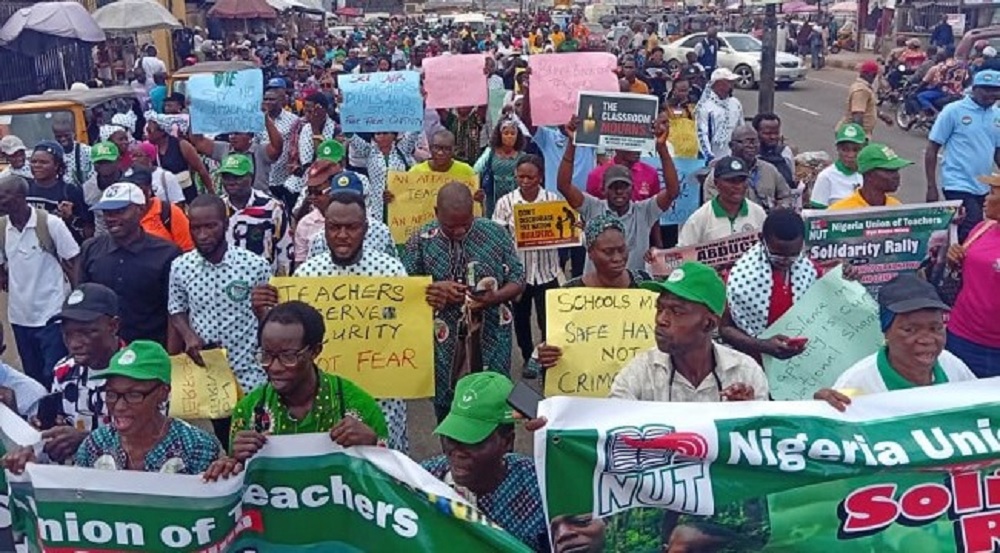
The Osun State chapter of the Nigeria Union of Teachers, NUT, on Tuesday staged a peaceful protest in Osogbo over the abduction of teachers and students in Oriire Local Government Area of Oyo State.
The Osun NUT called for urgent measures to improve security in schools across the country.
The teachers marched through major streets carrying placards with inscriptions such as “Government Should Act Now”, “Free Our Teachers and Students Now” and “Our Teachers and Students Must Be Free Now”, while condemning the incident and demanding the safe return of the victims.
The demonstration drew participation from teachers across the state, who expressed concern over what they described as growing threats to educational institutions and the safety of both staff and learners.
Addressing the protesters, Osun NUT Chairman, Isaac Babalola, described the abduction as unfortunate and warned that such attacks posed a serious threat to education and the welfare of teachers and students nationwide.
He said, “Schools must remain safe environments for teaching and learning. Continued attacks on educational institutions could discourage parents from sending their children to school.”
Babalola urged security agencies to intensify efforts to rescue the abducted teachers and students and ensure that those responsible for the attack were brought to justice.
According to him, “The recurring cases of attacks on schools in different parts of the country require urgent and coordinated action from relevant authorities.
“The safety of teachers and students must be treated as a priority. No child should be afraid of going to school and no teacher should work under fear of abduction or violence.”
He further called on both the Federal and State Governments to strengthen security infrastructure in schools through the deployment of security personnel and the installation of surveillance facilities where necessary.
The union leader also stressed the need for stronger collaboration among security agencies, school authorities and host communities to safeguard educational institutions from future attacks.
Some of the protesting teachers expressed concern over recurring security challenges facing schools and urged governments at all levels to adopt proactive measures to prevent similar incidents.
They appealed to education stakeholders and relevant authorities to act swiftly to protect teachers and students, warning that failure to address the situation could further endanger learning environments across the country.
Responding to the demands of the protesters, Osun State Governor, Ademola Adeleke, commended the union for raising concerns over the kidnapping of teachers and students in Oriire local government area.
Represented by the Permanent Secretary in the Ministry of Education, Muritala Jimoh, the governor said “efforts were ongoing by both the Oyo State Government and the Federal Government to secure the release of all the abducted victims”.
Adeleke assured teachers and students of their safety and disclosed that a high-level security meeting was being planned to strengthen the protection of lives, property and educational infrastructure.
He also called for the collective efforts of stakeholders across the country to ensure safer schools.

Shettima Urges States To Unlock Full Potential Of $750m SABER Programme

FG heightens Ebola alert, strengthens border controls, emergency response systems

Insecurity: CAN declares 3-day national mourning




-

 News24 hours ago
Kano lawmaker rejoins APC after losing return ticket in NDC
-

 News14 hours ago
Wike Assures Protesting Teachers of Rescue Efforts, Warns Against Politicising Insecurity
-
 News23 hours ago
2022 train attack: FG re-arraigns Tukur Mamu on amended terrorism charge
-
 News24 hours ago
Oyo Abduction: Tinubu inherited security challenges from PDP govt, says Nuhu Ribadu
-

 News19 hours ago
Six members of same family shot dead during domestic dispute in US
-

 Economy24 hours ago
Middle East Tensions: Oil Prices Jump as Iran Suspends Peace Talks with US
-

 News12 hours ago
BETNLAFF New Betting Platform Set To Hit Nigerian Markets
-
 News18 hours ago
FG stops three-month Pre-retirement leave for civil servants