Connect with us

Economy

Iran’s Currency Crashes Past 2.2 Million Against one Dollar as Military Strikes Intensify

Published

on

ADVERTISEMENT
Zoom Ad
ADVERTISEMENT
Zoom Ad

Iran’s currency has suffered another historic collapse, with the rial plunging to more than 2.2 million against the US dollar amid renewed military strikes and escalating tensions in the Middle East.


The latest crash represents a fresh blow to Iran’s already battered economy as the conflict continues to put pressure on the country’s financial markets and businesses.

The rial has been under sustained pressure in recent weeks, with growing uncertainty over the country’s economic outlook, sanctions and the intensifying military confrontation contributing to the currency’s rapid decline.

Advertisement

Advertisement

The latest exchange-rate movement means that $1 is now worth more than 2.2 million Iranian rials on the open market, highlighting the extraordinary deterioration in the currency’s purchasing power.

The plunge comes as US-Iran military hostilities enter another dangerous phase, with fresh strikes reported amid the wider confrontation surrounding the strategically vital Strait of Hormuz.

The economic impact of the escalating conflict is expected to extend beyond Iran, particularly as disruption around the Strait of Hormuz threatens global energy supplies and international trade.

For ordinary Iranians, the continued fall of the rial could translate into higher prices for imported goods, increased inflationary pressure and further erosion of household purchasing power.

Advertisement

The latest record low adds to mounting economic challenges facing Tehran as the country grapples with the combined impact of sanctions, military tensions and declining confidence in its currency.

With the rial now trading above the 2.2-million mark to the dollar, Iran’s currency crisis has entered another alarming phase as the military confrontation continues.
Continue Reading
Advertisement

Economy

See Photos As US Releases $1 Coins Featuring President Trump

Published

on

By

ADVERTISEMENT
Zoom Ad
ADVERTISEMENT
Zoom Ad

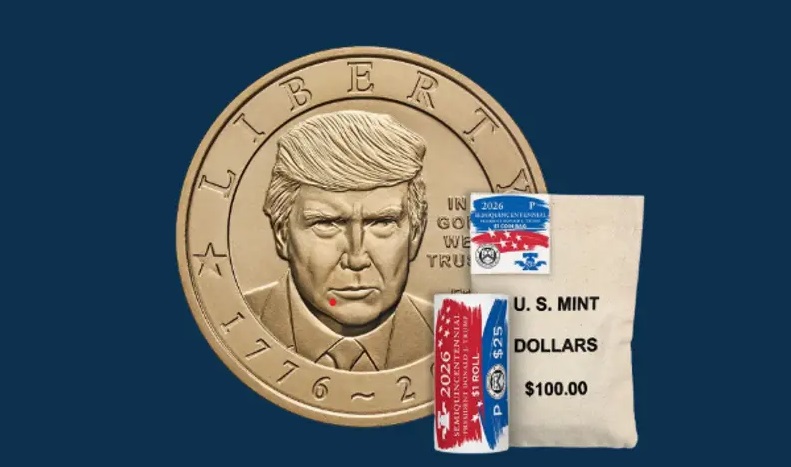
The United States Mint has released 250,000 $1 coins featuring the likeness of President Donald Trump to commemorate the country’s 250th anniversary.

The coins, released on Wednesday, are legal tender and have also entered circulation, meaning members of the public could receive them as change when making cash payments.

US Mint, in a post on its website, said the coin features a portrait of Trump designed by the United States Mint Chief Engraver, Joseph Menna, and inspired by an official White House photograph by Daniel Torok.

“The reverse (tails) design features the Presidential Seal, which shows an eagle holding an olive branch and a bundle of arrows, with a shield on its breast and a banner inscribed ‘E PLURIBUS UNUM’ in its beak.

Advertisement

“The shield contains the additional inscription ‘250’ to honor the Semiquincentennial of the United States. The additional inscriptions are ‘UNITED STATES OF AMERICA’ and ‘ONE DOLLAR.’

The coins have a gold-like finish but are made from non-precious metals. They are being minted in Philadelphia.

The Mint is selling the coins in rolls of 25 and bags of 100. A roll costs $61, while a bag costs $154.50.

Some special-issue coins were randomly included in the rolls and bags. According to the Mint, those coins bear a “July 4th” mark because they were struck on July 4, the anniversary of the Declaration of Independence.

Advertisement

The Mint said demand for the coins was high, with a virtual waiting room activated on Wednesday because of “extraordinarily high traffic” on its website.

Households were initially limited to two orders, although the Mint said the restriction would be lifted at 2 p.m. Eastern time on Thursday.

The release follows controversy over the depiction of a living president on US currency.

Federal law had previously prohibited living people from being depicted on US currency, but the Circulating Collectible Coin Redesign Act of 2020, signed by Trump during his first term, contained provisions allowing coins commemorating the country’s 250th anniversary.

Advertisement

Treasury Secretary Scott Bessent said the coin “celebrates the strength of American values, and the promise of a nation dedicated to preserving freedom for all.”

The Trump administration has also maintained that congressional approval was not required for the coin, citing a history of commemorative coins bearing the likeness of sitting presidents.

The US Mint has released other commemorative coins as part of the 250th-anniversary celebrations, including Revolutionary War Quarters, American Eagle Gold Coins and Enduring Liberty Half Dollars.

In June, 250,000 Semiquincentennial 2026 Declaration of Independence Quarters bearing a special “July 4th” mark were also released into circulation.

Advertisement

Continue Reading

Economy

See Black Market Dollar To Naira Exchange Rate Today 1st September 2026

Published

on

ADVERTISEMENT
Zoom Ad
ADVERTISEMENT
Zoom Ad

The Black Market Dollar-to-Naira Exchange Rate for 1st September 2026 Can Be Accessed Below.
NOTE: The exchange rate changes hourly. It depends on the volume of dollars available and the Demand. This means…you can buy or sell 1 dollar at a certain rate, and the price can change (high or low) within hours.

The official naira black market exchange rate in Nigeria today, including the Black Market rates, Bureau De Change (BDC), and CBN rates.

The exchange rate fluctuates hourly based on the supply and demand of dollars in the market.
What’s the dollar to naira black market today, 1st September 2026?

The exchange rate for a dollar to naira at Lagos Parallel Market (Black Market) players sell a dollar for ₦1405 and buy at ₦1390 on Monday, 1st September, 2026, according to sources at Bureau De Change (BDC).
Please note that the Central Bank of Nigeria (CBN) does not recognize the parallel market (black market), as it has directed individuals who want to engage in Forex to approach their respective banks.

Advertisement

Dollar to Naira Black Market Rate Today
Dollar to Naira (USD to NGN) Black Market Exchange Rate Today
Selling Rate ₦1405
Buying Rate ₦1390
Dollar to Naira CBN Rate Today
Dollar to Naira (USD to NGN) CBN Rate Today
Highest Rate ₦1343
Lowest Rate ₦1320

Continue Reading

Economy

NNPCL Increases Price Of Petrol

Published

on

By

ADVERTISEMENT
Zoom Ad
ADVERTISEMENT
Zoom Ad

The Nigerian National Petroleum Company Limited (NNPCL) has increased the pump price of Premium Motor Spirit (PMS), commonly known as petrol, at some of its retail outlets in Abuja.

The latest adjustment has pushed the price of petrol at affected NNPCL filling stations to ₦1,345 per litre, representing a ₦75 increase from the previous price of ₦1,270 per litre.

Checks conducted on Monday showed that NNPCL stations in parts of the Federal Capital Territory, including outlets around Gwarinpa and Wuse Zones 4 and 6, were dispensing petrol at the new price.

The increase comes amid a fresh wave of upward adjustments in petrol prices by several marketers across the country.

Advertisement

NNPCL Stations Adjust Pump Price

A staff member of an NNPCL retail outlet, who spoke on condition of anonymity, confirmed that the company had adjusted its pump price on Monday.

“Our petrol pump price was raised to ₦1,345 per litre today (Monday),” the attendant said.

The latest development means motorists who purchase 50 litres of petrol at the affected NNPCL stations will now spend approximately ₦67,250, compared with ₦63,500 under the previous ₦1,270-per-litre price.

Advertisement

The increase is expected to put additional pressure on motorists and other consumers who rely heavily on petrol for transportation and business activities.

Other Marketers Also Increase Prices

The NNPCL adjustment follows similar price reviews by several independent petroleum marketers over the weekend.

Filling stations operated by MRS, Ranoil, Empire Energy and other downstream operators reportedly increased their petrol prices by between ₦20 and ₦80 per litre in different locations.

Advertisement

The varying adjustments highlight the increasingly market-driven nature of petrol pricing in Nigeria, with retail prices differing depending on the marketer, location, supply costs and prevailing market conditions.

Motorists in Abuja and other parts of the country are therefore expected to continue seeing different pump prices from one filling station to another.

Dangote Refinery Raises Ex-Depot Price

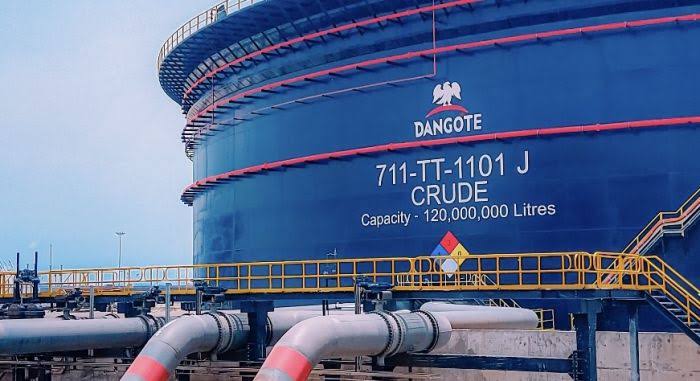
The latest pump price increases came after Dangote Refinery reportedly adjusted its ex-depot price for petrol.

Advertisement

The refinery increased its gantry price by ₦65, taking it from the previous level to ₦1,265 per litre.

The ex-depot price is a major component of the cost structure faced by petroleum marketers before transportation, logistics, storage, operational expenses and other charges are added before the product reaches retail filling stations.

An increase at the depot level can consequently result in higher pump prices if marketers pass the additional cost on to consumers.

Rising Petrol Imports Raise Concerns

Advertisement

The latest petrol price adjustments have also emerged amid renewed concerns over the increasing volume of imported petrol entering the Nigerian market.

The development has attracted attention because Nigeria’s domestic refining capacity, particularly following the commencement of operations at the Dangote Refinery, has been expected to reduce the country’s dependence on imported refined petroleum products.

However, petrol imports have continued to account for a significant portion of the country’s total supply.

Data from the Nigerian Midstream and Downstream Petroleum Regulatory Authority (NMDPRA) reportedly showed that imported petrol accounted for 43.3 per cent of total PMS supply in July.

Advertisement

The figure has raised concerns within the domestic refining and downstream petroleum sector.

Dangote Refinery Raises Concern Over Imports

The Dangote Refinery had previously expressed concerns about the increasing volume of imported petrol into Nigeria.

The refinery reportedly threatened to restrict petrol sales to importers and marketers amid what it described as a surge in imported products.

Advertisement

The development has contributed to an ongoing debate over competition, supply sources and pricing within Nigeria’s downstream petroleum industry.

While domestic refiners are seeking to expand their share of the local market, petroleum marketers continue to source products from different suppliers based on prevailing commercial conditions.

What the Latest Increase Means for Nigerians

The latest increase in Abuja is likely to generate concern among motorists and businesses, particularly those already dealing with high operating and transportation costs.

Advertisement

Petrol price movements often have a wider impact on the economy because the product is heavily relied upon for transportation, power generation and the distribution of goods and services.

An increase in pump prices can therefore raise transportation fares and increase the cost of moving food, agricultural produce and other commodities.

For businesses that depend on petrol-powered generators and vehicles, the additional cost could also translate into higher operating expenses.

With NNPCL stations now selling petrol at ₦1,345 per litre in some parts of Abuja, motorists will be watching closely to see whether other filling stations follow with further increases in the coming days.

Advertisement

The latest adjustment also adds to recent concerns that petrol prices could continue rising if depot prices and other supply-related costs remain elevated.

Continue Reading

Trending

Copyright © 2024 Naija Blitz News