Connect with us

News

Reps To Probe Implications Of Cryptocurrency, Other Digital Asset Transactions

Published

on

ADVERTISEMENT
Zoom Ad
ADVERTISEMENT
Zoom Ad
By Gloria Ikibah
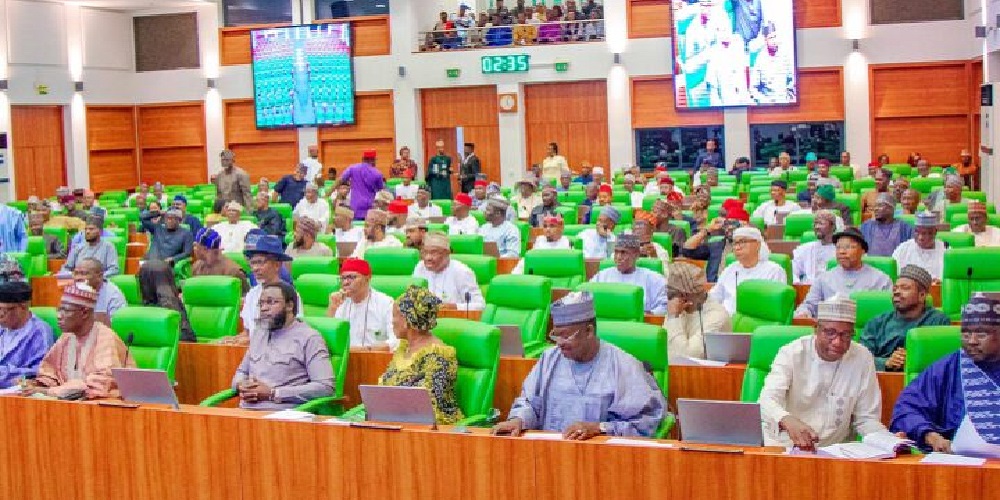
The House of Representatives as resolved to investigate the current status of Cryptocurrency, blockchain, digital asset transactions in Nigeria to identify threats to National Security and gaps in legislative framework and regulations to the detriment of the country.
Others to be investigated are all the online peer-to-peer (P2P) marketplace, utility sharing.
These resolution was sequel to a motion by Rep. Isiaka Ibrahim on “International money transfer operators, payment gateways and platforms, cloud computing, infrastructure (networks).
The House also resolved to investigate the current status of the e-Naira on the global cryptocurrency platform, the cost incurred, processes undertaken, and statutory compliance in creating the digital currency.
The House further resolved to engage all relevant stakeholders to initiate necessary processes for establishing required legislation and regulations, while establishing the profile of operators in the sector such as legal status, parent company, and assess their compliance with our existing statutes or complicity in infractions against Nigeria including money laundering, illicit transactions, currency speculation and bad practices.
The House also resolved to superintend the engagement of the office of the NationalSecurityAdviser(NSA), other relevant agencies, cryptocurrency exchanges, and stakeholders in tracking, Identifying, and recovering illicit and laundered funds or assets.
The House is to ensure that equity, probity, transparency, the rule of law, and international best practices are observed by the government in investigating cryptocurrency exchanges and others.
Leadingthedebate, Rep Isiaka highlighted the growing global concerns about the national security implications of cryptocurrency transactions through cryptocurrency exchanges including consumer and investor security as these exchanges are said to enable money laundering by criminals and terrorists for their illicit activities.
The lawmaker further stated that as part of its sweeping market friendly reforms designed to attract substantial foreign direct investment into the countries struggling economy, this administration reversed the ban on cryptocurrency transactions in Nigeria imposed by the previous administration.
He further explained that the current actions by the government should not be perceived by the global community and international investors as a policy somersault so early in the life of the administration and the existence of a hostile business environment.
The motion reads: “Cognisance of the concerns expressed by the CBN with regards to the likelihood of illicit transactions and money laundering on the cryptocurrency exchanges and their seeming use as an alternative platform for determining local foreign exchange rates.
“The US Treasury 2022 National Money Laundering Risk Assessment indicates that fiat and traditional financial activities contribute substantially higher (over 200%) than digital assets transactions to global money laundering activities.
“The conflict with the government about whether or not the crypto exchanges are determining the local foreign exchange rate and usurping the functions of the national bank does not appear to arise in other developed climes where appropriate statutes and regulations have been enacted and enforced to superintend crypto and other digital asset transactions”.
Rep Isiaka opined that the government should not be seen to be trying to “throw away the baby with the bath water” without considering the benefits of digital asset transactions to the country.
The House adopted the motion and mandated its Committee on National security and Intelligence to investigate and report back to the House for further legislative action.

Continue Reading
Advertisement

News

Bandits: They still prefer to return to terrorist activities despite their rehabilitation – John Enenche

Published

on

ADVERTISEMENT
Zoom Ad
ADVERTISEMENT
Zoom Ad


Retired Major General and former Defence spokesperson, John Enenche, has raised concerns over Nigeria’s rehabilitation and reintegration programme for former terrorists, revealing that some participants openly expressed their intention to return to insurgent activities.

The retired military officer recounted being part of an assessment team that visited camps housing former terrorists in locations including Gombe. According to him, some of the individuals undergoing rehabilitation admitted they remained committed to their former causes despite being enrolled in government-backed deradicalisation programmes.

Speaking during an interview on Channels Television on June 3, 2026, Enenche said his personal experience assessing former insurgents in rehabilitation camps left him doubtful about the effectiveness of the current approach.

Advertisement

“I was part of a team that visited their camps in Gombe and elsewhere to assess them. Some told me: ‘Even if you take me to prison and bring me out, I am still going back to join them,’” Enenche said.

His remarks came as he discussed the merits and shortcomings of rehabilitation initiatives designed to reintegrate repentant terrorists and bandits into society. While acknowledging that rehabilitation and reintegration are recognised international practices, Enenche argued that Nigeria must critically evaluate whether such programmes are achieving their intended objectives.

The former Defence spokesperson suggested that authorities should reconsider existing approaches where evidence indicates that participants remain committed to violent extremism. He maintained that individuals who continue to pose security threats should not be treated as genuinely reformed simply because they have entered rehabilitation programmes.

Enenche’s comments add to the broader national debate over the effectiveness of initiatives such as Operation Safe Corridor, which was established to deradicalise and reintegrate former insurgents who surrender to security forces.

Advertisement

His intervention comes amid renewed concerns over insecurity across several parts of the country, with kidnappings, bandit attacks and insurgent violence continuing to challenge security agencies despite ongoing military operations.

Continue Reading

News

Gov Sani signs laws to transform energy, agric, climate governance

Published

on

By

ADVERTISEMENT
Zoom Ad
ADVERTISEMENT
Zoom Ad

Governor Uba Sani has signed three laws that will provide a comprehensive framework to transform the energy, agriculture and environmental sectors of Kaduna State.

A statement issued by the Commissioner for Information and Culture, Malam Ahmed Maiyaki, listed the new laws as the Kaduna State Electricity Law, 2026, Kaduna State Agricultural Development Fund (KADFund) Law, 2025, and Kaduna State Climate Change Advisory Board Law, 2026.

The statement quoted the Deputy Chief of Staff, Legal and Legislative Matters to the Governor, Dr. Mustapha Musa, as describing the laws as the most transformative governance reform packages.

He further said that the laws aim at expanding energy access, accelerating agricultural growth, strengthening climate resilience, and driving sustainable economic development through strong institutions.

Advertisement

The statement pointed out that the Kaduna State Electricity Law, 2026 establishes the Kaduna State Electricity Regulatory Commission to oversee electricity generation, transmission, distribution, and supply within the State.

The Commissioner added that the Electricity Law will create opportunities for private-sector investment, renewable energy development, and improved access to electricity.

Maiyaki also said that the KADFund Law, 2025 creates a dedicated financing mechanism to support farmers, cooperatives, agribusinesses, and agricultural value-chain actors through grants, soft loans, technical assistance, and investments in critical infrastructure aimed at boosting food security and agricultural productivity.

He further noted that the Kaduna State Climate Change Advisory Board Law, 2026 establishes a state-level framework for climate action, environmental sustainability, climate finance mobilization, and the integration of climate considerations into development planning, reinforcing Kaduna’s commitment to sustainable development.

Advertisement

The Commissioner also said the three laws collectively underscore the administration’s vision of building resilient institutions capable of driving inclusive growth, attracting investment, expanding opportunities, and delivering lasting benefits to citizens.

He noted that the landmark legislations reflect Governor Uba Sani’s commitment to laying the foundations for a prosperous, sustainable, and competitive Kaduna State through electricity sector reform, agricultural transformation, and climate-responsive governance.

According to him, the reforms establish the institutional framework needed to strengthen food security, improve living standards, and position Kaduna as a model for innovation, sustainable development, and effective subnational governance.

Advertisement
Continue Reading

News

EFCC arraigns oil magnate, two others over alleged N691.6m fraud

Published

on

By

ADVERTISEMENT
Zoom Ad
ADVERTISEMENT
Zoom Ad

The Economic and Financial Crimes Commission (EFCC) has arraigned the Managing Director of Abu-Haneefa Oil and Gas Ltd, Musa Farouk Abubakar, alongside his company and Sandra Chizoba Attoh before Justice Obiora Egwuatu of the Federal High Court, Maitama, Abuja, over alleged fraud involving N691.6 million.

The defendants were arraigned on an amended 15-count charge bordering on conspiracy, corruption, and money laundering to the tune of N691,677,310, according to a statement by the anti-graft agency posted on X.

One of the counts alleged that Abubakar, in July 2025, transferred N297 million from the company’s Zenith Bank account to an account belonging to Attoh, knowing the funds were proceeds of unlawful activity.

Another count alleged that he procured Attoh to transfer N262.8 million to a company account for the purchase of property at Kapital Villa, Guzape, Abuja, also suspected to be proceeds of corruption.

Advertisement

All the defendants pleaded not guilty to the charges.

Following their pleas, prosecution counsel, Rita Ogar, urged the court to fix a trial date and remand the defendants in a correctional facility, stating that the EFCC had “overwhelming evidence” against them.

Counsel to the first and second defendants, Ishaka M. Dikko, informed the court that a bail application had already been filed and urged that his client be remanded in EFCC custody pending hearing.

Counsel to the third defendant, Y. G. Haruna (SAN), also confirmed filing a bail application and noted that responses had been exchanged between both parties.

Advertisement

Ruling on the applications, Justice Egwuatu ordered that the first defendant be remanded at the Kuje Correctional Centre pending the determination of his bail application, while the third defendant was granted bail in the sum of N200 million with two sureties in like sum.

The court held that the sureties must reside in Abuja, provide verifiable means of identification, deposit passport photographs, and own property within the jurisdiction. One of the sureties must be a civil servant not below Grade Level 15 and must present letters of appointment and promotion.

The case was adjourned to September 1 and 2, 2026 for trial.

Advertisement
Continue Reading

Trending

Copyright © 2024 Naija Blitz News