




News
Reps Set Up Ad-hoc Committee To Settle Feud Between PENGASSAN and Dangote Refineries
- /home/naijuinz/public_html/wp-content/plugins/mvp-social-buttons/mvp-social-buttons.php on line 27
https://naijablitznews.com/wp-content/uploads/2024/09/images-17.jpeg&description=Reps Set Up Ad-hoc Committee To Settle Feud Between PENGASSAN and Dangote Refineries', 'pinterestShare', 'width=750,height=350'); return false;" title="Pin This Post">
- Share
- Tweet /home/naijuinz/public_html/wp-content/plugins/mvp-social-buttons/mvp-social-buttons.php on line 72
https://naijablitznews.com/wp-content/uploads/2024/09/images-17.jpeg&description=Reps Set Up Ad-hoc Committee To Settle Feud Between PENGASSAN and Dangote Refineries', 'pinterestShare', 'width=750,height=350'); return false;" title="Pin This Post">
By Gloria Ikibah
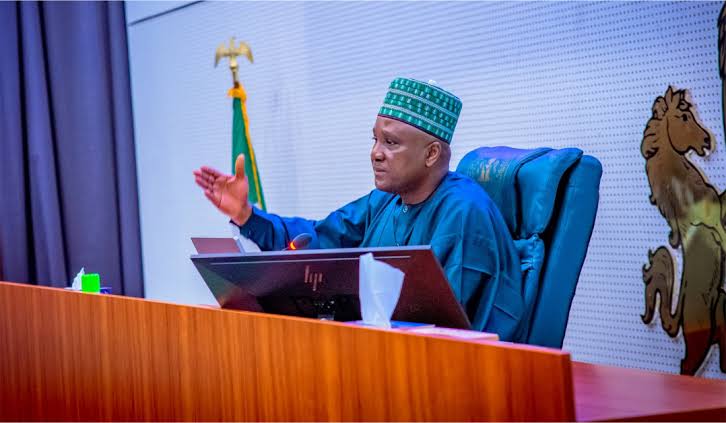
The House of Representatives has set up an ad-hoc committee headed by Speaker Tajudeen Abass, comprising members from the council of leadership of the House to look into the feud between petroleum workers and Dangote refineries.
This resolution was sequel to the adoption of a motion of urgent public importance moved by Rep. alhassan Ado Doguwa and Rep. abdulsamad Dasuki on “The need to Protect Strategic Private Investments from Adversarial Unionism”, on Tuesday at plenary.
Debating the motion Rep. Doguwa said that the recent face-off between the Petroleum and Natural Gas Senior Staff Association of Nigeria (PENGASSAN) and the Dangote Refinery, located within the Lekki Free Trade Zone, which culminated in a strike action that disrupted operations at the $20 billion refinery — the largest single-train refinery in the world.
According to him, the industrial action led to a disruption in Nigeria’s crude oil production, with a reported daily loss of approximately 200,000 barrels over a period of three days.
He further asserted that the disruption worsened the fuel supply situation across the country, resulting in scarcity and long queues at filling stations in several states, thereby causing severe hardship for ordinary Nigerians.
The motion reads: “Aware that the Dangote Refinery is a strategic private investment of immense national importance, with the potential to guarantee energy security, reduce import dependency, generate employment, and conserve foreign exchange;
“Further aware that the Dangote Refinery operates within a Free Trade Zone, and therefore falls under the regulatory framework of the Nigeria Export Processing Zones Authority (NEPZA), particularly Section 18(5) of the Nigeria Export Processing Zones Act which clearly states:
“Employment in the Free Zone shall be governed by rules and regulations made by the Authority and not subject to the provisions of any enactments relating to employment matters.”
The lawmakers expressed concern that actions by labour unions that disregard the legal protections conferred on Free Zones under the NEPZA Act not only constitute a breach of law but also create a hostile investment environment that may deter future local and foreign investors.
They fear that if private investments of strategic national importance are continually subjected to unlawful disruptions by adversarial unionism, Nigeria risks not only the failure of key economic assets but also the erosion of investor confidence necessary for national growth and development.
News
CJN declares war on delayed Justice, orders Judges to embrace active case management
By Francesca Hangeior, Abuja.
The Chief Justice of Nigeria, Hon. Justice Kudirat Motonmori Olatokunbo Kekere-Ekun, has called on judges across the country to adopt proactive case management strategies to tackle delays in the administration of justice and strengthen public confidence in the judiciary.
Speaking at the opening of the National Workshop on Case Management for Judges of the Superior Courts of Record, organised by the National Judicial Institute in Abuja on Monday, the CJN said the effectiveness of the judiciary is measured not only by the quality of its judgments but also by the speed and efficiency with which cases are concluded.
She stressed that prolonged litigation, repeated adjournments, procedural abuse and poor scheduling practices continue to undermine access to justice, increase the cost of litigation and weaken public trust in the courts.
“To the ordinary litigant, justice delayed often translates into justice denied,” she said, adding that delays also create uncertainty for businesses and investors while eroding confidence in the rule of law.
Justice Kekere-Ekun noted that effective case management has become a defining indicator of judicial performance worldwide, urging judges to exercise greater control over proceedings, enforce timelines and make effective use of pre-trial procedures to reduce case backlogs.
The Chief Justice also encouraged judicial officers to embrace technology, including electronic filing, virtual hearings, digital case-tracking systems and automated scheduling tools, describing them as essential instruments for improving efficiency while maintaining fairness and due process.
Drawing lessons from jurisdictions such as the United Kingdom, Singapore and South Africa, she said active judicial leadership and structured case management have significantly improved court efficiency and reduced delays.
She acknowledged that increasing commercial activities, constitutional litigation and rising public expectations have placed greater demands on Nigeria’s judicial system, making continuous reforms and procedural discipline imperative.
The workshop, she explained, is designed to equip judges with practical strategies on docket control, electronic case management, scheduling practices, judgment delivery timelines and other measures aimed at enhancing justice delivery.
Justice Kekere-Ekun urged participants to reflect on existing practices, identify procedural bottlenecks and embrace reforms that promote efficiency without compromising fairness.
She expressed confidence that the workshop would provide practical solutions for reducing delays, improving judicial productivity and building a judiciary that is efficient, technologically responsive and worthy of public trust.
The Chief Justice thereafter declared the workshop open and wished participants fruitful deliberations.
Earlier, The National Judicial Institute (NJI) Justice Babatunde Adejumu in his welcome address called on judges of the Superior Courts of Record to adopt proactive case management practices as a key strategy for improving judicial efficiency and ensuring timely justice delivery across Nigeria.
According to Justice Adejumo, effective case management is essential to reducing case backlogs, eliminating administrative bottlenecks, and preventing unnecessary delays in court proceedings.
The NJI administrator explained that modern case management requires judges to move beyond their traditional adjudicative role by actively supervising cases from filing to conclusion.
He explained that this approach enhances access to justice, promotes fairness, and strengthens public confidence in the judicial system.
While emphasising that judicial education and leadership training remains a critical tools for equipping judges with contemporary case management skills, he added that the workshop provides an important platform for participants to exchange ideas, share best practices, and develop practical solutions to challenges affecting court administration.
The NJI Administrator encouraged participants to engage actively in the sessions and contribute meaningfully to discussions that would improve the administration of justice in their respective courts.
Justice Adejumo also commended the Chief Justice of Nigeria and Chairman of the NJI Board of Governors, Hon. Justice Kudirat M. O. Kekere-Ekun, GCON, FNJI, for her steadfast commitment to judicial capacity building.
He further acknowledged the contributions of the Chairman of the NJI Education Committee, Hon. Justice John Inyang Okoro, CFR, JSC, Heads of Courts, facilitators, and session managers for their continued support in advancing judicial excellence.
The workshop is expected to strengthen the capacity of judges to manage cases more efficiently, ultimately contributing to a faster, more responsive, and more effective justice system in Nigeria.
News
DAY 14 of Projects Commissioning in the FCT
President Tinubu Will Commission Newly Rehabilitated and Expanded Roads from Karu Interchange to Customs Clinic
Junction, including other adjoining Roads in Karu Today
#FCTRenewedHope
#FCTProjectsCommissioning
News
Certified True Copy of court judgment ordering NDC deregistration emerges (Photos)
The Certified True Copy (CTC) of the Federal High Court judgment ordering the deregistration of the Nigeria Democratic Congress (NDC) has emerged.
The ruling, delivered by Justice Isa H. Dashen of the Federal High Court, Lokoja Judicial Division, set aside the court’s earlier judgment of December 10, 2025, which had directed the Independent National Electoral Commission (INEC) to register the NDC as a political party.
According to the judgment, the earlier decision was nullified because it affected the legal rights of the Peace Movement Party (PMP), which claimed ownership of the logo used by the NDC but was not joined as a party in the original suit.
Following the ruling, INEC is expected to remove the NDC from its list of recognised political parties.
However, the commission has maintained that it will act only after reviewing the Certified True Copy of the judgment.
INEC National Commissioner and Chairman of the Information and Voter Education Committee, Mohammed Kudu Haruna, said the commission had applied for the court document before taking any decision.
> “We have applied for the Certified True Copy of the judgment. Until we receive it, we cannot be in a position to comment on it. However, the position that existed before the December 10, 2025 judgment was that INEC rejected NDC’s letter of intent to be registered as a political party,” Haruna said.
The development comes as the NDC continues to face challenges ahead of the 2027 general elections.
The party has alleged that it was denied the portal access code required to upload the names of its candidates to INEC’s nomination portal, a situation it says threatens the political aspirations of its presidential candidate, Peter Obi, vice-presidential candidate Rabiu Kwankwaso, and other party candidates.
INEC recently shifted the release of portal access codes from June 26 to Monday, June 29, to streamline submissions by eligible political parties.
Under the commission’s timetable, presidential and National Assembly candidates are expected to upload their nomination forms between June 27 and July 11, 2026, while governorship and state assembly candidates have from July 18 to August 8, 2026.
Confirming the denial of access, the NDC’s National Publicity Secretary, Osa Director, said the party’s request for the upload credentials was unsuccessful.


“We approached INEC to collect the access code to upload the names of our candidates to the INEC portal. They told us that they will get back to us,” he said.
Director added that the party would return to the commission while pursuing legal action to halt the implementation of the court judgment.
“We will go back there by tomorrow. I believe by tomorrow we must have filed a stay of execution in court,” he said.
Full Judgement:


-
News23 hours agoNDLEA operatives pin down N12.3bn Loud at Lagos port (Photos)
-
Sports23 hours agoSee fixtures as nine African nations make FIFA World Cup knockout stage
-
News23 hours agoFinally, Oyo Govt Lifts Curfew In 10 LGAs
-
News23 hours agoLady attempts Guinness Record with 144-Hour Bible reading in Port Harcourt
-
Politics23 hours agoAtiku to TInubu on NDC: Buhari, Jonathan never deregistered opposition parties
-
News23 hours agoXenophobia: FG processing new flight to evacuate Nigerians in S’Africa before June 30 deadline
-
News23 hours agoTension as ISIS releases video of top military grade weapons captured in Niger
-
News23 hours agoNSCDC Intercepts 45,000L Of Suspected Illegal Ethanol, Nabs Three In Akwa Ibom