
News
“I went to court to restore my right, I won’t attend convention”-Lamido

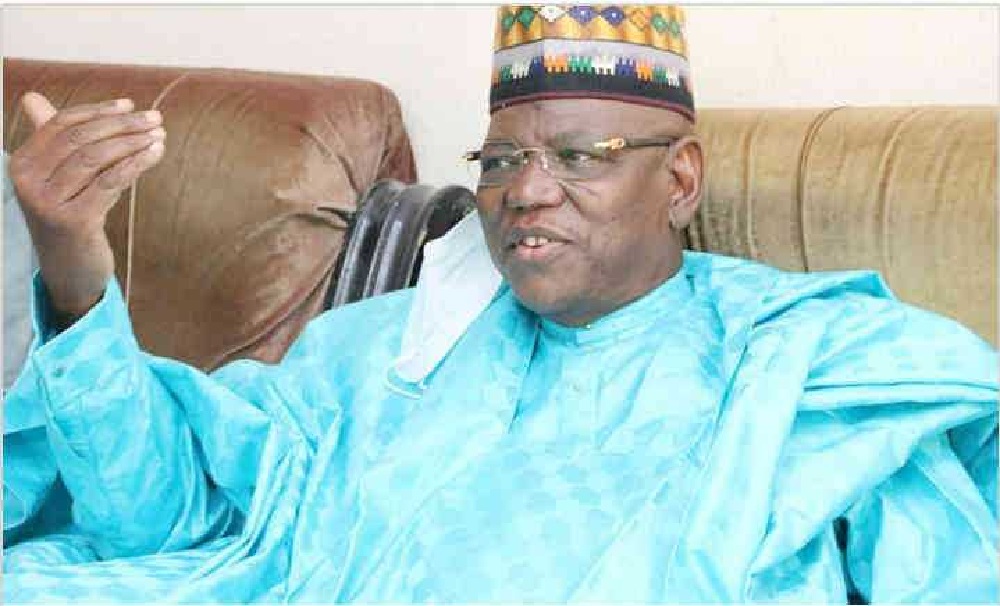


Former Jigawa State Governor, Sule Lamido, says he approached the court to reclaim his right to vie for leadership positions within the Peoples Democratic Party (PDP).
Lamido, in an interview in Friday’s edition of Channels Television’s Politics Today, said the case was a personal fight for dignity and not a move against the party.
“I went to court not because I have anybody in mind, but I went to get my rights back taken by my party. The issue is just about my own personality, dignity and honour being restored more than anything else or being in the court,” he said.
The former governor stated that it was disheartening to see the party, once united, struggle with distrust.
“I won the case, fair enough, but then again, it is also equally tormenting that the case I won is about my party, about our unity, family. A family that was so united and cohesive, with so much love and trust, is all eroded, and we are now simply fighting. And I feel very sad; let the problem be solved,” the former governor added.
He also explained that he could “not withdraw the suit” because a judgment now exists.
‘I’ll Stand By Court’
Lamido insisted he would not attend the convention scheduled for 15 November in Ibadan, Oyo State.
“This is very clear. For someone saved by the court, I can’t go where there is an injunction on the convention. How do I go there again? Am I now renouncing something I gained in the court?
“If I go to the convention, then it means whatever I have gotten has been washed away. There is a certain order from the court which restored my dignity, and therefore I will stand by the court because I am a party man who believes in law and order.
“Therefore, going to Ibadan means a renunciation of what I have gotten. The court gave a very clear injunction that the convention must not hold, so how do I go there? I can’t go there,” he clarified.
Lamido also dismissed rumours that he met with governors over the crisis and blamed them for weakening the party.
“PDP had 14 governors; today, there are only three left. We were 14 governors under the chairmanship of the PDP governors’ forum under Bala Mohammed, Bauchi State Governor. Under [Umar] Damagum today, we are only three. Even the three, two of them are going.
“I mean, the problem came from the governors, because they are so eroded, because they have a wrong notion of themselves. That they are now in charge,” he said.
He stressed he was “not desperate” to become national chairman but believed he could help restore the PDP’s lost structure.
Court Order, Deepening Crisis
In October, Lamido threatened legal action when he was unable to purchase the nomination form.
According to him, he visited the party secretariat but was reportedly told by the National Secretary, Senator Samuel Anyanwu, and the Organising Secretary, Umar Bature, that they had no information about the forms.
An Oyo State High Court in Ibadan adjourned ruling on a preliminary objection challenging its jurisdiction over a suit filed by PDP member Folahan Adelabi.
The case concerns the legality of the planned national convention scheduled for November 15 and 16.
INEC’s counsel argued that only the Federal High Court had jurisdiction over matters involving the commission.
The claimant’s counsel countered, insisting the objection breached his client’s constitutional rights to assembly.
The court adjourned ruling to December 8 and reaffirmed its interim order allowing preparations for the convention.
Similarly, the Federal High Court in Abuja issued a final order stopping the PDP from holding the convention.
Justice Peter Lifu ruled in favour of Lamido, ordering that the convention be suspended until he is allowed to purchase the nomination form for national chairman.
Meanwhile, a former Senate President, Bukola Saraki, advised the PDP to suspend the convention and set up a caretaker committee.
He said this would promote reconciliation and restore confidence among aspirants.
The conflicting judgments have intensified the party’s internal divisions.
PDP governors and major stakeholders met on Thursday in Abuja and insisted the convention would proceed.
They described November 15 and 16 as “irrevocable dates” despite the Abuja court order.
Delegates have already arrived in Ibadan, with the Lekan Salami Stadium fully decorated for the event.
…says this loss to me is particularly poignant
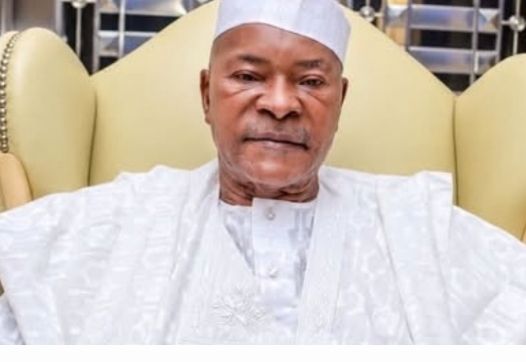
A Board of Trustees, BoT member of the Peoples Democratic Party PDP and 2027 Kogi West Senatorial candidate, Hon TeeJay Yusuf has expressed sadness over the demise of former Kogi Governor Ibrahim Idris.
Yusuf in a condolence message he personally signed said:
“I received with profound sadness the news of the passing of Alhaji Ibrahim Idris, former Governor of Kogi State.
“For me, this loss is particularly poignant. I had the privilege of knowing Alhaji Ibrahim Idris and crossing paths with him in the course of our political and public service journey in Kogi State.
“His presence in our political space, his experience, and his years of service gave him a distinctive place in the history of our state.
“Alhaji Ibrahim Idris leaves behind a significant political legacy. He was part of the generation of leaders who helped shape Kogi State’s political evolution and contributed to the development of our democratic institutions.
“His tenure and years of engagement in public affairs will remain important chapters in the story of Kogi State. Like every leader who serves in public life, his record will continue to be remembered, discussed, and assessed against the times in which he served.
“Beyond politics and the offices he held, he was a father, elder, leader, and statesman whose life touched many people. His departure is therefore a profound loss to his family, Kogi State, and the wider community of people who knew and respected him.
“I extend my deepest condolences to his family, loved ones, associates, and the entire people of Kogi State. May Almighty Allah forgive his shortcomings, accept his good deeds, and grant him Aljannatul Firdaus.
“May Allah grant his family the strength and fortitude to bear this irreparable loss.
“May his memory remain a blessing, and may the legacy of his service continue to endure. Ameen.
News
NDLEA intercepts N3.4bn Loud, opioids, arrests fake police officer, mechanic-drug dealer(Photos)

. Recovers over 1.3 million pills of opioids, 6,000kg skunk; nabs two teenagers with AK-47 rifles, pistol and ammunition in sweeps across Lagos, Edo, Niger, Delta, Abuja, Gombe, Imo and Ondo
Operatives of the National Drug Law Enforcement Agency (NDLEA) have intercepted over 1.3 million pills of tramadol and other opioids as well as 6,000 kilograms of potent strains of cannabis with a combined street value of more than N3.4 billion in a string of major operational breakthroughs across Lagos, Edo, Niger, Delta, Ondo, Gombe, Imo and FCT.
Top on the line up of successful operations was the interception of 1,200 parcels of Canadian Loud, a synthetic strain of cannabis with a gross weight of 603.75 kilograms, valued at One Billion Eight Hundred and Eleven Million Two Hundred and Fifty Thousand Naira (N1,811,250,000), and the arrest of a trafficker who impersonates as a senior police officer to evade scrutiny at checkpoints while ferrying drugs across state lines.
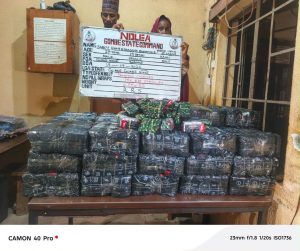
The 49-year-old fake police officer Innocent Ekpe was arrested on Wednesday 16th September 2026 by NDLEA operatives along the Benin-Onitsha expressway in Asaba, Delta state with 292.48 kilograms of skunk hidden in his silver Toyota Sienna bus. Investigation established that Ekpe had long paraded himself as Godwin Emeka, a Deputy Superintendent of Police, using a forged ID card to escape scrutiny at checkpoints while transporting illicit consignments. An accomplice, 39-year-old Nduka Joseph, was arrested along with him.

In Edo State, NDLEA operatives acting on intelligence stormed a location on Agbor Road, Benin City, where they arrested 45-year-old Matthew Ossai, who used his auto-repair workshop as a front for storing illicit drugs. Officers recovered 48 kilograms of Canadian Loud and 152 grams of methamphetamine, along with a metal box used to store the illicit substances.
At the Tin-Can Island Port in Lagos, a 40-foot container shipped from Montreal, Canada, and arrived on 12th September was placed under intensive monitoring by NDLEA operatives based on processed intelligence. The shipment was eventually subjected to a full joint physical examination with Customs and other security agencies on Wednesday 16th September. The search uncovered 1,200 parcels of Canadian Loud weighing 603.75 kilograms, concealed inside 31 black jumbo bags loaded within two Toyota Sienna vehicles in the container.
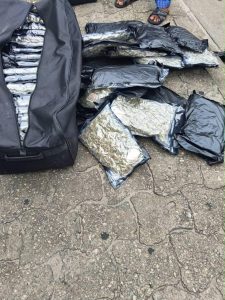
In Niger State, NDLEA operatives on patrol along the Abuja-Kaduna expressway at Chachi, Tafa LGA, on Tuesday 15th September arrested three young suspects: Bashir Usman (20), Abubakar Nuhu (18) and Abdulrahman Abdulwahab (18) with two locally fabricated AK-47 rifles and a magazine, a locally made pistol with magazine, and nine rounds of 9mm ammunition concealed in a black travel bag.
Two suspects: Aminu Isyaku (23) and Jamilu Habibu (25) were on Friday 18th September arrested by NDLEA officers along Abaji-Abuja highway. Over 1.1 million assorted tramadol tablets/capsules, codeine syrup, methamphetamine and Exol tablets concealed in eight sacks en route from Onitsha, Anambra state to Mararaba, Nasarawa state, were recovered from them.
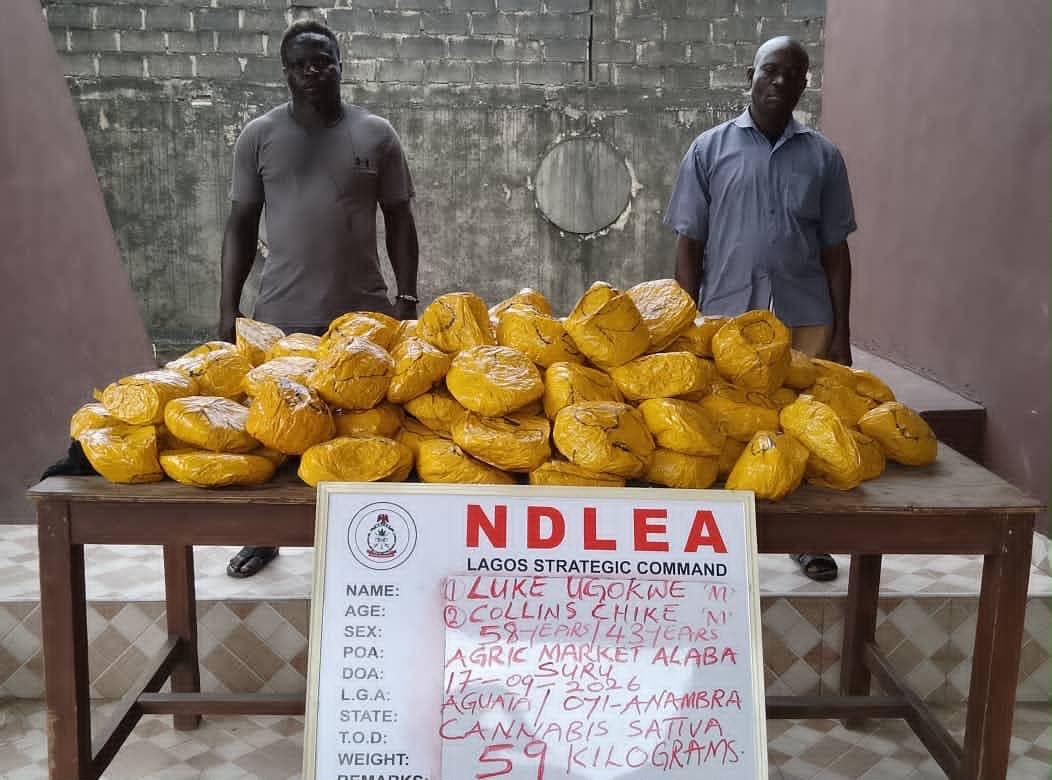
In Lagos, a suspect Onyeka Ofor was arrested on Friday 18th September at his residence in Aguda, Surulere with 48,900 pills of tramadol 225mg , while seven cartons of cannabis sativa weighing 59kg were intercepted at a logistics company with a suspect Luke Ugokwe taken into custody. In another operation in Lagos, Ibrahim Hudu (43) was arrested at Apongbo with 998.38kg of nitrous oxide gas on Thursday 17th September.
A total of 154,480 capsules of tramadol were recovered from two suspects: Sabi’u Umar (27) and Hassana Muhammad (19) who were arrested at Barunde area and Gombe main market respectively in Gombe state on Friday 18th September.
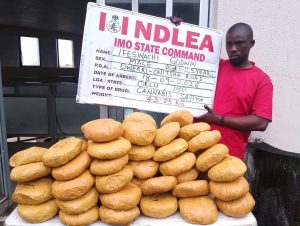
A suspect Ifesinachi Godwin (25) was arrested along the Owerri-Onitsha road, Imo state with 43.85kg of skunk on Friday 18th September, while four suspects: Blessing Effiong, Saviour Peter, David Friday Sunday and Ability Peter Sunday, were nabbed during raid and destruction of 5,000 kilograms of skunk on a two-hectare cannabis farm in Ita-Ogbolu forest, Ondo state on Tuesday 15th September. No less than 48kg of dry and fresh cannabis was recovered from the location for the prosecution of the suspects.
With the same vigour, Commands and formations of the Agency across the country continued their War Against Drug Abuse (WADA) sensitization activities to schools, worship centres, work places and communities among others in the past week. These include: WADA enlightenment lecture to students and staff of St. Ferdinand School, Ogbomoso, Oyo; Unizik Secondary School, Awka, Anambra; Scholars Nursery and Primary School, Epe, Lagos, and
Government Technical Training School, Jalingo, Taraba state, while the Delta Ports Command of NDLEA paid a WADA advocacy visit to His Royal Majesty, King Couple Mackson Oromoni Mobene III, Pere Ama-Okosu of Ogbe-Ijoh Warri Kingdom, Delta state, among others.
While commending the officers and men of Lagos, Tincan, Edo, Niger, Delta, Ondo, Gombe, Imo and FCT Commands for their professionalism and intelligence-driven approach to the various successful operations, Chairman/Chief Executive Officer of NDLEA, Brig. Gen. Mohamed Buba Marwa (rtd) enjoined them and their colleagues across the country to continue with the current balanced approach to the drug control efforts of the Agency.
News
Arewa Youths Hail NNPCL Boss Ojulari For Launch of Nigeria’s Pioneer Smart Self-Service Station

The Arewa Youth Council (AYC) has praised the Group Chief Executive Officer of the Nigerian National Petroleum Company Limited, Engr. Bashir Bayo Ojulari, following the commissioning of Nigeria’s first Smart Self-Service Filling Station in Abuja.
The youth body also welcomed the clear plan to establish between 50 and 70 similar modern energy hubs across the country within the next six months.
In a statementAmbassador Sidi Sani and Publicity Secretary Mallam Bilal Usman, the Council described the project as a progressive transformation of the nation’s downstream petroleum retail sector.
It noted that traditional filling stations are being converted into integrated energy and mobility hubs that combine fuel dispensing with digital and multi-energy services.
“This initiative marks a significant and progressive transformation of Nigeria’s downstream petroleum retail sector,” the Council stated.
“By converting traditional filling stations into integrated energy and mobility hubs, NNPC Limited has introduced self-service fuel dispensing through a mobile application, digital payment systems, electric vehicle charging points, liquefied petroleum gas facilities, planned compressed natural gas services, solar-powered operations, and complementary customer amenities.
“The model prioritises convenience, accuracy, transparency, and round-the-clock accessibility,” the statement added.
“For Nigeria, the Smart Station programme represents a decisive shift toward technology-enabled energy retailing.”
The Arewa Youth Council emphasised that the programme strengthens national energy security while modernising service delivery.
It said the initiative positions the country to meet changing consumer demands and prepare for a multi-energy future that includes petrol, diesel, LPG, CNG, and electricity.
Direct benefits for citizens were highlighted as practical and immediate. Motorists, commercial transporters, and households stand to gain from shorter queues, greater control over transactions, and more reliable product delivery, according to the Council.
“Motorists, commercial transporters, and households will experience reduced waiting times, greater control over transactions, and improved reliability in product delivery,” the statement declared.
“Digital self-service options minimise disputes over quantity and enhance accountability.
“The inclusion of electric vehicle charging infrastructure anticipates the gradual expansion of cleaner mobility options, while solar power reduces operational dependence on the national grid,” it continued.
“These stations will deliver a more efficient, modern, and dignified retail experience for ordinary Nigerians.”
At the national level, the Council observed that the programme carries strategic value by supporting the expansion and modernisation of NNPC Limited’s retail network of about 900 outlets.
The transformation is expected to deepen market presence, create new value chains, and generate opportunities in technology support, infrastructure maintenance, and customer service.
Rather than displacing workers, the new model is expected to evolve existing roles and introduce new skill requirements, thereby contributing to sustainable employment across the sector.
“We specifically commend Engr. Bashir Bayo Ojulari for the strategic leadership that has made this possible,” the Arewa Youth Council said.
“Since assuming office, he has demonstrated a consistent commitment to performance, institutional reform, and national interest.
“Under his direction, NNPC Limited has maintained focus on production growth, critical infrastructure delivery, commercial discipline, and customer-oriented transformation,” the statement noted.
“The Smart Self-Service Station initiative is a tangible expression of that leadership—practical, measurable, and citizen-focused.”
While acknowledging NNPC Limited’s other achievements in upstream operations, gas development, and organisational efficiency, the Council chose to focus on the downstream innovation because of its direct impact on the daily lives of Nigerians.
Energy, it stressed, remains the lifeblood of economic activity and household wellbeing.
Making retail more efficient, transparent, and multi-dimensional is therefore a matter of national importance, the group maintained.
“The Arewa Youth Council urges accelerated and inclusive nationwide rollout, with deliberate attention to northern and underserved regions,” the statement read.
“We call on state governments, private sector partners, and technology providers to support the expansion.
“Continuous refinement of the customer experience and structured training for personnel supporting the new systems will be essential for long-term success,” it added.
“We congratulate Engr. Bashir Bayo Ojulari, the Management and staff of NNPC Limited and NNPC Retail, and all collaborating partners.”

TeeJay Yusuf mourns Ex-Kogi Governor Ibrahim Idris
EPL: Shearer Warns Arsenal After Brighton Humbling

NDLEA intercepts N3.4bn Loud, opioids, arrests fake police officer, mechanic-drug dealer(Photos)



-

 News13 hours ago
Nicki Minaj follows Peter Obi on X after viral repost
-

 News13 hours ago
TikToker remanded over alleged defamation of Kano politician
-

 News13 hours ago
Social media abuzz as Aisha Buhari, Seyi Tinubu, Dino Melaye, others attend pre-wedding in Spain
-

 Politics13 hours ago
NDC Dissociates Itself From OK Movement PCC, Says Political Party Is Serious Business
-
 Metro13 hours ago
NDLEA officer drowns chasing drug suspect into Delta river
-
 News13 hours ago
How ASUU brought snake to my office – Former VC