
Foreign
Check Out The Top 10 Countries with the Weakest Military in the World In 2026 Rankings


- /home/naijuinz/public_html/wp-content/plugins/mvp-social-buttons/mvp-social-buttons.php on line 27
https://naijablitznews.com/wp-content/uploads/2026/02/images-10.jpeg&description=Check Out The Top 10 Countries with the Weakest Military in the World In 2026 Rankings', 'pinterestShare', 'width=750,height=350'); return false;" title="Pin This Post">
- Share
- Tweet /home/naijuinz/public_html/wp-content/plugins/mvp-social-buttons/mvp-social-buttons.php on line 72
https://naijablitznews.com/wp-content/uploads/2026/02/images-10.jpeg&description=Check Out The Top 10 Countries with the Weakest Military in the World In 2026 Rankings', 'pinterestShare', 'width=750,height=350'); return false;" title="Pin This Post">


The 2026 Global Firepower Index ranks the 10 weakest militaries in the world, with Bhutan, Belize and the Central African Republic recording the highest PowerIndex scores among 145 nations assessed.
Global military strength remains uneven, with wide gaps between major powers and smaller or conflict-affected states. The 2026 Global Firepower Index ranks 145 countries using more than 60 indicators, including manpower, equipment, defence spending, logistical capacity, geography and resource access.
Under the index methodology, a lower PowerIndex score indicates stronger military capability, while a higher score reflects weaker overall capacity. The following ten countries recorded the highest PowerIndex scores in 2026, placing them at the bottom of the global military strength rankings.
10 Countries with the Weakest Military in the World
10. Moldova
Rank: #136
PowerIndex: 3,6225

Moldova Military Force
Moldova ranks 136th out of 145 countries, with a PowerIndex score of 3.6225. The Eastern European nation maintains a relatively small and lightly equipped military force. Limited defence funding has slowed modernisation efforts, affecting procurement and force expansion. Moldova’s defence posture remains largely defensive, with emphasis on territorial integrity rather than expeditionary capability.
9. Somalia
Rank: #137
PowerIndex: 3.7393

Somalia Military Force
Somalia places 137th with a PowerIndex score of 3.7393. Years of internal conflict have significantly constrained the country’s defence institutions and operational capacity. Although international partnerships and training missions have supported rebuilding efforts, Somalia’s armed forces continue to face structural and resource limitations.
8. Benin
Rank: #138
PowerIndex: 3.8963

Benin Military Force
Benin ranks 138th globally, posting a PowerIndex score of 3.8963. The West African country maintains a modest military establishment focused primarily on internal security and border protection. Rising instability in parts of the Sahel region has influenced greater attention to defence preparedness, though overall capacity remains limited.
7. Kosovo
Rank: #139
PowerIndex: 3.8041
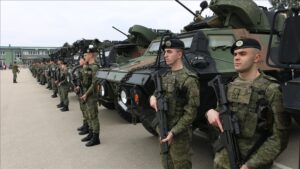
Kosovo Military Force
Kosovo occupies the 139th position with a PowerIndex score of 3.8041. Having formally established its armed forces in 2019, the country remains in the early stages of building a fully structured military institution. Development efforts have focused on training, professionalisation and gradual capability expansion.
6. Sierra Leone
Rank: #140
PowerIndex: 3.9201

Sierra Leone Military Force
Sierra Leone ranks 140th with a PowerIndex score of 3.9201. Its military remains relatively small and constrained by limited funding. More than two decades after the end of its civil war in 2002, the country continues to prioritise stability and institutional rebuilding, with defence capacity evolving gradually.
5. Liberia
Rank: #141
PowerIndex: 3.9275

Liberia Military Force
Liberia stands at 141st globally, recording a PowerIndex score of 3.9275. Similar to neighbouring Sierra Leone, Liberia’s armed forces are modest in size and equipment. The country has focused on rebuilding national institutions following prolonged periods of conflict, resulting in a lean defence structure.
4. Suriname
Rank: #142
PowerIndex: 4.0538

Suriname Military Force
Suriname ranks 142nd with a PowerIndex score of 4.0538. The South American nation maintains a small defence force with limited manpower and equipment inventories. Its relatively stable regional environment reduces immediate external security pressures, shaping a defence model that is compact rather than expansive.
3. Central African Republic
Rank: #143
PowerIndex: 4.2381

Central African Republic Military Force
The Central African Republic places 143rd with a PowerIndex score of 4.2381. Persistent internal security challenges have strained the country’s defence institutions and operational capabilities. External support and partnerships have played a significant role in maintaining security functions amid ongoing instability.
2. Belize
Rank: #144
PowerIndex: 4.3602
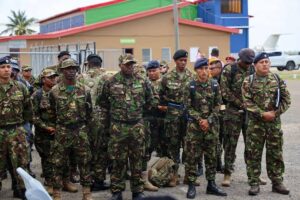
Belize Military Force
Belize ranks 144th globally with a PowerIndex score of 4.3602, making it the second weakest military power in the 2026 index. The Belize Defence Force is one of the smallest in its region, with limited manpower and equipment. However, Belize benefits from relative geopolitical stability and established relationships with larger regional partners.
1. Bhutan
Rank: #145
PowerIndex: 5.7991

Bhutan Military Force
Bhutan occupies the final position at 145th, recording the highest PowerIndex score of 5.7991. The Himalayan kingdom maintains a small volunteer-based army and does not operate a significant air force. Bhutan’s defence posture is shaped by its strategic reliance on close security cooperation with India for external defence support. The gap between Bhutan’s score and that of the next weakest nation reflects a markedly lower overall military capability compared to other ranked states.
Conclusion
Military strength, as measured by the Global Firepower Index, extends beyond troop numbers. Economic resilience, logistics networks, equipment diversity, natural resources and geographic positioning all contribute to overall ranking outcomes. Countries with limited defence budgets or post-conflict rebuilding priorities often score higher on the PowerIndex, reflecting constrained capability rather than immediate vulnerability.
Several of the countries listed operate within relatively stable regional environments or maintain defence partnerships that help offset limited domestic capacity. In some cases, smaller militaries align with national policy choices that prioritise internal stability, diplomacy or economic development over military expansion.
The 2026 Global Firepower Index underscores the wide disparity in global military capability. While Moldova, Somalia, Benin, Kosovo, Sierra Leone, Liberia, Suriname, the Central African Republic, Belize and Bhutan rank at the bottom based on their PowerIndex scores, their security realities differ significantly.
For some, limited military strength reflects economic constraints or post-conflict rebuilding. For others, it aligns with strategic decisions shaped by geography and alliances. The rankings provide a comparative snapshot of defence capacity, but they also highlight that military power is only one dimension of national resilience and security.









The US government says it will stop funding programmes in South Africa intended to tackle the spread of HIV and Aids.
More than eight million South Africans are living with HIV – the highest number of any country in the world.
The US State Department appeared to link the decision to South Africa’s alleged failure to protect the white-minority Afrikaner community – an allegation the South African government has repeatedly rejected.
South Africa’s health ministry responded by saying that though it had not been informed of this decision, it had “long been working on a self-reliance plan”.
Until 2025, the US was supporting South Africa’s efforts to deal with the virus with an estimated $400m (£300m) a year through the President’s Emergency Fund for Aids Relief (PEPFAR).
But since the inauguration of President Donald Trump, relations between the two countries have increasingly soured.
Shortly after he came into office, Trump issued an executive order alleging that “countless” South African policies dismantled equal opportunities and fuelled violence “against racially disfavored landowners”.
This is disputed by the South African government, which says its Black Economic Empowerment policy is needed to correct economic inequality dating from the apartheid era.
The executive order also highlighted South Africa’s case against Israel at the International Court of Justice and its links to Iran.
The White House said that given these “unjust and immoral practices”, further aid to South Africa would not be provided.
Trump has also falsely alleged that there is a “white genocide” taking place in South Africa, which has led to the administration setting up a refugee programme for Afrikaners – descendants of Western Europeans who settled in southern Africa in the 17th Century.
They are now just about the only refugees being allowed into the US.
The genocide claim has been widely discredited.
Pepfar funding, which had been providing about a fifth of South Africa’s total spending on HIV programmes, got a reprieve last October with what was called a “bridge plan”.
But a US State Department official has confirmed that a “phased drawdown” of Pepfar funding would now start.
This was because of “South Africa’s failure to make demonstrable progress on policy requests by the administration”, the official said.
The US government intended to “foster self-reliance” and reduce dependency on American funding, they added, pointing out that “South Africa is a middle-income country and is more than capable of supporting its own health programs”.
South Africa’s health ministry has said that while Pepfar contributed to the country’s HIV programme, the provision of life-saving antiretroviral drugs was funded entirely separately, with most coming from the government.
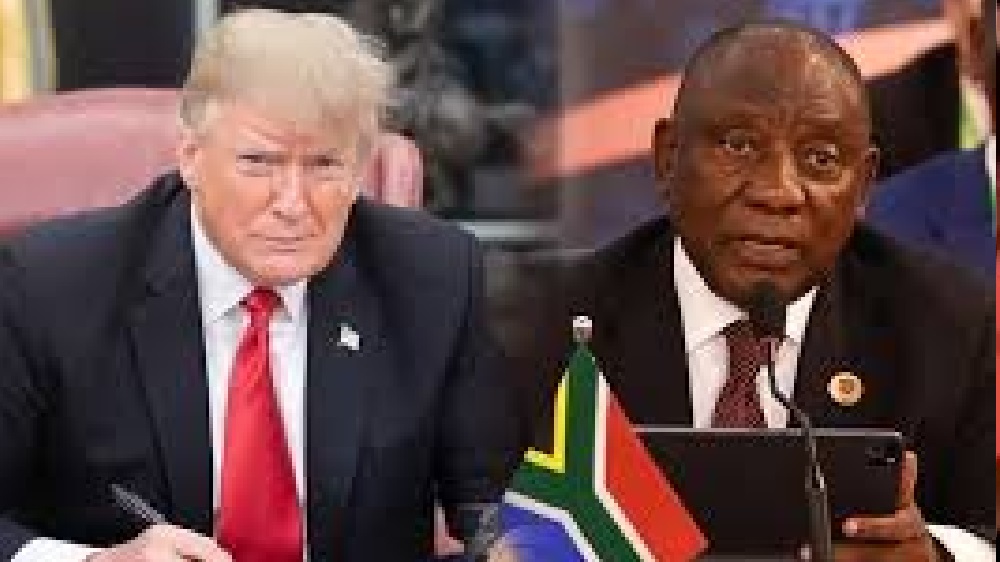
Attempts to mend US-South Africa relations have floundered. These include a high-profile White House meeting between Trump and South African President Cyril Ramaphosa just over a year ago, when the US president confronted his counterpart with his claims of white persecution.
The US also boycotted the G20 meeting, a gathering of the world’s major economies, hosted by South Africa last November.
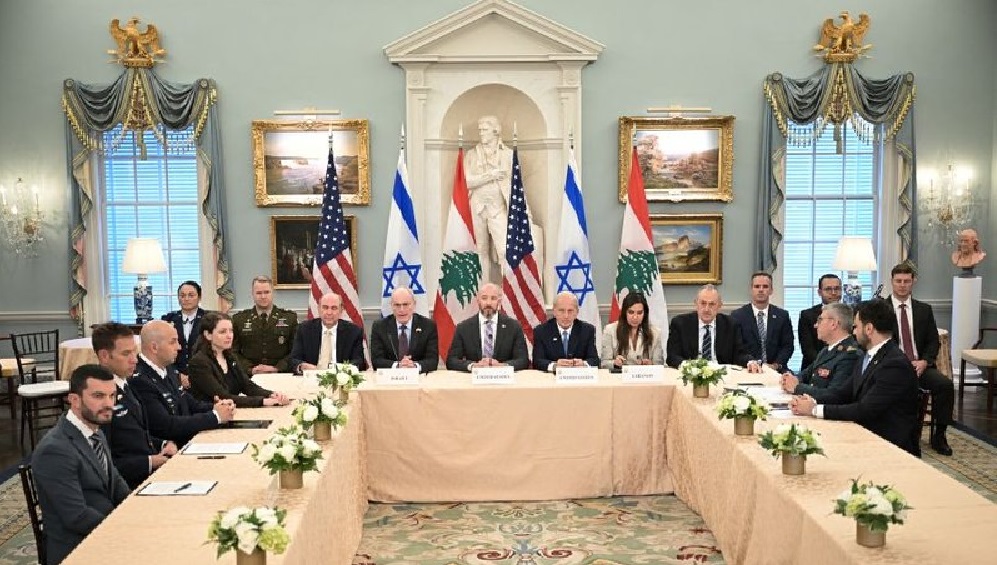
Israel and Hezbollah agreed a ceasefire on Friday, a US official said, after deadly exchanges between the two sides in Lebanon put a deal to end the Middle East war under strain, less than two days after it was signed.
Talks that were scheduled to take place between the US and Iran in Switzerland on Friday to build on the deal and work towards a lasting settlement were postponed amid the fighting, with no new date announced.
Tehran’s top negotiator warned it would not bend on its red lines and that its finger was still “on the trigger”, even as shipping appeared to pick up in the Strait of Hormuz, which had essentially been closed during the war.
The deal signed this week by President Donald Trump and his Iranian counterpart Masoud Pezeshkian aims to end a war that began on February 28 with US-Israeli strikes that killed supreme leader Ayatollah Ali Khamenei.
The agreement was also meant to halt the fighting in Lebanon, which Iran has always insisted should be covered under any accord, turning Israel’s ongoing campaign there into a source of frustration for Washington.
Israel’s military said Friday that it had struck more than 80 Hezbollah targets in Lebanon and killed dozens of members of the Iran-backed group.
‘Permanent war’
Lebanon said 47 people were killed and 97 others wounded in Israeli strikes on Lebanon Friday. Israel’s military reported four troops were killed.
But a US official told AFP a truce between Israel and Hezbollah, beginning immediately, had been brokered by US and Qatari mediators following talks with Israel and Iran. A Gulf diplomat confirmed the ceasefire.
Yet even after the truce was announced, Lebanese state media reported an Israeli airstrike on the country’s south in the Jezzine region.
A previous truce nominally agreed in April did nothing to stop attacks by either side, and Prime Minister Benjamin Netanyahu had said just hours earlier that the Israeli army would stay in Lebanon “as long as necessary” and would make Iran-backed Hezbollah pay a “heavy price” for its attacks.
Far-right Israeli National Security Minister Itamar Ben Gvir went even further, saying after the soldiers’ deaths that “all of Lebanon must burn”.
Iran’s Foreign Minister Abbas Araghchi accused Israel of only being interested in “permanent war”.
‘No urgency’
Preparations had been made to host Iranian and US delegations led by Tehran’s top negotiator Mohammad Bagher Ghalibaf and US Vice President JD Vance at the Swiss resort of Burgenstock, overlooking Lake Lucerne.
The talks were due to kick off a two-month period of negotiations to discuss outstanding issues not covered by the initial deal, notably Iran’s nuclear programme.
Switzerland’s foreign ministry confirmed the discussions had been postponed but said it “remains ready to facilitate these talks”.
Quoting diplomats, the Financial Times said Israel’s strikes on Lebanon had led to the postponement but there was no immediate confirmation.
Iranian foreign ministry spokesman, Esmaeil Baqaei, said there was “no urgency to hold the meeting” but that it was planned “in the coming days”
‘Crushing response’
Ghalibaf said on Friday that talks with the United States would remain bound by Tehran’s “red lines”.
“If the enemy seeks to be excessive, we have proven that our fingers are on the trigger and we have no hesitation in giving a crushing response to the enemy,” he said, in remarks published by the official IRNA news agency.
Vance, meanwhile, has expressed a degree of exasperation with the Israeli government rare for a top US official, telling the New York Times “you can’t just kill your way out of solving every single national security problem that you have”.
A key aspect of the deal was the immediate re-opening of the Strait of Hormuz, the key shipping bottleneck whose closure caused global energy prices to rise.
A total of 25 commercial vessels crossed the newly-reopened strait on Thursday, the highest number since mid-April, according to data from maritime tracking firm AXSMarine published on Friday.
American forces on Thursday lifted their parallel naval blockade of Iranian ports, the US military said, noting that American warships “will remain in the general area”.
Iran’s maritime authority said on Friday that all ships seeking to cross the Strait of Hormuz should submit a transit request “48 hours in advance”, despite its reopening.
AFP

US Vice President JD Vance on Thursday defended the deal to end the Iran war, saying he would likely head to Switzerland for talks to turn it into a long-term agreement.
“The Iranians have to perform,” Vance told a briefing at the White House as President Donald Trump faced mounting criticism over the deal.
“If they don’t perform as we’ve said before, they don’t get any of the benefits of the bargain.”
Vance — a war skeptic who has become the public face of the deal Trump signed at Versailles on Wednesday — rejected claims that the deal rewards Iran without achieving Trump’s war aims.
The most controversial points have been around oil sales, sanctions relief and a $300 billion reconstruction fund for Iran, while there is no firm program for destroying Iran’s nuclear program.
But Vance said Iran would only get the rewards if it proves that it has complied with the terms that will be hammered out in a 60-day period that he said began on Thursday following the signing of the memorandum of understanding (MoU).
“There’s a lot of discussion — the MoU, the gentleman’s agreements, the final deal. Words don’t matter, ladies and gentlemen, we’re about verification,” Vance told reporters.
He added that oil prices were falling, and said the US had lifted its blockade of Iran.
The US military “has allowed north of a dozen ships to go through our naval blockade, and so we’re also honoring our end of the early part of the agreement,” Vance told journalists.
– ‘Smell the reality’ –
Vance said he now planned to head to Switzerland for technical talks on a long-term deal, although the arrangements were not yet finalized.
“I plan to go to Switzerland,” Vance said. “I suspect this weekend but I’m not sure. It just depends on exactly when the Iranians can get there.”
Vance’s new role as Iran pointman is a political gamble for a man who is widely expected to run for president in the 2028 US election.
If a deal to end the war succeeds it will be a boost for a long-term skeptic of US military entanglements — but if it fails, Trump has already said that he will blame Vance.
“I mean, I think the president was joking, as he often does,” Vance said when asked if he feared that Trump would make him the fall guy.
“But, no, look, the entire team has worked very well on this, and we’ve got this thing to a very good place for the American people.”
Vance meanwhile issued an extraordinary rebuke to Israeli critics of the Iran deal, amid growing tensions between Trump and Prime Minister Benjamin Netanyahu.
“If I was in the cabinet of the Israeli government, I might not be attacking the only powerful ally that I have anywhere left in the entire world,” Vance said.
“Anybody in Israel who thinks their biggest problem is the president of the United States needs to wake up and smell the reality of the situation.”
AFP

Tinubu Declares End to Neglect of FCT Satellite Towns as Karu Water Project Comes on Stream(Photos)

110bn SUVs Procurement: Respect Separation of Powers, pro-democracy group warns critics of N’Assembly

Peter Obi advises Tinubu to consider quitting like UK PM




-

 News19 hours ago
JAMB ends affiliated degree programmes in Colleges of Education
-

 News19 hours ago
Fresh Controversy as Group Petitions INEC Over Tinubu’s Credentials, Seeks Clarification Ahead of 2027 Election
-

 News19 hours ago
Full List: Winners Of By-Elections In Kano, Rivers, Others
-

 Metro19 hours ago
Sad: Unidentified lady slumps, dies on Ajah bridge in Lagos
-
 News15 hours ago
Xenophobia: Malawian National K!lled in South Africa
-

 Entertainment19 hours ago
Cubana Chief Priest’s Alleged Babymama, Hellen Ati Uses Her ‘Yansh’ To Curse Him
-
 News12 hours ago
Just in: Finally, Starmer resigns as UK PM
-
 News19 hours ago
Nnamdi Kanu Expels Chika Edoziem, 9 Other Senior IPOB Members Over Alleged Betrayal, Sabotage, Power Grab