Connect with us

News

Access Bank speaks on Herbert Wigwe’s death

Published

on

ADVERTISEMENT
Zoom Ad
ADVERTISEMENT
Zoom Ad

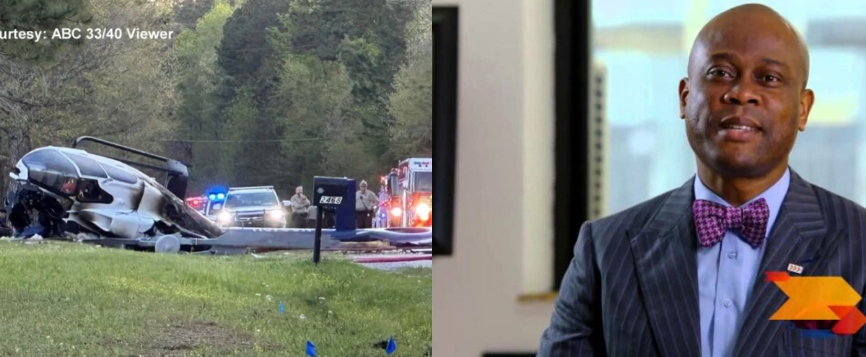
Access Bank Plc has reacted to reports of death of its Group CEO, Herbert Wigwe, in a helicopter crash in California, USA.


Wigwe, who has been feared killed in a helicopter crash was said to be with his wife, son, and a former Group Chairman of the Nigerian Exchange Group Plc, Abimbola Ogunbanjo.

The bank in a statement posted on its X handle on Sunday said it has received numerous inquiries concerning the crash and is working with the US authorities for updates.

“We have received numerous inquiries concerning an airplane crash in the USA. Presently, we lack specific information; however, we are actively collaborating with US authorities who will furnish updates.

Advertisement

“Your understanding and support are valued, and we commit to keeping you informed promptly as we receive updates on the situation.”

Wigwe, his wife and others onboard the ill-fated helicopter are reported to have been en route to Boulder City, Nevada from Palm Springs, California, on Friday night when it crashed at about 10 pm, near a small town in California’s Mojave Desert.

This development has dashed the hope of many Nigerians who planned to fly to the country to watch the final match.

There has been an outcry over the high airfare to Abidjan, which is less than one hour, 30 minutes from Lagos.

Advertisement

Nigeria’s Air Peace, Asky and Air Côte d’Ivoire, are few of the airlines flying to Abidjan.

Checks by our correspondent revealed that a one-way ticket from the Murtala Muhammad International Airport (MMIA) costs between N890,000 to N1.2million, while a return ticket costs over N2m, depending on the airline.

Checks on the website of Asky on Saturday indicated that a one-way fare is 1,229,811 for Sunday’s flight when the final match would be played, while the same flight costs N890,000.

On Air Côte d’Ivoire, the flight was priced at $913, which is over N1.3m at N1,450 to a dollar.

Advertisement

Yesterday, a Professor of Law, Joy Ezeilo, a Senior Advocate of Nigeria (SAN), decried the price of flight ticket to Abidjan, saying she dreamt of watching the AFCON match live but was shocked with the price of the return ticket, which is estimated at over N2.1m.

She wrote, “I am dreaming of watching AFCON 2024 live and I enquired about flights to Abidjan to watch our Super Eagles play in the final. I believed that Ivory Coast, being so close (an hour and 35 minutes) wouldn’t cost me too much. However, my travel agent of over 20 years sent me a price quotation of N2,183,000.00, which was a huge shock. I did the math and realised that I would need to save my five months’ salary as a Professor of Law on the last professional step to buy one return ticket to a West African country.

“This is a sad reflection of our current economic realities. Please refrain from attempting to convert to US dollars, it is extremely depressing and demystifying of a full professor position. This will push the resolve of brilliant young ones we are training and mentoring to take over from us farther away from the classrooms to becoming political aspirants/election delegates.

She, however, pointed out that she had made an alternative plan which includes recharging her DSTV at N19,800, and to buy 20 litres of fuel to generate power because they didn’t have electricity during the semifinal match.

Advertisement

“The struggle continues! Good luck to our Super Eagles! You are in my thoughts and prayers,” she stated.

However, an aviation management consultant, Babatunde Adeniji, said with the huge demand for flight to Abidjan, the value of a seat on the route also increased.

“Demand and supply of must-watch mean that each seat becomes so much more valuable. The demand and supply principle states that because of this final match, which is coming up just once, the value of your seat has gone up. If you throw a bid now on a 120-seat aircraft for all Nigerians to bid for seats, you know some people would bid much more than this amount you are even talking about, and that’s what is happening with ticketing,” he said.
Advertisement
Continue Reading
Advertisement

News

Watch moment construction staff indigenous company, Val Construction hailing FCT minister Wike (Wike)

Published

on

ADVERTISEMENT
Zoom Ad
ADVERTISEMENT
Zoom Ad

It was an atmosphere of joyful noise as Staff of Abdul Val Construction Company, an indigenous contractor handling the ongoing construction of Karu, Abuja roads hailing the FCT Minister, Nyesom Wike, while inspecting the road project today.

Watch:

Continue Reading

News

Experts Say Africa Forfeits $89bn Every Year To Illicit Financial Flows

Published

on

ADVERTISEMENT
Zoom Ad
ADVERTISEMENT
Zoom Ad

By Gloria Ikibah

African economies continue to suffer major revenue losses due to illicit financial flows, with experts estimating that as much as 89 billion dollars slips out of the continent annually.

Specialists from the West African Tax Administration Forum WATAF and Tax Justice Network Africa TJNA highlighted the scale of the challenge during an engagement with lawmakers at the ongoing 2026 First Ordinary session of the Economic Community of West African States Parliament in Abuja on Monday.

They linked the persistent losses to a range of harmful tax practices that continue to undermine public finances across the region. These include tax evasion, aggressive tax avoidance and the manipulation of trade invoices, all of which weaken governments’ ability to generate revenue.

Discussions at the session also focused on how to implement regional tax directives more effectively, with particular emphasis on strengthening domestic resource mobilisation and promoting greater alignment of tax systems across West Africa.

According to the experts, the continent is grappling with a substantial funding gap, with nearly 194 billion dollars needed each year to meet development demands, a shortfall made worse by ongoing financial leakages.

“Africa has a prevalent problem of illicit financial flows, and at least 65 per cent of these could be categorised as commercially-driven.

“The main practices that could lead to IFFs are: tax evasion, tax avoidance, tax misinvoicing and other harmful tax practices.

“These harmful tax practices haemorrhage the available resources that can be used for development of the continent, and Africa loses up to eighty-nine billion dollars annually,” they said, citing a 2020 report.

They also asserted that advancing tax harmonisation within the ECOWAS sub-region presents a strategic opportunity for WATAF to strengthen regional integration, enhance domestic resource mobilisation, and support sustainable development.

“Tax harmonisation is the fiscal backbone of ECOWAS integration. Without it, the region will continue to lose revenue through loopholes, smuggling, opacity, and profit shifting,” they said.

However, they emphasised that the effectiveness of such efforts would depend on strong political commitment, effective national-level implementation, and active parliamentary oversight.

Dr Nita Belemaobgo, Research Manager, WATAF, while highlighting the session’s expected outcomes, said the organisation’s objective was to support ECOWAS’ transition on tax directives aimed at harmonising fiscal policies across member states.

“Regional cooperation and evidence-based tools can significantly enhance accountability and reform outcomes,” she said.

Danicius Sengbeh, WATAF’s Manager, Communications and Information Technology, underscored the importance of setting regional tax harmonisation and domestic resource mobilisation.

He said the ECOWAS Parliament had an indispensable role to play in the oversight function of tax administration, adding that the engagement was about “sovereignty, fairness, accountability and West Africa’s future.”

Dr Zandile Ndebele of TJNA, in her submission, urged the regional MPs to make laws to ensure that local citizens in African countries benefited from domestic resource mobilisation and management.

Speaking on the theme, “Addressing Tax-Related Illicit Financial Flows (IFFs) through Legislative Frameworks and Transparency,” she said:

“It’s possible to introduce legislation for domestic beneficiation to gain more resources and revenues, apart from gaining from just taxes.”

The experts urged lawmakers to adopt a broad and coordinated approach to tackling illicit financial flows, noting that meaningful progress in this area would be critical to strengthening both national and regional revenue generation.

Speaking on behalf of the Tax Justice Network Africa, Solomon Adoga called on parliamentarians to prioritise stronger legal frameworks for the mining sector, emphasising the need for stricter oversight and accountability.

He advised legislators to focus on “strengthening extractive legislation, scrutinising new mining agreements and monitoring tax incentives through cost-benefit analysis.”

He also stressed the importance of safeguarding the continent’s fiscal interests, warning against continued dependence on external systems.

“It’s important that Africa protects its taxing rights. We must look at where we are losing revenue as Africans. We don’t need to be reliant on other countries outside of Africa,” he said.

The experts further encouraged the Economic Community of West African States to deepen tax harmonisation efforts across the region as a way of reducing distortions, curbing unhealthy tax competition and reinforcing economic integration.

They pointed out that progress in tackling illicit financial flows does not necessarily depend on a unified currency, maintaining that countries can retain separate monetary systems while still working together to address the problem.

“There must be local beneficiation in our countries. Africa has been deprived of taxing rights. Multinational companies are not paying their fair share of taxation,” they noted.

In addition, lawmakers were urged to give priority to global tax reforms, improved information exchange and greater transparency, while encouraging member states to draw lessons from advocacy efforts in countries such as Nigeria, Ghana and Côte d’Ivoire.

A representative of the West African Tax Administration Forum, Jonas Igwe, highlighted the need for sustained commitment to make regional reforms effective.

“Effective implementation of tax harmonisation would require political commitment, institutional coordination, digital modernisation, sustained regional cooperation, monitoring and evaluation by national transition committees,” he added.

Continue Reading

News

ECOWAS Sets Out Sweeping Reform Plan To Steady Regional Bloc Amid Mounting Crises

Published

on

ADVERTISEMENT
Zoom Ad
ADVERTISEMENT
Zoom Ad

By Gloria Ikibah

The Economic Community of West African States has introduced an extensive roadmap aimed at overhauling regional integration, as it seeks to rebuild confidence, restore cohesion and respond more effectively to growing political, economic and security pressures across West Africa.

The proposal, unveiled during a session of the ECOWAS Parliament in Abuja on Tuesday, was presented by the organisation’s Commissioner for Political Affairs, Peace and Security, Ambassador Abdel-Fatau Musah. It outlines a broad reset of the bloc’s direction, with a renewed focus on making integration more inclusive and people-centred.

At the core of the initiative is the implementation of the ECOWAS Vision 2050 framework, alongside efforts to reposition the organisation at a time when it faces one of its most challenging periods since its establishment in 1975. Ongoing governance concerns, democratic backsliding and the rise of alternative alliances such as the Alliance of Sahel States, involving Burkina Faso, Mali and Niger, have all contributed to the strain.

The reform plan stems from a directive issued by regional leaders during their 65th Ordinary Session in Abuja in July 2024, which called for a dedicated summit to reassess the future of integration in West Africa.

Structured around six key pillars, the framework sets out priorities including economic transformation, peace and democratic governance, advances in science and technology, social inclusion, institutional reform and a clearer geopolitical strategy for the bloc.

On the economic front, the organisation is targeting a significant increase in intra-regional trade, with ambitions to deepen industrialisation, strengthen food security and introduce a single regional currency, the ECO, in the coming years.

Security and governance proposals emphasise stricter opposition to unconstitutional changes of government, alongside plans to reinforce regional peacekeeping capacity through a stronger standby force.

In the technology space, the roadmap envisions the creation of a unified digital market, while social measures include increasing women’s representation in leadership roles and embedding youth participation in governance structures.

Institutional reforms are also central to the plan, with proposals aimed at improving accountability, strengthening merit-based systems and achieving financial independence for ECOWAS institutions through enhanced revenue mechanisms.

A major feature of the document is its emphasis on “strategic autonomy,” positioning ECOWAS as a unified geopolitical actor capable of defending West Africa’s sovereignty in an increasingly multipolar world.

The proposal further outlines a framework for structured dialogue and confidence-building measures with the AES countries to prevent permanent fragmentation of the region.

To address ECOWAS’ longstanding implementation deficit, the Compact introduces a robust monitoring and evaluation system, including compliance scorecards for member states and an evidence-based approach to policy implementation.

Musah said the ultimate goal is to transform ECOWAS from an institution known for issuing declarations into one that delivers concrete public goods such as security, economic mobility and digital connectivity to citizens.

He noted that the draft Compact was developed through extensive consultations involving citizens across West Africa, civil society groups, the African diaspora, ECOWAS institutions and heads of state and government.

“The Compact for the Future of Regional Integration is a survival strategy for the region,” Musah said. “It seeks to rebuild trust between states and their peoples, ensuring that regional integration remains relevant, citizen-centred and capable of responding to 21st-century challenges.”

The presentation formed part of deliberations at the ongoing ECOWAS Parliament session, where lawmakers are examining the future of regional cooperation amid rising insecurity, democratic instability and economic pressures across West Africa.

Continue Reading

Trending

Copyright © 2024 Naija Blitz News