Connect with us

News

Economic Hardship: CSO Gives FG Ultimatum, Threatens Nationwide Protest

Published

on

ADVERTISEMENT
Zoom Ad
ADVERTISEMENT
Zoom Ad

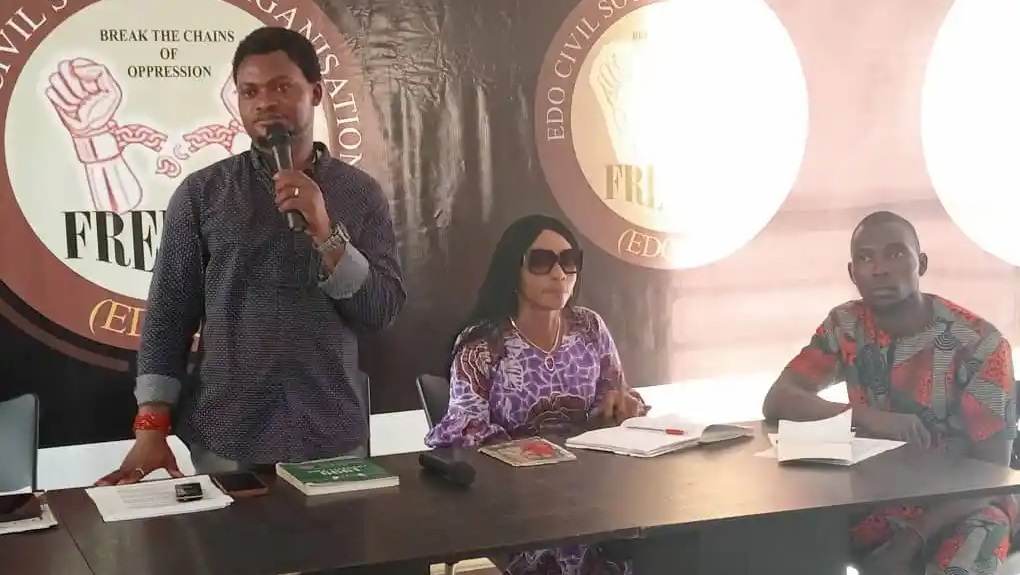
Edo Civil Society Organisations (EDOCSO), has given the President Bola Tinubu-led Federal Government to urgently end the suffering in Nigeria with two weeks, threatening that failure to do so will lead to mass protest.


The civil society organisations gave the ultimatum in Benin City, the Edo State capital, during its General Assembly on Saturday.

Reading a statement jointly signed by Comrade Austine Enabulele,
Interim Technical Committee Chairman, and Comrade Grace Okike, Interim Technical Committee Secretary, EDOCSO, the organisations lamented that the economic hardship in the land is becoming unbearable.

“We want to state clearly that failure for the federal government to swing into emergency action to end this HUNGER and economic suffering in Nigeria within the next two week the President and his Vice should resign so we can elect a better leader, or we at Edo Civil Society Organisations (EDOCSO) will have no option than to mobilize other citizens all over the country on a Tinubu/Shetima must go protest, and we shall ensure a change in the leadership of Nigeria government to prove that indeed section 14 subsection 2a can be activated by any person elected into place of leadership.

Advertisement

“We shall ensure a better tomorrow for Nigerians and not this present better yesterday than we are currently experiencing. Let’s not be discouraged by the show of ineptitude of our leaders but focus on taking back our country from the hands of greedy politicians,” they added.

According to the civil society organisations, since the first day President Tinubu took over the leadership of Nigeria, “the country has known no peace in terms of our daily living.”

The EDOCSO added: “Beginning from the increase in fuel price till date, continuous rising of dollar that has affected everything in Nigeria including farm produce that comes from the local farms to our markets today, this has made the saying that whatever goes up must surely come down an irony, considering Dollar-naira exchange rate and suffering in Nigeria.”

They continued: “With dismay, pain and agony we have watched Nigerians groan in pains even when we try to assist as individuals from our own personal struggles is still never enough, and this has led to the continuous rising of suicide being committed by Nigerians everyday because they can no longer bear the hunger and sufferings, women are turning to widows and men widowers, children becoming fatherless or motherless all because, parents can no longer bear the pains of watching their children suffering, as a result of not being able to provide a meal for their children.”

Advertisement

According to EDOCSO, “Is it the crime that has increased all over the 36 states including the FCT, everyday we hear and experience kidnapping, armed robbery all over the country, that even the common local farmer, petty trader and mechanics are now being kidnapped in Nigeria in exchange for whatever the kidnappers can scoop for themselves from innocent citizens as ransom.

“The Federal Government has suddenly become somewhat deaf and dumb that they have refused to act or do anything about it, the almighty giant of Africa has suddenly become handicapped.

“Today in our markets, we can not even buy products manufactured locally, even the foods we bring from our local farms, all because the prices of food and all other things are going up every blessed day and the government supposedly has agencies that control market prices, while these agencies watch in their slumber with their hands folded doing nothing to correct these anomalies in the system and yet we say we have a government in Nigeria?

“Citizens get sick in Nigeria today and can’t afford money to buy common paracetamol, there are no health centers or government hospitals to go to by citizens to be attended to with little or no money.

Advertisement

“In some cases, you go to the very limited hospitals and you are not well attended to by professionals because of its shortage, you can’t get drugs from these few hospitals that are available and yet the wife of the president could donate 100,000 dollars to Sierra Leone to build a hospital when we have needs for it here in Nigeria.”

EDOCSO stated that, “We also wants to state here that we are most disappointed in the National House Of Assemblies who have become a puppet in the hand of the executive not knowing the power the constitution gave them to serve the people, unfortunately we have slumbering representatives who originally don’t know why they were sent to the National House of Assemblies.

“They feel it’s their time to enrich themselves at the expense of Nigerians and we think to the extent of their uselessness, they should all go home, so Nigerians can now conveniently know they have a country without legislators.

“Flowing from the above, it is clear of the general sufferings that Nigerians have been plunged into by the federal government since the day of taking over, due to the removal of fuel subsidy without proper plans on ground to ensure the welfare of Nigerians, and of course the further devalue of our Naira till date.

Advertisement

“We say to the Federal Government and president Bola Ahmed Tinubu that he has failed in his responsibilities and agreement reached with Nigerians, in Section 14 subsection 2b and Section 16 subsection 1b of the 1999 Constitution of the federal republic of Nigeriand as such have made the following demands.”

The civil society organisations therefore urged the Federal Government to urgently “put in place all machineries to ensure proper market price regulations to end the current economic hardship in the country,” and also put “all economic processes to give value to our currency be put in place.”

The organisations also demanded that “a proper fair and citizens friendly policies be put in place to ensure economic stability in the country,” and “all security measures to end insecurity be activated immediately.”

Advertisement
Continue Reading
Advertisement

News

Watch moment construction staff indigenous company, Val Construction hailing FCT minister Wike (Wike)

Published

on

ADVERTISEMENT
Zoom Ad
ADVERTISEMENT
Zoom Ad

It was an atmosphere of joyful noise as Staff of Abdul Val Construction Company, an indigenous contractor handling the ongoing construction of Karu, Abuja roads hailing the FCT Minister, Nyesom Wike, while inspecting the road project today.

Watch:

Continue Reading

News

Experts Say Africa Forfeits $89bn Every Year To Illicit Financial Flows

Published

on

ADVERTISEMENT
Zoom Ad
ADVERTISEMENT
Zoom Ad

By Gloria Ikibah

African economies continue to suffer major revenue losses due to illicit financial flows, with experts estimating that as much as 89 billion dollars slips out of the continent annually.

Specialists from the West African Tax Administration Forum WATAF and Tax Justice Network Africa TJNA highlighted the scale of the challenge during an engagement with lawmakers at the ongoing 2026 First Ordinary session of the Economic Community of West African States Parliament in Abuja on Monday.

They linked the persistent losses to a range of harmful tax practices that continue to undermine public finances across the region. These include tax evasion, aggressive tax avoidance and the manipulation of trade invoices, all of which weaken governments’ ability to generate revenue.

Discussions at the session also focused on how to implement regional tax directives more effectively, with particular emphasis on strengthening domestic resource mobilisation and promoting greater alignment of tax systems across West Africa.

According to the experts, the continent is grappling with a substantial funding gap, with nearly 194 billion dollars needed each year to meet development demands, a shortfall made worse by ongoing financial leakages.

“Africa has a prevalent problem of illicit financial flows, and at least 65 per cent of these could be categorised as commercially-driven.

“The main practices that could lead to IFFs are: tax evasion, tax avoidance, tax misinvoicing and other harmful tax practices.

“These harmful tax practices haemorrhage the available resources that can be used for development of the continent, and Africa loses up to eighty-nine billion dollars annually,” they said, citing a 2020 report.

They also asserted that advancing tax harmonisation within the ECOWAS sub-region presents a strategic opportunity for WATAF to strengthen regional integration, enhance domestic resource mobilisation, and support sustainable development.

“Tax harmonisation is the fiscal backbone of ECOWAS integration. Without it, the region will continue to lose revenue through loopholes, smuggling, opacity, and profit shifting,” they said.

However, they emphasised that the effectiveness of such efforts would depend on strong political commitment, effective national-level implementation, and active parliamentary oversight.

Dr Nita Belemaobgo, Research Manager, WATAF, while highlighting the session’s expected outcomes, said the organisation’s objective was to support ECOWAS’ transition on tax directives aimed at harmonising fiscal policies across member states.

“Regional cooperation and evidence-based tools can significantly enhance accountability and reform outcomes,” she said.

Danicius Sengbeh, WATAF’s Manager, Communications and Information Technology, underscored the importance of setting regional tax harmonisation and domestic resource mobilisation.

He said the ECOWAS Parliament had an indispensable role to play in the oversight function of tax administration, adding that the engagement was about “sovereignty, fairness, accountability and West Africa’s future.”

Dr Zandile Ndebele of TJNA, in her submission, urged the regional MPs to make laws to ensure that local citizens in African countries benefited from domestic resource mobilisation and management.

Speaking on the theme, “Addressing Tax-Related Illicit Financial Flows (IFFs) through Legislative Frameworks and Transparency,” she said:

“It’s possible to introduce legislation for domestic beneficiation to gain more resources and revenues, apart from gaining from just taxes.”

The experts urged lawmakers to adopt a broad and coordinated approach to tackling illicit financial flows, noting that meaningful progress in this area would be critical to strengthening both national and regional revenue generation.

Speaking on behalf of the Tax Justice Network Africa, Solomon Adoga called on parliamentarians to prioritise stronger legal frameworks for the mining sector, emphasising the need for stricter oversight and accountability.

He advised legislators to focus on “strengthening extractive legislation, scrutinising new mining agreements and monitoring tax incentives through cost-benefit analysis.”

He also stressed the importance of safeguarding the continent’s fiscal interests, warning against continued dependence on external systems.

“It’s important that Africa protects its taxing rights. We must look at where we are losing revenue as Africans. We don’t need to be reliant on other countries outside of Africa,” he said.

The experts further encouraged the Economic Community of West African States to deepen tax harmonisation efforts across the region as a way of reducing distortions, curbing unhealthy tax competition and reinforcing economic integration.

They pointed out that progress in tackling illicit financial flows does not necessarily depend on a unified currency, maintaining that countries can retain separate monetary systems while still working together to address the problem.

“There must be local beneficiation in our countries. Africa has been deprived of taxing rights. Multinational companies are not paying their fair share of taxation,” they noted.

In addition, lawmakers were urged to give priority to global tax reforms, improved information exchange and greater transparency, while encouraging member states to draw lessons from advocacy efforts in countries such as Nigeria, Ghana and Côte d’Ivoire.

A representative of the West African Tax Administration Forum, Jonas Igwe, highlighted the need for sustained commitment to make regional reforms effective.

“Effective implementation of tax harmonisation would require political commitment, institutional coordination, digital modernisation, sustained regional cooperation, monitoring and evaluation by national transition committees,” he added.

Continue Reading

News

ECOWAS Sets Out Sweeping Reform Plan To Steady Regional Bloc Amid Mounting Crises

Published

on

ADVERTISEMENT
Zoom Ad
ADVERTISEMENT
Zoom Ad

By Gloria Ikibah

The Economic Community of West African States has introduced an extensive roadmap aimed at overhauling regional integration, as it seeks to rebuild confidence, restore cohesion and respond more effectively to growing political, economic and security pressures across West Africa.

The proposal, unveiled during a session of the ECOWAS Parliament in Abuja on Tuesday, was presented by the organisation’s Commissioner for Political Affairs, Peace and Security, Ambassador Abdel-Fatau Musah. It outlines a broad reset of the bloc’s direction, with a renewed focus on making integration more inclusive and people-centred.

At the core of the initiative is the implementation of the ECOWAS Vision 2050 framework, alongside efforts to reposition the organisation at a time when it faces one of its most challenging periods since its establishment in 1975. Ongoing governance concerns, democratic backsliding and the rise of alternative alliances such as the Alliance of Sahel States, involving Burkina Faso, Mali and Niger, have all contributed to the strain.

The reform plan stems from a directive issued by regional leaders during their 65th Ordinary Session in Abuja in July 2024, which called for a dedicated summit to reassess the future of integration in West Africa.

Structured around six key pillars, the framework sets out priorities including economic transformation, peace and democratic governance, advances in science and technology, social inclusion, institutional reform and a clearer geopolitical strategy for the bloc.

On the economic front, the organisation is targeting a significant increase in intra-regional trade, with ambitions to deepen industrialisation, strengthen food security and introduce a single regional currency, the ECO, in the coming years.

Security and governance proposals emphasise stricter opposition to unconstitutional changes of government, alongside plans to reinforce regional peacekeeping capacity through a stronger standby force.

In the technology space, the roadmap envisions the creation of a unified digital market, while social measures include increasing women’s representation in leadership roles and embedding youth participation in governance structures.

Institutional reforms are also central to the plan, with proposals aimed at improving accountability, strengthening merit-based systems and achieving financial independence for ECOWAS institutions through enhanced revenue mechanisms.

A major feature of the document is its emphasis on “strategic autonomy,” positioning ECOWAS as a unified geopolitical actor capable of defending West Africa’s sovereignty in an increasingly multipolar world.

The proposal further outlines a framework for structured dialogue and confidence-building measures with the AES countries to prevent permanent fragmentation of the region.

To address ECOWAS’ longstanding implementation deficit, the Compact introduces a robust monitoring and evaluation system, including compliance scorecards for member states and an evidence-based approach to policy implementation.

Musah said the ultimate goal is to transform ECOWAS from an institution known for issuing declarations into one that delivers concrete public goods such as security, economic mobility and digital connectivity to citizens.

He noted that the draft Compact was developed through extensive consultations involving citizens across West Africa, civil society groups, the African diaspora, ECOWAS institutions and heads of state and government.

“The Compact for the Future of Regional Integration is a survival strategy for the region,” Musah said. “It seeks to rebuild trust between states and their peoples, ensuring that regional integration remains relevant, citizen-centred and capable of responding to 21st-century challenges.”

The presentation formed part of deliberations at the ongoing ECOWAS Parliament session, where lawmakers are examining the future of regional cooperation amid rising insecurity, democratic instability and economic pressures across West Africa.

Continue Reading

Trending

Copyright © 2024 Naija Blitz News