Connect with us

News

President Tinubu Seeks Legislative Approval for $8.6bn External Borrowing Plan

Published

on

ADVERTISEMENT
Zoom Ad
ADVERTISEMENT
Zoom Ad
By Gloria Ikibah
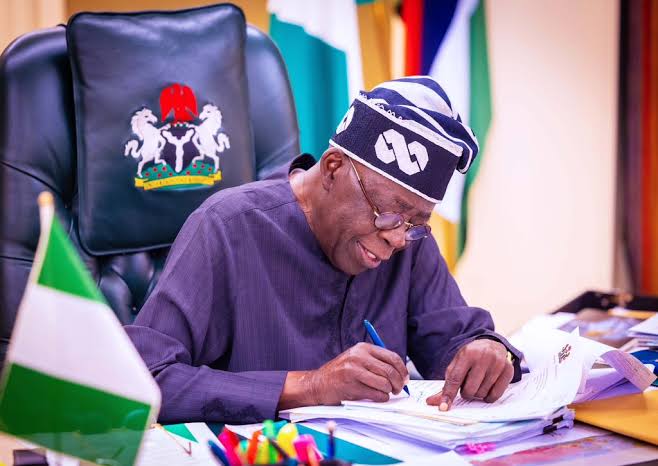
President Bola Tinubu has written to the National Assembly, seeking the approval for N1.767 trillion ($2.209 billion) new external borrowing plan in the 2024 Appropriation Act.
This request from President Tinubu was contained in a letter addressed to the Speaker, House of Representatives, Rep. Abbas Tajudeen titled: “Request for a Resolution of the National Assembly for the Implementation of the New External Borrowing of N1.767 trillion (About $2.209 billion) in the 2024 Appropriation Act”.
In the letter read by Speaker Abbas at the resumed plenary on Tuesday, the President said the borrowing was to part-finance the 2024 budget deficit of N9.179 trillion.
According to President Tinubu, the 2024 Appropriation Act approved the sum of N7.828 trillion as New Borrowings out of which Domestic Borrowing stood at N6.061 trillion and New External Borrowing pegged at N1.767 trillion to part-finance the N9.179 trillion budget deficit.
The letter reads in part: “In accordance with the provisions of Sections 21(1) and 27(1) of the Debt Management Office (DMO) (Establishment, Etc.) Act, 2003, and the approval of the Federal Executive Council, I write to request for a Resolution of the National Assembly to raise the sum of N1,767,610,321,779.00 (equivalent of USD2,209,512,902.22 at the Budget Exchange Rate of USD1.00/N800) provided as New External Borrowing in the 2024 Appropriation Act to part finance the budget deficit of N9.179 trillion.
“The Right Honourable Speaker may wish to recall that the 2024 Appropriation Act approved the sum of N7,828,529,477,860.00 as New Borrowings to part-finance the 2024 budget deficit of N9.179 trillion. The total New Borrowings of N7.828 trillion was further subdivided into New Domestic Borrowing of N6.061 trillion and New External Borrowing of N1.767 trillion”.
The President also explained that external borrowing funds were needed to give more momentum to the ongoing implementation of the projects and programmes in the 2024 Appropriation Act, which were designed to stabilise the economy and put it on the path of sustainable growth and development.
According to him, the key projects to which the proceeds will be deployed include the priority sectors of the economy, such as power, transport, agriculture, defence and security, while increasing accretions to the external reserves.
Likewise, President Tinubu in aletter transmitted to the House requested that it approve the 2025-2027 Medium Term Expenditure Framework and the Fiscal Strategy Paper (MTEF/FSP).
Naijablitznews.com reports that the Federal Executive Council last week, approved the MTEF/FSP which pegged the 2025 budget at N47.9 trillion, oil price benchmark at $75 per barrel, oil production of 2.06 million barrels per day, an exchange rate of N1,400/$1, and GDP growth of 4.6 per cent.
The president asked the House to expeditiously consider the
MTEF/FSP as the 2025 budget was prepared based on the document.
“It is with pleasure that I forward herewith, the 2025-2027 Medium Term Expenditure Framework and Fiscal Strategy Paper (MTEF&FSP) for the kind consideration and approval by the House of Representatives. The 2025- 2027 (MTEF&FSP) was approved during the Federal Executive Council (FEC) meeting of 10th November, 2024.
“The House is invited to note that, as the 2025 budget of the Federal Government will be prepared based on the parameters and fiscal assumptions of the approved 2025-2027 (MTEF&FSP), it is imperative to seek National Assembly’s expeditious legislative action on this submission,” the letter stated.
In another letter to the House, President Tinubu transmitted to the House, the National Social Investment Programme Agency Establishment Amendment Bill, 2024, and requested expeditious consideration and passage.
He said the purpose of the bill was to make National Social Register a primary targeting tool for the implementation of social investment programmes of government.
According to the President, this will ensure social welfare programmes are data driven and implementation processes are transparent, targeted, dynamic and effective in delivering social protection benefits to vulnerable Nigerians.
“Pursuant to Section 58(2) of the Constitution of The Federal Republic of Nigeria 1999 (as amended), I forward, herewith, for the kind consideration and passage by the House of Representatives, the National Social Investment Programme Agency (Establishment) (Amendment) Bill, 2024, for the amendment of the National Social Investment Programme Agency Act, 2023.
“The purpose of the bill is to make the National Social Register the primary targeting tool for the implementation of social investment programmes of Government. This will ensure our social welfare programmes are data driven and implementation processes are transparent, targeted, dynamic and effective in delivering social protection benefits to vulnerable Nigerians,” the letter read.

Continue Reading
Advertisement
Click to comment

Warning: Undefined variable $user_ID in /home/naijuinz/public_html/wp-content/themes/zox-news/comments.php on line 49

You must be logged in to post a comment Login

Leave a Reply

News

If Umahi’s daughter was found naked and dead in a poor man’s house Nigeria would’ve been on fire-Dalung

Published

on

ADVERTISEMENT
Zoom Ad
ADVERTISEMENT
Zoom Ad

Ex- Minister of Youth and Sports, Barrister Solomon Dalung, has criticised what he described as double standards in the investigation into the death of physiotherapist Mary Habila, saying the public response would have been entirely different if the victim had been the daughter of a government official

Dalung made the remark while reacting to the controversy surrounding Habila’s death at the country residence of the Minister of Works, David Umahi, in Uburu, Ohaozara Local Government Area of Ebonyi State.

Speaking in a video shared on social media, the former minister questioned the pace and manner of the investigation, arguing that ordinary Nigerians are often subjected to harsher scrutiny than powerful public office holders.

“If Umahi’s daughter had been found naked in a poor man’s house, Nigeria would be burning,” Dalung said, suggesting that the circumstances surrounding Habila’s death would have attracted a different level of public outrage and official response if the roles had been reversed.

Advertisement

Mary Habila, a 26-year-old physiotherapist from Kaduna State, was found dead at Umahi’s residence on June 27, 2026. She was reportedly attached to the David Umahi Federal University of Health Sciences and had been seconded to the Federal Ministry of Works.

Umahi has since confirmed the incident, describing Habila as a dedicated member of staff who had worked with him for about three years. He said emergency medical personnel were contacted immediately after she was found unresponsive and disclosed that he advised the family to consent to an autopsy to determine the exact cause of death.

The minister has repeatedly denied allegations of any cover-up, insisting that he has nothing to hide and supports a thorough investigation into the circumstances surrounding the physiotherapist’s death.

Meanwhile, the Nigeria Police Force transferred the case to the Ebonyi State Criminal Investigation Department (CID) for further investigation, as public interest in the incident continues to grow.

Advertisement

Dalung’s remarks add to the increasing calls for transparency and accountability in the investigation, with many Nigerians demanding that the case be thoroughly investigated and that its outcome be made public regardless of the status of those involved.

Continue Reading

News

DAY 27 of Projects Commissioning and Flag-Off in the FCT

Published

on

ADVERTISEMENT
Zoom Ad
ADVERTISEMENT
Zoom Ad

Launch of the Sales Office/Experience Centre: The Abuja City Walk Development

#FCTProjects2026
#FCT31DaysCommissioning

Continue Reading

News

US expands sanctions aiming at Iran oil, cryptocurrency sectors

Published

on

ADVERTISEMENT
Zoom Ad
ADVERTISEMENT
Zoom Ad

The United States on Tuesday expanded its sanctions aiming at Iran’s oil sector, taking further aim at the network of petroleum shipping magnate Mohammad Hossein Shamkhani, the Treasury Department said.

Treasury Secretary Scott Bessent said the department had also frozen $130 million held in digital wallets linked to Iran’s central bank, hitting a sector that has seen increased activity since the start of the war.

The move came after US forces carried out a fourth straight day of strikes against Iran and reimposed a naval blockade, with Iran in turn hitting ships in the Strait of Hormuz, according to the International Maritime Organization.

Iran started blocking the strait — a key waterway for energy transit — after US-Israel attacks in February. Washington imposed an initial blockade on Tehran’s ports from mid-April to mid-June.

Advertisement

“This action is part of Treasury’s ongoing efforts to ramp up economic pressure on the Iranian regime after it resumed destabilizing attacks in the Strait of Hormuz,” the Treasury Department said in a notice Tuesday.

It charged that the Shamkhani network remains a key force behind Iran’s oil exports, and has expanded into global commodities trading.

The latest move took aim at more than 50 individuals, entities and vessels that it said enabled Iranian authorities to reap profit.

The Treasury Department added that it has now imposed sanctions on over 200 individuals, entities and vessels operating under Shamkhani’s patronage.

Advertisement

Shamkhani is the son of security official Ali Shamkhani, an advisor to Iranian supreme leader Ali Khamenei.

Both were killed February 28, the first day of US-Israeli attacks and the start of the Middle East war.

Bessent said the department “sanctioned multiple wallets tied to the Central Bank of Iran, resulting in the freeze of over $130 million.”

“We will continue to aggressively follow the money and deny the Iranian regime access to the proceeds of its illicit revenue schemes,” he said in a post on X.

Advertisement

Experts say digital asset platforms have been used to circumvent sanctions placed on Iran’s Revolutionary Guards and as a financial safe haven for civilians hit by soaring inflation.

Iran has largely been cut off from the global financial system due to US and European sanctions in place for years before the war. Cryptocurrency has offered a path for citizens and businesses to transact with the rest of the world.

Continue Reading

Trending

Copyright © 2024 Naija Blitz News