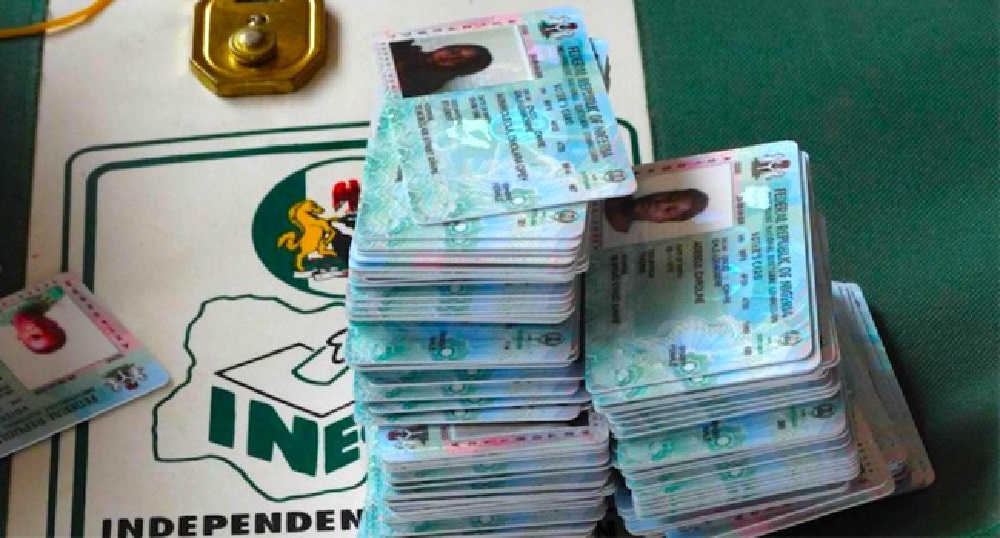
The Independent National Electoral Commission is contemplating a policy to withdraw and destroy Permanent Voter Cards that remain uncollected for a decade, The PUNCH has learnt.


This recommendation was among 208 proposals arising from the commission’s review of the 2023 general elections.
The move stemmed from the persistent issue of unclaimed PVCs, with over six million cards still uncollected as of the 2023 elections, including many issued as far back as 2015. 
Stakeholders in the post-election review recommended that INEC address the backlog of uncollected PVCs by implementing a policy to withdraw PVCs that remain uncollected for extended periods, starting with cards issued in 2015.
The rationale is that these cards are unlikely to be claimed, and their retention clogs the voter management system.
“Following the publication of the Register of Voters, the commission made available the PVCs for collection by voters on December 12, 2022. The exercise was initially planned to end on the 22nd of January 2023. However, the fact that a huge number of registered voters had yet to collect their PVCs forced the commission to extend the deadline to the 5th of February 2023 after devolving the collection to the ward level between January 6-15, 2023 to ease the process.
“The low rate of PVC collection and other related challenges are illustrative of the problem of processing and managing voters in Nigeria. To increase the rate of collection of PVCs, the commission implemented a policy that made it possible for voters to locate their PVCs online and subsequently pick them up. Several CSOs supported the commission’s drive to increase PVC collection by working with INEC’s state/FCT Offices to record all uncollected PVCs and to inform their owners where and how to collect them.
“With support from the development partners, some of the CSOs also created information centres in selected states and the FCT to assist voters locate and collect their PVCs. Despite these efforts, over six million PVCs remained uncollected, many of them dating back to 2015.
Consequently, one recommendation from the review was that the commission should consider withdrawing PVCs issued in 2015 since it is not clear if the owners will ever collect them,” INEC said.
Also, the commission proposed plans to modernise Nigeria’s electoral process, including the gradual phase-out of PVCs and the introduction of diaspora voting.
It was explained that with the adoption of the Bimodal Voter Accreditation System, PVCs may no longer be necessary for voter accreditation. Instead, voters could use computer-generated slips or credentials downloaded from the commission’s website.
“Unlike the SCR, the voters’ register is now resident in the BVAS. The new device does not read and extract voters’ details from the PVC. Moreover, the Electoral Act 2022 has made biometric accreditation (fingerprint or facial) mandatory for voting.
“The utility of the PVC is now limited to voter identification. It is therefore possible to identify voters using their registration slips which obviates the need for PVCs, the cost of producing them, the logistics for their distribution and the fact that voters without them are unable to vote, thus raising serious issues of disenfranchisement.
With the BVAS, voters can be identified using their registration slips otherwise known as the Temporary Voter’s Card and accredited biometrically without the need for a plastic PVC.
“However, such a step requires the amendment of Section 47(1) of the Electoral Act 2022 which makes the presentation of the card (PVC) to the PO at the PU mandatory before accreditation and voting,” the recommendation said.
Political parties divided
Political parties in the country hold differing opinions about INEC’s plan to destroy uncollected PVCs.
In an interview with The PUNCH, the National Legal Adviser of the Labour Party, Kehinde Edun, believed that the initiative was in order, stressing that there was a need to declutter the voters register, especially if it is confirmed that many of those registered have died.
He said, “I am sure most of those uncollected PVCs must have been as a result of irregularities in the process of registration and all that. If truly people register to vote and register as eligible electorate, they must have collected over a long period, after being given enough time.
“But I believe no system is perfect. So I think destroying them may be in order. If people have not collected over a long period, there is a likelihood those lapses were the result of some irregularities in the process of registration.”
But the Peoples Democratic Party raised a concern that destroying uncollected PVCs could be another ploy by INEC to distract Nigerians.
The PDP Deputy National Youth Leader, Timothy Osadolor, who spoke to The PUNCH, said INEC had given Nigerians enough reasons to be suspicious.
He asserted that people refused to collect the PVCs because they had lost faith in INEC to make their votes count during elections.
Osadolor said, “How do you contemplate destroying cards produced with billions of taxpayers’ money because INEC has failed the credibility and integrity test that has made millions of Nigerians lose faith in the commission’s ability to organise free, fair and credible elections?
“I urge INEC to, as a matter of immediate action, begin an image laundering and rebranding campaign to convince Nigerians and stakeholders that the commission is ready to be truly independent in spelling, actions and character.”
Also, the New Nigeria People’s Party advised INEC to reconsider the plan to destroy PVCs.
The National Publicity Secretary of the NNPP, Ladipo Johnson, said destroying over six million voter cards would amount to sheer waste of money.
He said, “If people register and haven’t come to collect over a long period of time unless they know those people have passed on, I think the cards should not be destroyed as long as they are in safekeeping.
“If you destroy about six million PVCs, and all of a sudden, some of the owners show up and want to vote, it will cost God-knows-how-much to register them again. It’s a waste of money.”
SANs back INEC
However, some Senior Advocate of Nigeria, who spoke to The PUNCH backed INEC to destroy the uncollected PVCs, asserting that there are no legal impediments.
A former Chairman of the Presidential Advisory Committee Against Corruption, Prof. Itse Sagay (SAN), said some of the uncollected PVCs were likely products of double registration.
“They (uncollected PVCs) are taking space. My suspicion is that the owners don’t exist. It is double fraudulent registration by a lot of people. Just as I am sure that we are not up to 200 million neither do I believe that we are up to 90 million registered voters when only 20 percent of that is always voting. There is a lot of fake information and fake facts in this country and I’m sure this is part of it. So, let them destroy the uncollected PVCs,” he said.
Sharing a similar view, another SAN, Sam Erugo, said, “The PVCs have been uncollected over time, so I don’t see anything wrong in them destroying them because not collecting them means something is definitely wrong with the owners. Either they are dead or they are duplication. Now, that brings the question whether eligible voters have voters card or that will will impede their right to vote or not.
That is a different question altogether but if they have uncollected voter cards, of course, they have a right to destroy them because that will help stop people from using them to rig elections. Given that they are uncollected, they are useless already and money has been wasted already.”
But Paul Obi (SAN) differed, calling for greater awareness instea of rushing to destroy the PVCs.
“What is the basis for destroying six million voters cards?” he queries. “Even if they are uncollected, they belong to Nigerians who are also supposed to use them in the next election and they spent money in producing them.
“I think greater awareness should be created for people who own those PVCs to collect them. It doesn’t make sense spending money and next time they will still have to produce PVCs for those people who own them. More awareness should be done for collection,” he said.
Credit: PUNCH