By Gloria Ikibah
ADVERTISEMENT

ADVERTISEMENT

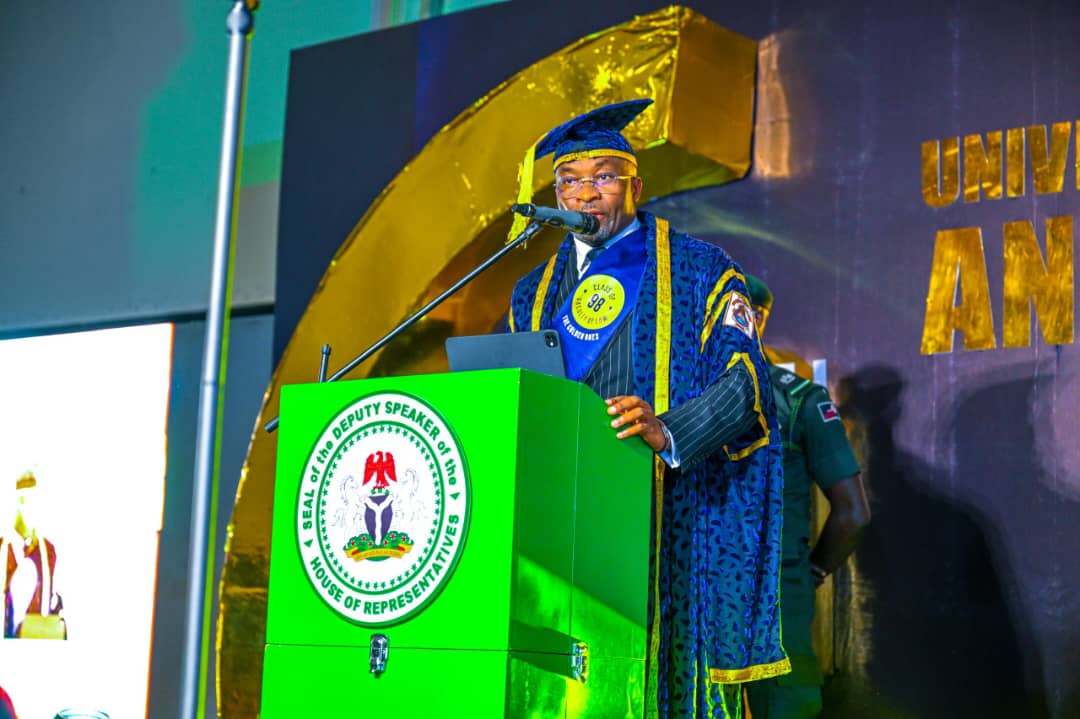
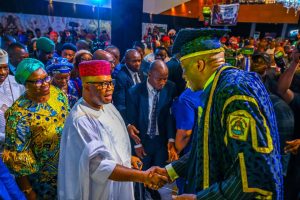
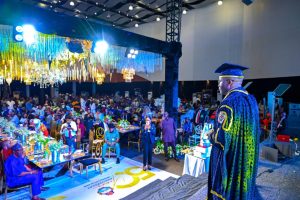
Deputy Speaker of the House of Representatives, Rep. Benjamin Kalu has called on the need for universities and institutions of higher learning in Nigeria to make a tangible impact on the citizenry.
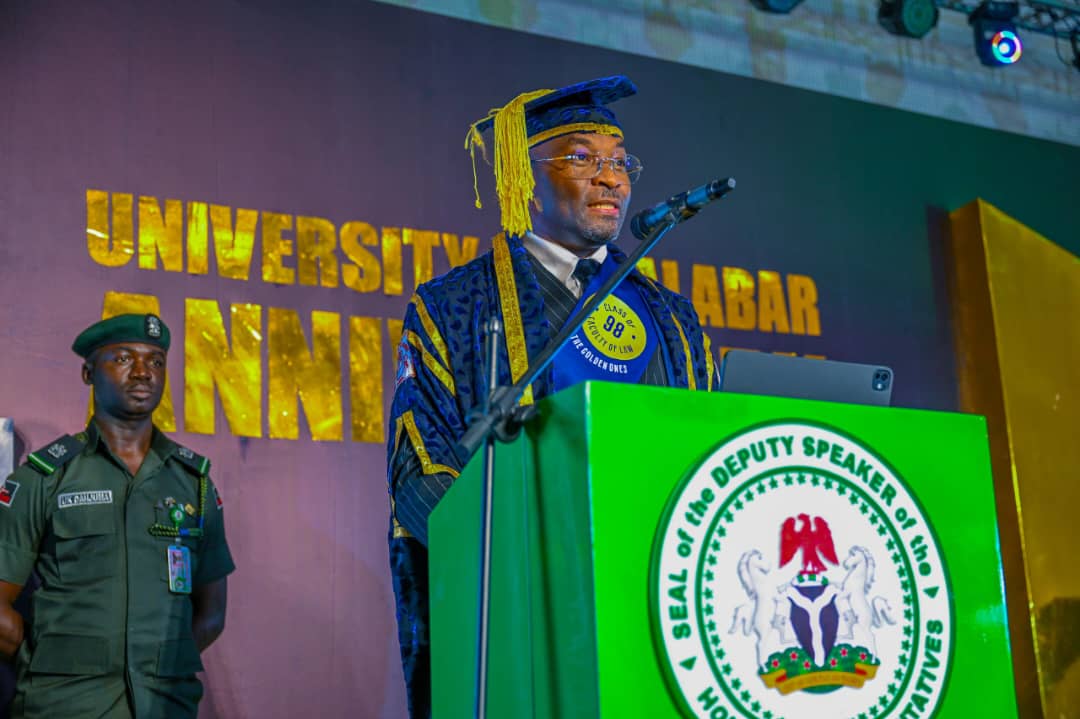
The Deputy Speaker stated this while delivering a convocation lecture titled “Our Gown in Town and in Cyberspace: Sustainable and Human-Centred Education, The Mandate of Our Universities, 2025-2075” at the University of Calabar’s 37th Convocation and 50th Anniversary ceremony in Calabar, Cross River State on Thursday.
According to him, universities were established as engines of progress, but have often failed to deliver on their core mandate of innovation and problem solving.
He noted that there is a disconnect between the academia and everyday life with problems arising not from a lack of intellect, but from a misalignment with society’s needs.
The Deputy Speaker who is of the class of ’98, faculty of law of the university noted that universities have a critical role to play in driving national progress and contributing to global knowledge.
He said: “This topic: ‘Our Gown in Town and in Cyberspace: Sustainable
and Human-Centred Education, The Mandate of Our Universities, 2025-2075′, invites us to reflect on a simple yet profound idea. Our ‘gown’ represents the academic robe. ‘Our gown in town’ is a symbol of our commitment to education that transcends the boundaries of the classroomband impacts the very fabric of our communities.
“Our universities were established as engines of progress. Today, however, we face problems highlighting a disconnect between academia and everyday life. These problems arise not from a lack of intellect but from a misalignment with society’s needs, as teaching and learning have long been measured solely by academic metrics—the length of dissertations, the complexity of theories, and the splendor of research—rather than their real-world impact.
“The challenge before us is clear: our universities must move beyond theory to practical impact, bringing the “gown” into the “town”—and now, into cyberspace—where knowledge is applied and ideas ignite change.
“If universities do not first serve their own Communities, their achievements risk remaining confined to ivory towers. Our research must offer tangible solutions, while graduates must be equipped to address real issues, from policy refinement to sustainable transportation. If the town does not feel the impact of our “gown,” our education is incomplete.
“Our universities are more than centers of learning; they are the backbone of our communities and nation. Their value lies not in certificates but in real-world impact. Institutions must go beyond academic debates, producing research that shapes policies proactively rather than reacting to crises. They should serve as policy hubs, not just locally but globally, proving that when education meets innovation, solutions follow.”
Kalu also highlighted the potential of Nigeria’s blue economy sector, emphasizing the need for universities to take the lead in building expertise tailored to the sector.
He said the sector remained largely untapped, emphasizing that it can yield $576 billion annually and create 127 million jobs by 2063 for Africa.
The Deputy Speaker also underscored the need for universities to incorporate hydrospace studies alongside town and cyberspace development, noting that universities must produce graduates who can solve real-world problems.
Kalu also said that university curricula should be updated to reflect the changing needs of society.
“Why are maritime students not modeling the economic impact of a decentralized port system? Why aren’t logistics departments partnering with fishing communities in nearby Bakassi and Oron to design cold-chain networks? If tomatoes rot in traffic jams heading to Apapa, that’s a 40% price hike in Kano markets—a problem the gown can solve with data and policy blueprints.
“As Africa’s largest economy, Nigeria stands to gain immensely from a thriving Blue Economy, but only if its universities take the lead in building expertise tailored to the sector. How many institutions currently offer specialized programs in maritime studies, oceanography, or marine engineering?
“Despite these immense opportunities, the sector remains largely untapped due to insufficient investment, inadequate infrastructure, and a lack of specialized knowledge. According to the United Nations Environment to in Programme (UNEP), Africa’s marine and coastal sector has the potential to generate over $100 billion in revenue by 2030. Additionally, projections indicate that the continent’s blue economy could yield $576 billion annually and create 127 million jobs by 2063.
“How many research centers focus on marine conservation, coastal management, or offshore renewable energy? Without a deliberate commitment to aligning education with national priorities, we risk missing out on an industry that could drive economic diversification, job creation, and food security.
“As we strive towards Agenda 2075, our education system must evolve to incorporate hydrospace studies alongside town and cyberspace development. The future is not just on land or in digital frontiers but also in the vast, blue wealth that surrounds us. Our universities must take the challenge of producing the maritime economists, manne scientists, and naval architects who will transform Nigenia into a leading force in Africa’s Blue Economy.
“The true measure of education is its impact on the town. How many
university projects directly tackle local challenges like power, healthcare,
water access, food security, or transportation? If universities do not first
serve their own communities, their achievements risk remaining confined to
ivory towers. Our research must offer tangible solutions, while graduates
must be equipped to address real issues, from policy refinement to sustainable transportation. If the town does not feel the impact of our “gown,” our education is incomplete.
“Our universities are more than centers of learning; they are the backbone
of our communities and nation. Their value lies not in certificates but in
real-world impact. Institutions must go beyond academic debates, producing research that shapes policies proactively rather than reacting to crises. They should serve as policy hubs, not just locally but globally, proving that when education meets innovation, solutions follow.
“It is time for our curricula to leap. Agriculture students must master drone mapping for pest control. Medical schools should integrate telemedicine and AI. Law faculties must adopt blockchain for land registry reforms. Engineering students must embrace robotics, and so on. When the gown mirrors the town’s needs, productivity follows. When we bridge the gap between academia and society, universities can drive national progress while contributing meaningfully to global knowledge.
“The question before us is simple: Will our universities shape the future or
merely react to it? The answer lies in our collective commitment to innovation, sustainability, and purpose-driven education. But to shape the
future, we must first understand how education itself has evolved”, he said.
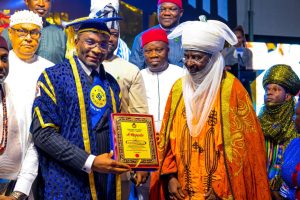
The Deputy Speaker who received a thunderous applause from his audience and former classmates better known as “The Golden Ones” for the “powerful” lecture he delivered was equally honoured by the university of calabar with an award for his contributions to education.
The event was attended by dignitaries, including the Senate President, Godswill Akpabio, many senators and members of the House of Representatives and the Chancellor of the University, Alhaji Aminu Ado Bayero.