Connect with us

News

Kenyan Catholic Church Introduces New Altar Wine After Old Brand Floods Bars

Published

on

ADVERTISEMENT
Zoom Ad
ADVERTISEMENT
Zoom Ad

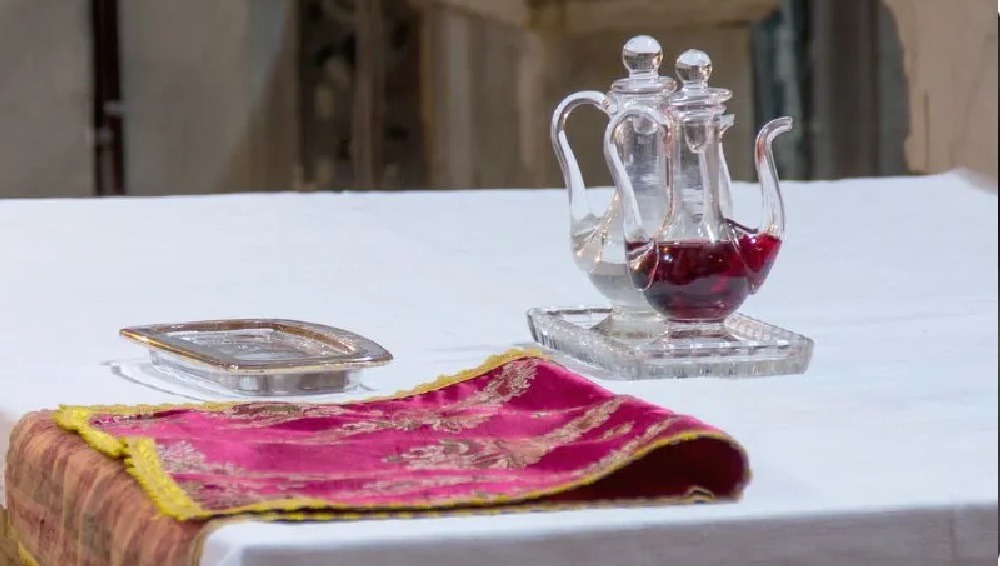
The Catholic Church in Kenya has unveiled a new brand of altar wine to be used during Holy Mass, following concerns that the previous brand had become widely available in liquor stores and bars across the country, compromising its sacred significance.


The newly introduced wine, officially labelled “Mass Wine”, bears the coat of arms of the Kenya Conference of Catholic Bishops (KCCB) and an authorized signature confirming its authenticity and exclusive use for liturgical purposes.

According to Archbishop Anthony Muheria of Nyeri, the initiative was taken to restore reverence to the Eucharistic celebration and ensure that the wine used for the sacrament remains distinct from commercial products.

“The newly approved wine is not for sale at any business outlet. It is imported and owned by the KCCB and only distributed to dioceses,” Archbishop Muheria told the BBC.
“This assures purity from source.”

Advertisement

For years, the Church had used a locally distributed altar wine that eventually became available for public sale in supermarkets, hotels, and bars. The widespread commercial distribution, according to Church authorities, blurred the line between what is sacred and what is secular.

“It has become common that, unfortunately, the former wine is readily available in secular outlets and bars,” Archbishop Muheria lamented.

To address the situation, the bishops conducted a comprehensive review of various wine options before settling on a South African vintage deemed suitable for liturgical use.

The new wine was formally introduced to thousands of worshippers during the National Prayer Day held at the Subukia National Marian Shrine in Nakuru County last Saturday.

Advertisement

Holding a bottle of the new sacramental wine, Archbishop Maurice Muhatia Makumba, chairman of the KCCB, announced that the product would henceforth be the only authorized altar wine to be used in Mass celebrations across all Catholic churches in Kenya.

“This is the only wine that will be used in Mass celebrations across the country going forward,” Archbishop Makumba declared.
“All parishes are directed to discontinue use of the old brand and strictly follow the new distribution guidelines.”

The Church emphasized that the production and composition of altar wine are governed by Canon Law, which requires that the wine used for Holy Communion be made purely from grapes and free from additives.

Archbishop Muheria explained that Catholic bishops in each country are tasked with monitoring the quality and standards of both the wine and the Eucharistic hosts used in Mass. This vigilance, he said, is reviewed periodically to ensure adherence to sacred tradition.

Advertisement

The label on the new wine carries a spiritual inscription:

“The fruit of the vine and the work of human hands will become our cup of joy,”
a reflection of the wine’s divine purpose in the liturgy.

Many members of the Catholic community have praised the decision, describing it as a much-needed step toward safeguarding the sanctity of the Eucharist.

“It is a valid step toward preserving the sacredness of the Eucharist and ensuring that only properly prepared wine is used for Mass,” one Catholic faithful told the BBC.

Advertisement

The shift also highlights growing awareness among Church leaders about the need to distinguish religious elements from commercialized imitations.

Kenya remains one of the most Christian nations in Africa, with over 80% of its 50 million citizens identifying as Christians. Of these, approximately 10 million around 20% of the total population are Catholics.

The Catholic Church plays a prominent role in Kenya’s social and spiritual life, operating schools, hospitals, and charities across the country.

In many parishes, the use of altar wine known in Swahili as divai fluctuates depending on the liturgical calendar, with demand peaking during major religious seasons such as Easter and Christmas.

Advertisement

With the introduction of the new wine, Church authorities say they hope to restore full reverence to one of Christianity’s holiest rituals the celebration of the Holy Eucharist, symbolizing the blood of Jesus Christ shed for the salvation of humanity.

Continue Reading
Advertisement

News

DAY 13 of Projects Commissioning in the FCT

Published

on

ADVERTISEMENT
Zoom Ad
ADVERTISEMENT
Zoom Ad

President Tinubu Will Commission Roads 01 and 02 Linking Mabushi Bus Terminal and Ahmadu Bello Way Today

#FCTRenewedHope
#FCTProjectsCommissioning

Continue Reading

News

BEWARE: FG warns 26 States of flood, places, Bayelsa, Delta, Lagos, Adamawa, Benue, others as critical risk areas

Published

on

ADVERTISEMENT
Zoom Ad
ADVERTISEMENT
Zoom Ad

The Federal Government has alerted residents of 26 states and the Federal Capital Territory (FCT) to the possibility of flooding between June 22 and July 5, 2026, following forecasts of heavy rainfall in different parts of the country.

The warning was issued by the Federal Ministry of Environment through the National Flood Early Warning Centre under its Erosion, Flood and Coastal Zone Management Department.

The ministry said several communities across the country have been identified as areas that could face serious flood threats during the period.

According to the forecast released on June 22, heavy rainfall is expected in many locations, raising concerns about possible flooding in vulnerable communities.

Advertisement

States placed under the critical-risk category include Abia, Adamawa, Akwa Ibom, Anambra, Bayelsa, Benue, Cross River, Delta, Ebonyi, Edo, Ekiti, Enugu, Imo, Kogi, Kwara, Lagos, Niger, Ogun, Ondo, Osun, Oyo and Rivers.

In Abia State, the affected communities include Aba, Arochukwu and Umuahia. In Adamawa, the ministry listed Jimeta and Numan, while Eket, Oron and Uyo were named in Akwa Ibom. In Anambra, Onitsha Inland Town and Awka Urban Drainage Corridors were identified as vulnerable locations.

Bayelsa communities such as Yenagoa, Brass and Nembe Town were also listed among areas that could be affected by flooding.

Other locations mentioned include Makurdi, Gboko and Katsina-Ala in Benue State; Calabar Metropolis and Creek Town in Cross River State; Asaba, Warri and Sapele in Delta State; and Abakaliki, Afikpo and Onueke in Ebonyi State.

Advertisement

The ministry also identified Benin City Urban Core and Auchi in Edo State, Ado-Ekiti and Ikere-Ekiti in Ekiti State, as well as Enugu, Nsukka and Oji River Town in Enugu State.

In Imo State, Owerri, Orlu and Okigwe were listed, while Lokoja and Ajaokuta were named in Kogi State. Communities such as Ilorin, Jebba and Pategi in Kwara State were also included in the warning.

Several parts of Lagos State were equally listed among the areas at risk.

These include Agege, Alimosho, Apapa, Badagry, Ikeja, Ikorodu, Lagos Island, Lekki and Surulere.

Advertisement

In Niger State, Bida, Minna, Mokwa, Suleja and Kontagora were identified, while Abeokuta, Ota and Sagamu were listed in Ogun State.

The flood alert further covered Akure, Owo and Okitipupa in Ondo State; Oshogbo, Ile-Ife and Ilesa in Osun State; Ibadan, Ogbomoso and Oyo in Oyo State; as well as Port Harcourt Urban Core, Bonny, Ahoada and Omoku in Rivers State.

Apart from the states under the critical-risk category, the ministry also placed parts of Adamawa, the FCT, Kebbi, Kogi, Nasarawa, Plateau and Taraba states under a high-risk category.

Communities listed in this group include Yola North, Yola South, Mubi and Gurin in Adamawa State; Abuja Municipal, Gwagwalada, Kubwa, Nyanya and Wuse in the FCT; Birnin Kebbi and Argungu in Kebbi State; Bako in Kogi State; and Keffi, Lafia, Karu and Toto in Nasarawa State.

Advertisement

The warning also covered Jos and Jos North in Plateau State, as well as Jalingo, Wukari, Takum, Serti and Karim Lamido in Taraba State.

Continue Reading

News

Finally, INEC confirms suspension of staff linked to Emeka Ike’s voter data leak

Published

on

ADVERTISEMENT
Zoom Ad
ADVERTISEMENT
Zoom Ad

Finally, the Independent National Electoral Commission, INEC, has confirmed suspended an electoral officer allegedly involved in the voter data leak concerning Nollywood actor and politician, Emeka Ike.

The Commission disclosed that investigations by security agencies and data protection regulators are still ongoing.

INEC National Commissioner and Chairman of the Information and Voter Education Committee, Mohammed Haruna, made the disclosure during a fireside chat organised by the Peering Advocacy and Advancement Centre in Africa, PAACA, in Abuja.

The suspension came against the backdrop of a controversy that arose after the voter registration details of actor and politician, Emeka Ike, surfaced online during a dispute linked to a political party primary election in the Federal Capital Territory.

Advertisement

The electoral body said preliminary findings showed there was no external breach of its ICT infrastructure or compromise of its voter register.

Rather, according to the Commission, the data was allegedly accessed using valid credentials assigned to officials involved in the ongoing CVR exercise and subsequently disclosed without authorisation.

INEC said its audit trail enabled investigators to identify the specific user account used to access the voter record, leading to the questioning of personnel with access to the system.

Advertisement
Continue Reading

Trending

Copyright © 2024 Naija Blitz News