
News
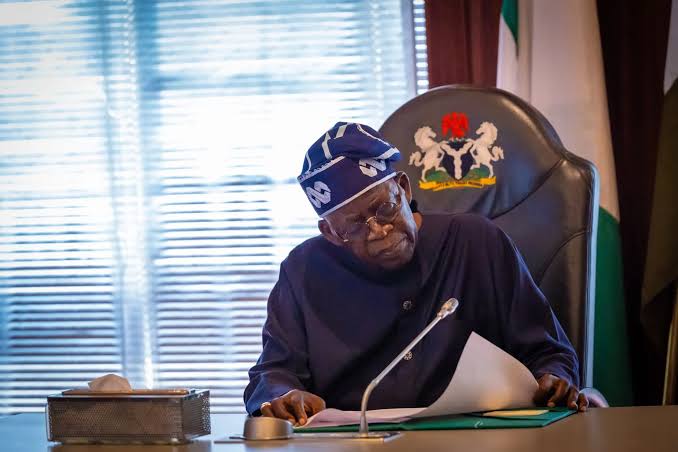
Just in: IPI blacklists IGP, two governors
- /home/naijuinz/public_html/wp-content/plugins/mvp-social-buttons/mvp-social-buttons.php on line 27
https://naijablitznews.com/wp-content/uploads/2024/06/download.jpeg&description=Just in: IPI blacklists IGP, two governors', 'pinterestShare', 'width=750,height=350'); return false;" title="Pin This Post">
- Share
- Tweet /home/naijuinz/public_html/wp-content/plugins/mvp-social-buttons/mvp-social-buttons.php on line 72
https://naijablitznews.com/wp-content/uploads/2024/06/download.jpeg&description=Just in: IPI blacklists IGP, two governors', 'pinterestShare', 'width=750,height=350'); return false;" title="Pin This Post">
The International Press Institute (IPI) Nigeria has listed the Inspector General of Police (IGP), Olukayode Egbetokun, and two governors in its Book of Infamy, while honouring the Director General of the Department of State Services (DSS), Adeola Oluwatosin Ajayi.

The Book of Infamy was unveiled by Vice President Kashim Shettima on Tuesday at the second Annual Conference of IPI Nigeria.
The two governors, who made the list of three persons to first get documented in the Book of Infamy, were those of Akwa Ibom State, Imo Eno; and Niger State, Mohammed Umar Bago.

While Egbetokun was said to have failed to heed the calls by IPI to stop the arbitrary arrests of Journalists nationwide by his operatives, Eno barred the crew of Channels TV from covering the activities of the Akwa Ibom State Government House.
For Bago, he ordered the closure of Badeggi FM, a private radio station.
Despite appeals by IPI Nigeria for reconsideration of their decisions which they had no powers to so take, both Bago and Eno refused to back down.
For the DG of the DSS, he was described as a listening head of a sensitive government agency who has listened to interventions by the IPI and corrected wrongdoings pointed out to him.
Top on the list of his quiet achievements was the removal from the government’s watchlist of the Executive Director of the International Press Centre, Lanre Arogundade, after 40 years.
In his speech, Mohammed Idris, Minister of Information, said an Independent press was central to functioning democracy.
The Minister, who was the Special Guest at the event, described a sure-footed, critical, and independent press as the central nervous system of a functioning democracy.
“But as we gather today, our first duty must be to a shared foundation of facts. We must ask: does this theme describe our present reality, or does it risk anchoring us to a sad past we are actively working to transcend?”
“If the theme suggests an active, systemic policy of repression by the current administration, then we must, with respect, interrogate it against the available evidence.
“A dialogue on freedom cannot itself be detached from fact. It is in that spirit of candour and shared purpose that I stand before you today, not to reel out a list of government achievements, but to present evidence and engage in a critical dialogue about the path we are walking together towards a more accountable and sustainable democracy.
“Let me state without any ambiguity that the administration of President Bola Ahmed Tinubu operates on the fundamental principle that a sure-footed, critical, and independent press is the central nervous system of a functioning democracy.
“It is significantly the mechanism through which a nation holds a conversation with itself. Our presence here today, under the chairmanship of His Excellency the Vice President, is a deliberate signal of our commitment to that conversation.”
The Minister said security agencies now operate under stricter protocols to respect the rights of journalists in conflict zones and during civil demonstrations.
He said the Tinubu administration has continued to guarantee the proper assurances of the enabling environment necessary for licensed media establishments to thrive and give more voices to our people without ambiguity or fear.
News
2027: We’re Focused On Taking Aso Rock – NDC Dismisses ‘Crisis’ Reports
The Nigeria Democratic Congress, NDC, has said it is focused on taking over Aso Rock in 2027.
The party made the assertion in a statement posted on its verified X handle on Friday.
The statement insisted that there is no crisis in the party as widely reported.
This is coming after the national leader of the party, Seriake Dickson, on Friday held a closed-door meeting with the presidential candidate, Peter Obi.
“There are no issues in the NDC.
We are focused on taking Aso Rock,” the statement said.
Speaking on the meeting with Obi, Dickson said they reviewed activities of party and discussed recent issues that have been a source of concern to all sides.
He said all the issues were amicably resolved.
According to him, the party’s members would continue to consult and engage with one another to address and resolve all concerns and strengthen their unity.
News
Uzodinma Releases N300 Million Support For South Africa Returnees, Imo Law Students
Imo State Governor, Hope Uzodimma, has approved the release of ₦300m to support Imo indigenes studying at the Nigerian Law School and returnees from South Africa.
Under the arrangement, 250 Imo indigenes who returned from South Africa will receive ₦1m each to support their rehabilitation and reintegration into society.
Also, 100 Imo students at the Nigerian Law School will receive ₦500,000 each to help them cope with the rising cost of living.
The state Commissioner for Information, Public Orientation and Strategy, Declan Emelumba, disclosed this in a statement issued in Owerri, the state capital.
Emelumba said the governor approved the intervention after considering the difficult circumstances faced by the beneficiaries.
According to him, the law students had appealed to the governor for support following the rising cost of living and other financial pressures affecting their studies.
“The law students made a passionate appeal to His Excellency to support them to cushion the global inflation as regards the cost of living. As a caring father, he responded promptly,” the commissioner said.
He added that the governor considered the request urgent and necessary because of the importance of supporting young Imo indigenes pursuing professional education.
The commissioner said the support for the South Africa returnees was approved out of empathy for the affected indigenes.
He explained that the governor believed the returnees, who had gone through difficult experiences, needed immediate assistance to help them settle down again.
According to Emelumba, the ₦1m support for each of the 250 returnees was approved as a reintegration fund.
He said Uzodimma was convinced that the returnees needed a helping hand from the state government to enable them to rebuild their lives and reintegrate into society with minimal hardship.
Emelumba said the gesture was in line with the shared prosperity agenda of the Uzodimma administration.
He noted that the governor remained committed to the welfare of Imo citizens, whether within or outside the state.
According to him, the administration’s focus is not limited to infrastructure but also includes social support for citizens facing hardship.
He said the governor had continued to demonstrate that every Imo citizen mattered under his administration’s development plan.
Speaking further, the commissioner said this was not the first time Uzodimma would be supporting Imo students at the Nigerian Law School.
He said many of the students were already beneficiaries of the state government’s scholarship scheme.
“Most of them are on the scholarship list of the state government, and from time to time, the governor extends a helping hand to them,” Emelumba added.
He said the latest approval was another demonstration of the governor’s commitment to education, youth development and the welfare of Imo indigenes in difficult circumstances.
News
Stone Age lost Atlantis about 8,500 years discovered beneath the waters of Denmark
By Ojomah Austin.
The mystery of Atlantis has created a city-sized gap in our grasp of history, with archaeologists searching the oceans for any trace of this submerged civilisation.
A prominent theory suggests that Atlantis never actually existed. Nevertheless, as we’re now aware, the notion of a coastal settlement being consumed by the ocean is entirely plausible.
Subsequently, archaeologists in Europe believed they’d discovered the missing piece of the puzzle. You wouldn’t necessarily expect Denmark to be the maritime location of an exotic lost metropolis from ancient times, yet this is precisely where archaeologists unearthed the most compelling proof of Atlantis, according to Global News.
“Europe’s Atlantis”, stretching back to the Stone Age, was discovered beneath the waters of Denmark’s Bay of Aarhus. Researchers unearthed numerous artefacts that paint a picture of a civilised community that inhabited the area nearly 8,500 years ago.
These included stone implements, arrowheads, animal remains, and even fragments of timber that appeared to be rudimentary tools.
Researchers plunged 26 feet beneath the surface of Denmark’s second-largest city, employing specialised suction apparatus, to retrieve the remains of Europe’s Atlantis.
The location dates back to the conclusion of the last Ice Age, when climbing sea levels submerged entire coastal communities, forcing Stone Age hunter-gatherer societies inland.
Because the artefacts have remained underwater for millennia, they are significantly better preserved than they would be inland. “What we actually tried to find out here is how life was at a coastal settlement 8,500 years ago,” archaeologist Peter Moe said.
He added: “Here, we actually have an old coastline. We have a settlement that was positioned directly at the coastline. What we actually try to find out here is how was life at a coastal settlement.
“It’s like a time capsule. When sea level rose, everything was preserved in an oxygen-free environment … time just stops. We find completely well-preserved wood. We find hazelnut. … Everything is well preserved.
“We can say very precisely when these trees died at the coastlines,” Moesgaard Museum dendrochronologist Jonas Ogdal Jensen, according to Fortune.
The specialist explained how this remarkable find has shed considerable light on how sea levels have shifted throughout history.

Stone Age lost Atlantis found is Denmark
He said: “It’s hard to answer exactly what it meant to people,” Moe Astrup said. “But it clearly had a huge impact in the long run because it completely changed the landscape.”
Researchers are keen to press ahead with investigations at a further site off the German coastline, with ambitions to examine locations in the notoriously unforgiving North Sea also in the pipeline.
Yet this is not the first occasion archaeologists have drawn comparisons between a site and Atlantis. Doggerland was a landmass that once extended between Britain, Denmark, and the Netherlands, linking the corners of Europe.
In 1931, evidence of this lost territory began to emerge after a Dutch fishing vessel retrieved artefacts from the seabed. A portrait of a hunter-gatherer community thousands of years old began to take shape. Yet, some 8,200 years ago, rising sea levels and a catastrophic tsunami ultimately swallowed this civilisation whole.
A colossal underwater landslide set off a chain of unstoppable natural disasters that plunged the landmass beneath the waves. Today, all that remains of this lost world lies buried under the North Sea.
-
News23 hours agoDemocracy Day: Senate President Akpabio Urges Unity, Resilience, Citizen Participation
-
News23 hours ago2026 World Cup: Why we lost 2-0 to Mexico – South Africa coach, Broos
-
Economy23 hours agoCardoso formally receives Central Bank of the Year Award in London
-
Economy23 hours agoCBN proposes stricter regulation of banks, affiliated companies’ business dealings
-
Economy22 hours agoNigeria exceeds OPEC quota as crude production hits 11-month high
-
News22 hours agoSenate Extends 2025 Capital Budget Implementation to September
-
News22 hours agoTroops kill ISWAP leader Khalifa, 2 commanders surrender in Borno
-
Metro22 hours agoPolice to impound vehicles without number plates in Lagos