
News
Alleged vote buying rocks ongoing Ekiti guber polls

- /home/naijuinz/public_html/wp-content/plugins/mvp-social-buttons/mvp-social-buttons.php on line 27
https://naijablitznews.com/wp-content/uploads/2025/08/vote.jpg&description=Alleged vote buying rocks ongoing Ekiti guber polls', 'pinterestShare', 'width=750,height=350'); return false;" title="Pin This Post">
- Share
- Tweet /home/naijuinz/public_html/wp-content/plugins/mvp-social-buttons/mvp-social-buttons.php on line 72
https://naijablitznews.com/wp-content/uploads/2025/08/vote.jpg&description=Alleged vote buying rocks ongoing Ekiti guber polls', 'pinterestShare', 'width=750,height=350'); return false;" title="Pin This Post">


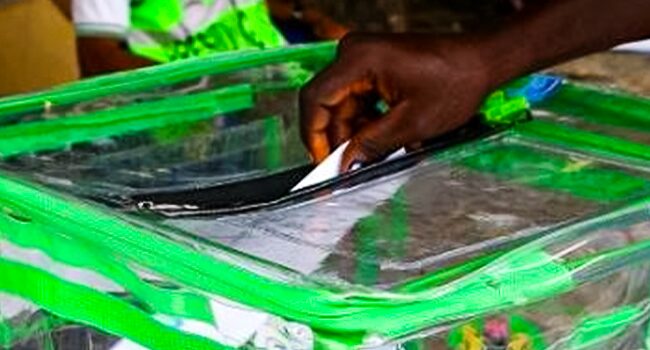
Allegations of vote buying surfaced on Saturday at a polling unit linked to Ekiti State Governor Biodun Oyebanji as residents participated in the governorship election.
The claims emerged at Polling Unit 003, located opposite the governor’s family compound in Okelele, Ikogosi, Ikogosi-Ekiti, in Ekiti West Local Government Area, where voters turned out to cast their ballots.
According to observations by The Whistler, concerns were raised after a voter, identified as Oladimeji Nafiu Abiodun, alleged that he received ₦5,000 to take part in the voting process.
Abiodun further claimed that the payment was coordinated through associates of the governor, although he did not provide evidence to support the allegation. The claim has not been independently verified, and there is no proof directly linking Governor Oyebanji or his campaign to the allegation. The development came amid heightened scrutiny of activities at the polling unit, which is situated close to the governor’s family residence. Earlier reports indicated that only the polling agent of the ruling All Progressives Congress (APC), identified as Ogundele Oluwatosin, was present to monitor proceedings during accreditation and voting.
Security operatives deployed to the area, including personnel of the Nigeria Police Force and the Nigeria Security and Civil Defence Corps (NSCDC), stated that they did not observe any incident of vote buying during their duty at the polling unit. They maintained that monitoring and enforcement of electoral offences fall under the responsibility of officials of the Independent National Electoral Commission (INEC), which oversees the conduct of elections and voter accreditation.
Officials of INEC at the polling unit reportedly declined to comment when approached regarding the allegation. The governorship election featured incumbent Governor Biodun Oyebanji of the APC, who is seeking re-election, alongside candidates from several political parties including Wole Oluyede of the Peoples Democratic Party (PDP), Professor Oyebanji Olajuyin of the Labour Party (LP), Ambassador Oluwadare Patrick Bejide of the African Democratic Congress (ADC), and other contenders from parties such as the Action Alliance (AA), Accord Party, Action Democratic Party (ADP), Allied Peoples Movement (APM), Boot
Party, New Nigeria Peoples Party (NNPP), Social Democratic Party (SDP), and Young Progressives Party (YPP)


By Gloria Ikibah
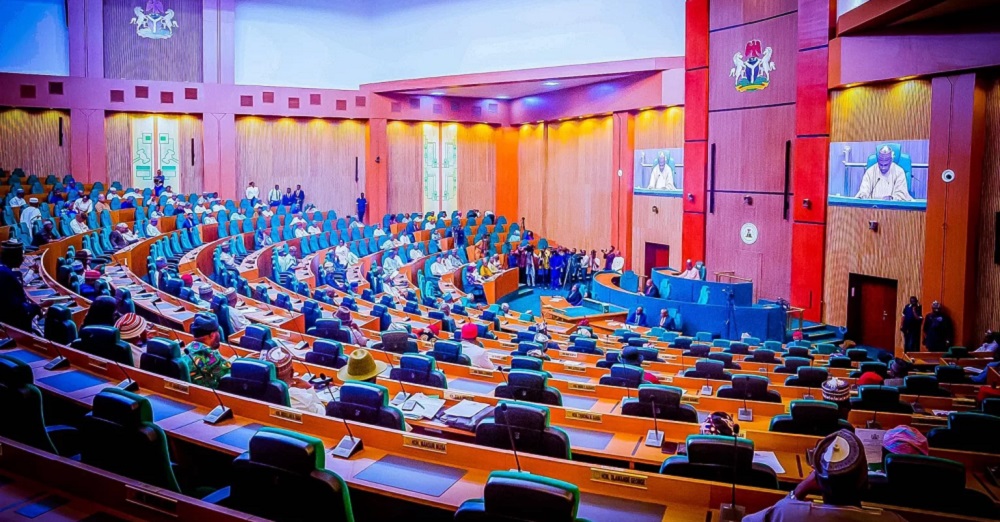
The House of Representatives has responded to recent concerns raised by its Minority Caucus over the country’s security situation, stressing that addressing Nigeria’s security challenges requires collective action, institutional commitment and practical legislative engagement rather than public commentary alone.
In a statement signed by the House Spokesman, Rep. Akintunde Rotimi on Friday, the House acknowledged growing public concern over insecurity in parts of the country, describing security as an issue of urgent national importance that demands sustained cooperation across all arms of government.
The House noted that the concerns expressed by the Minority Caucus reflect the anxieties of many Nigerians and reinforce the need for vigilance, coordinated action and continued collaboration among relevant stakeholders.
According to the statement, the National Assembly has continued to work with the Executive and security agencies to strengthen the country’s security architecture through legislation, budgetary support and oversight functions aimed at improving intelligence gathering, operational effectiveness, troop welfare and overall national preparedness.
The lawmakers also pointed to ongoing security operations across various parts of the country, noting that security agencies have recorded successes in dismantling criminal networks, rescuing kidnapped victims and restoring stability in affected communities.
While acknowledging that significant challenges remain, the House maintained that progress has been made and should be consolidated through continued support and institutional reforms.
The statement further cautioned against evaluating the country’s security situation without considering broader historical and operational realities.
“Public discourse on security must remain anchored on a balanced appreciation of context, trends, and historical developments. Nigeria has experienced both severe security setbacks and periods of improvement, and a fair assessment must recognise both realities while focusing on strengthening what works and addressing gaps”, the statement read.
Addressing the concerns raised by the Minority Caucus directly, the House emphasised that lawmakers possess constitutional tools that go beyond public criticism and should actively deploy them in tackling national challenges.
“Members of Parliament, irrespective of party affiliation, are not limited to public commentary. We are equipped with constitutionally recognised instruments: Bills, Motions, Committee Oversight, Appropriation Powers, and constituency engagement mechanisms which enable direct participation in shaping national responses and reforms”, it added.
The House also reminded members of the Minority Caucus that they remain part of the legislative arm of government and therefore share responsibility for advancing solutions to national problems.
The statement underscored the distinction between legislators and civil society groups, noting that lawmakers operate within formal decision-making structures and are therefore positioned to influence policy directly.
“In this regard, the House respectfully reminds the Minority Caucus that it remains an integral part of government within the legislative arm of the state. Parliament collectively bears responsibility for lawmaking, oversight, and appropriation, and is therefore jointly accountable for strengthening national security outcomes. The obligation to offer solutions, strengthen institutions, and support effective policy implementation is a shared one, not one divided along caucus lines.
“Unlike civil society actors whose primary tools are advocacy and public accountability, legislators operate within the formal decision-making architecture of government”, it added.
The House encouraged all members, regardless of political affiliation, to continue sponsoring bills, raising motions of urgent public importance and participating actively in committee engagements focused on security and governance reforms.
It also stressed that parliamentary interventions are most effective when concerns are accompanied by practical proposals capable of legislative consideration and implementation.
Speaking on the issue, House Leader, Rt. Hon. Julius Ihonvbere, said national security should remain above partisan politics.
He added that despite political differences, lawmakers remain united by their constitutional responsibility to Nigerians.
“Security remains a shared national responsibility that transcends political affiliation. Our duty as Parliament is not only to express concern but to ensure such concerns are translated into effective legislative and oversight actions that strengthen national security.
“The strength of the House lies in its unity of purpose, even amid differing perspectives. Majority or Minority, we are bound by the same constitutional responsibility to the Nigerian people”, Rotimi said.
The House acknowledged the continuing impact of insecurity on communities across the country, including threats to livelihoods, rural populations and other vulnerable groups, while reiterating its commitment to working with the Executive, security agencies, state governments and other stakeholders to improve security outcomes nationwide.
It maintained that overcoming the country’s security challenges would require more than rhetoric, insisting that sustainable progress depends on investment, institutional discipline, stronger inter-agency collaboration and a shared national resolve.

Tension erupted on Saturday at Unit 4, Ward 2, Ilawe-Ekiti, during the ongoing Ekiti State governorship election, as supporters of the All Progressives Congress, APC, and the African Democratic Congress, ADC, reportedly clashed over allegations of vote buying.
The confrontation, which disrupted the voting process briefly, reportedly left one ADC supporter injured, who was later rushed to a medical facility for treatment after sustaining a head injury during the altercation.
The ADC governorship candidate, Dare Bejide, who voted at the polling unit, accused political actors of attempting to compromise the electoral process through cash distribution allegedly brought into the area.
He alleged that money intended for voters was brought into the vicinity, triggering a confrontation when his supporters attempted to intervene and stop the alleged activity.
Bejide further claimed that a chieftain of the APC arrived at the scene in a Toyota Jeep, allegedly with cash meant for distribution to voters, a situation he said escalated into chaos.
According to him, the situation degenerated after efforts to intercept the alleged cash led to a heated exchange involving party supporters and security operatives.
“One of my aides was attacked by security men brought in by them, and he has been taken to the hospital,” Bejide alleged, describing the incident as a violent disruption of the voting process.
He also said the alleged presence of cash at the polling unit was brought to the attention of security authorities, adding that the matter sparked panic and disorder within the area.
Despite the unrest, Bejide commended the conduct of officials of the Independent National Electoral Commission, INEC, noting that the election had proceeded smoothly prior to the outbreak of violence.
“The electoral personnel have been very diligent, and everything was going on very well before the pandemonium started,” he said.
He added that the situation had calmed after security operatives were redeployed to the area, allowing voting activities to continue under tight security presence, though tension remained high in the polling unit.
News
Ekiti 2026: Yiaga alleges inconsistencies in ballot papers, result sheets, INEC candidates list


Yiaga Africa has alleged discrepancies between the ballot papers, result sheets, and the list of candidates published by the Independent National Electoral Commission (INEC) in the ongoing governorship elections in Ekiti State.
In a statement signed by Dr. Aisha Abdullahi, Chair, 2026 Ekiti Election Observation Mission Yiaga Africa, and Samson Itodo, Executive Director, Yiaga Africa, the duo drew attention specifically to the Form EC8A polling unit result sheets, which provided spaces for 15 political parties, as against 19 parties carried by the ballot papers in circulation.
Yiaga noted that INEC’s final list of candidates, as updated and available on the INEC website as of 18th June 2026, reflected 14 parties that fielded candidates.
“Yiaga Africa is observing the Ekiti State governorship election, and our preliminary findings raise serious concerns about the consistency of the materials INEC has deployed.
“As of 8:30 am, 96% of the observers from our 250 randomly sampled polling units were at the polling unit to observe the election.
“Yiaga Africa recognizes the context. After INEC published its initial list of 12 candidates in January 2026, subsequent court rulings (notably on the PDP’s candidacy) and late administrative changes altered party and candidate participation.
“Some of those changes do not appear to have been fully and consistently reflected across all election materials.
“Also, the public may not have fully received information about these changes.
“These inconsistencies might create confusion during voting and collation. Where result sheets include parties that are not on the ballot, presiding officers may record zero votes for parties that voters did not see.
“Conversely, where voters cast ballots for parties not reflected on the result sheet, such actions could create uncertainty in recording, reconciliation, and collation.”
To Polling Units
Yiaga Africa, therefore, called on INEC to: publicly clarify, without delay, the final list of parties and candidates, and explain any differences between the ballot papers, result sheets, and earlier announcements.
It also demanded that the Commission “Issue clear written instructions to presiding and collation officers on completing result sheets consistently with the law and relevant court judgments, including how to treat parties on the result sheet but not on the ballot and vice versa.”

Security Requires Action, Not Just Alarm, Reps Tell Minority Caucus

Ekiti: One injured as APC, ADC supporters clash over alleged vote buying

Ekiti 2026: Yiaga alleges inconsistencies in ballot papers, result sheets, INEC candidates list




-

 News11 hours ago
Again, Tinubu Extends Tenure Of Adewale Adeniyi As Comptroller General Of Customs
-
 Politics10 hours ago
Ekiti poll controversy deepens as SDP accuses INEC of frustrating opposition participation
-
 Opinion10 hours ago
Distinguished Ego, Reckless Falsehoods and Senator Oshiomole’s Journey of Self-Destruct
-

 News23 hours ago
‘You Have Not Disappointed Me’ — Tinubu Hails Wike as Abuja Transformation Gains Momentum
-

 News11 hours ago
Awujale of Ijebuland : Kingmakers Nominate Five Princes , Forward List to Ogun State Government
-
 News10 hours ago
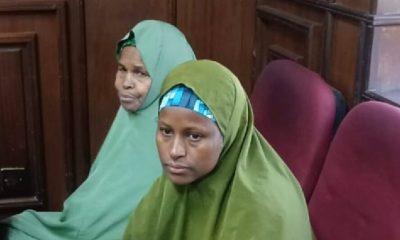
Bandit Leader’s Mother, Sister Jailed 20 Years for Aiding Terrorism
-

 News10 hours ago
Suspected ‘Repentant’ Terrorists Kill Driver, Abduct Nine Along Kaduna–Birnin Gwari Road
-

 News10 hours ago
Tinubu Orders Security Reinforcement At NIPSS