
Opinion
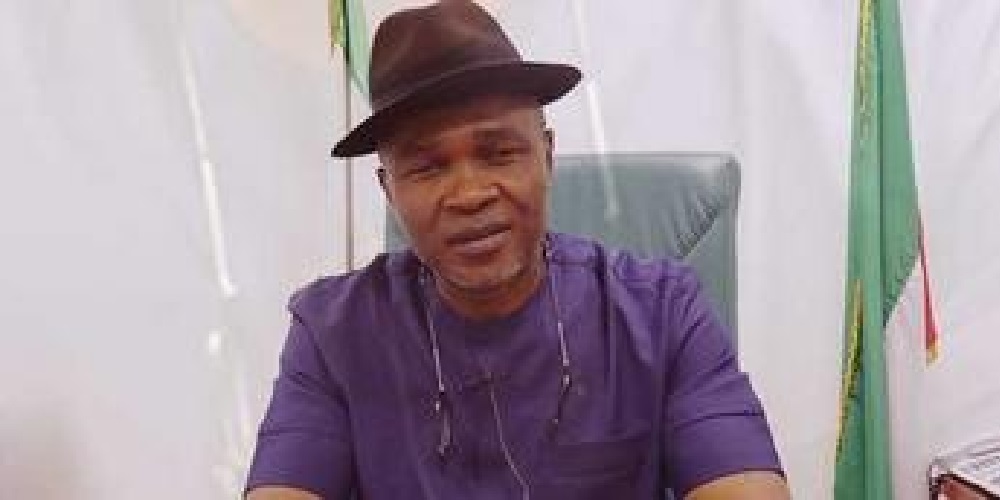
O.K CHINDA: APC’S ICE BREAKER FOR RIVERS GOVERNORSHIP ELECTIONS

- /home/naijuinz/public_html/wp-content/plugins/mvp-social-buttons/mvp-social-buttons.php on line 27
https://naijablitznews.com/wp-content/uploads/2024/06/kingsley-chinda3.jpg&description=O.K CHINDA: APC’S ICE BREAKER FOR RIVERS GOVERNORSHIP ELECTIONS', 'pinterestShare', 'width=750,height=350'); return false;" title="Pin This Post">
- Share
- Tweet /home/naijuinz/public_html/wp-content/plugins/mvp-social-buttons/mvp-social-buttons.php on line 72
https://naijablitznews.com/wp-content/uploads/2024/06/kingsley-chinda3.jpg&description=O.K CHINDA: APC’S ICE BREAKER FOR RIVERS GOVERNORSHIP ELECTIONS', 'pinterestShare', 'width=750,height=350'); return false;" title="Pin This Post">


BY BOLAJI AFOLABI
In the month of May, Nigerians witnessed increased political activities as all registered parties were in a frenzied mode to meet the guidelines of the Independent National Electoral Commission, (INEC) for next year’s general elections. Parties, members and supporters were all involved, at different levels in the quest to stay relevant post-2027. Though party primaries were to be conducted for all elective positions and offices, that of Governorship was more competitive. With over 20 states chief executives seats due for elections in February 2027, the contests towards emerging respective parties candidates were charged. Scheming, intrigues, propaganda, and brinkmanship became regular currencies. At different stages of the process – consultations, screenings, and primaries – politicians had long, tortuous nights, days of meetings and sessions to out-do and out-wit their opponents. The scenarios played out across and around the country, as, sadly, governance took the backstage.
Being the party in government, the All Progressives Congress, (APC) witnessed fierce and feisty primaries; particularly for Governorship. This was expected. Many politicians migrated to the party to enhance their electoral fortunes. However, it must be reiterated that given the peculiarities and circumstances in their states, a few others had to defect to the APC. The governorship primaries were smooth in a few states like Lagos, Borno, Enugu, Ogun, and Niger. It was muddy, dirty, and cobwebry in Bauchi, Kwara, Nassarawa, and Yobe – the last two states witnessed the entries of retired Inspector-General of Police Mohammed Adamu, and Usman Baba; an emerging trend where former military, paramilitary, and law enforcement top-guns aspire for political positions. The deluge of intrigues in some other states dragged on till the end of the primaries.
Rivers was one of those states that generated the interests of not just party members but also many people. The political velocity was further increased by the preponderance of media blitz around the primaries and any matter about the state. On a regular basis, social media was replete with stories, largely unconfirmed about the primaries. It appeared as though the handlers of these platforms were engaged in unethical competition to defeat one another in the consistent release of salacious and beer parlour tales. Sadly, many unsuspecting and gullible readers fell for their antics as they took hook, line, and sinker these reports. In many ways, the spate of fictional scenes painted as news and happenings added to the anxiety and apprehensions of party members and the generality of people about the true situation regarding the APC governorship primaries.
Weeks and days to the primaries, there were layers of uncertainty, driven by gossip and hearsay across the state. Interestingly, just as the rumour mills thrived, top players in the political chess-game knew exactly the target. They stayed focussed, with eyes on the ball and avoided distractions. On the eve of the primaries, a few hours actually, the entire tensed atmosphere evaporated and simmered down. Like lightning, ‘tory change’ using a popular street phrase. In quick succession, one after the other three aspirants announced their withdrawal from the primaries – sighting peace, unity, and the interest of Rivers. Arc. Tonye Cole; Sir Siminalayi Fubara, the incumbent Governor; and Dr. Dakorisiye George-Kelly also pledged to support the party’s candidate. So, after the state-wide affirmation process held in all the 319 Wards of the 23 LGAs in Rivers, Rep. Ogundu Kingsley Chinda emerged the unopposed governorship candidate with a total votes haul of 268,497 as declared by the Returning Officer, Rt. Hon. Laori Bitrus Kwamoti.
According to reports, Chinda’s victory elicited spontaneous celebrations. Sir Felix Obuah, an APC chieftain and Senatorial candidate declared that, “our party has presented the best candidate for the governorship election.” For Chief Maxwell Green, an entrepreneur and politician, “APC now has a formidable chance of winning the Rivers State Governorship elections.” A communications consultant, Mr. Alphonsus Opara projected that, “Rivers is most likely to be won, for the first time since 1999 by a different party other than the PDP. Chinda is an experienced, dependable and reliable administrator.” A chieftain of one of the new parties who pleaded anonymity declared that, “without any pretence, his choice is a technical knockout to other governorship candidates…it will be almost impossible to defeat him.” Comrade Alali Thompson, a youth activist described Chinda as, “fit and proper for the position considering all he has contributed to the development of the state, and the people.”
A careful analysis of Chinda’s political odysseys and public service credentials, largely confirms this optimism and confidence. His near-three decades career spanning the private sector, the executive and legislative arms of government gives a massive boost to his aspirations. Also, it will impact positively on the wheels of governance in the state; as his broad experiences will be useful. Having served Rivers in the past as Commissioner for the Environment, Chinda, if he emerged Governor by February 2027 will not be a chief executive that will be learning the ropes. Rather, he will be expected to hit the ground running from the beginning. His long years of interfacing with the bureaucracy at the state and federal levels should smoothen the pace of governance. By May 2027, he would have grossed 16 years as a ranking and resourceful lawmaker; which will be a big plus for executive and legislative collaboration and relationships in Rivers. Over the years, even as a legislator whose core responsibilities are lawmaking and oversights, Chinda has embarked on programmes and initiatives – that falls under the purview of the executive – focussed on the general well-being of the people.
Through projects spanning different sectors, Chinda has consistently contributed to the personal development of his constituents and Rivers; in some ways. Realizing that education is the bedrock of development, he has numerous programmes across the Obio-Akpor federal constituency including construction of blocks of classrooms; distribution of desks and other learning materials; sponsorship of about 200 teachers for the University of Buckingham (UoB) International Diploma in Education; Adult Education scheme; training of science teachers on the use of AI and Robotics for capacity development; and many others. Given the effects of environmental degradation on the movement of goods and services, as well as vehicular traffic, he has completed over 20 roads in the constituency, as some others are at various stages of completion. Conscious of the strategic importance of power to economic activities and human development, he, regularly provides and installs transformers – of varied capacities – to many communities in the constituency. Solar street lights are also installed to help the safety of people within and around their neighborhoods.
Mindful of the prevailing health challenges vis-a-vis the inadequate health infrastructures in his constituency, Chinda has been involved in the construction, rehabilitation, and upgrade of some primary healthcare centres. Many people; from his constituency and beyond have benefitted from regular medical outreaches, which covers eye treatment, minor surgeries, management of medical issues, and general observations. Conscious of the importance of the informal and semi-formal sectors in driving meaningful development in the grassroots, numerous capacity building initiatives are regularly organized for women and youths. This includes training in agriculture, poultry, fishing; hair dressing, interior decorations, make-up, beads making; welding and other artisanal services; as well as maritime services. Mrs. Amarachi Ifeanyi, a Woman Leader and trader averred that, “people who are not even from Obio-Akpor have benefitted from these programmes. According to what we heard, Chinda believes everyone should be considered anytime he is doing something that will improve the lives of people.” Corroborating, Alhaji Isiaka Abdulganiyu, a transporter said, “some of the non-indigenes have given different empowerment tools to help their trades. A few of our drivers were given vehicles, and the man does not discriminate against us in any of his programmes.”
Indeed, the Governorship elections which will be held in about nine months, promises to bring some interesting scenarios. From the words on the streets of Rivers, and across Wards, communities, and LGAs, the chances of Chinda becoming the fifth Governor – of the “Treasurer Base” State – in the 4th Republic are promising. Preliminary finding reveals that his public ratings, and that of the APC keeps increasing since he emerged as the party’s candidate. The confidence of the people on him is high, just as their expectations. No doubt, this itself, is a challenge – which many people believe Chinda knows, and is capable of meeting. As a chronicler of events, the writer’s focus will be on Rivers as events unfold between now and February 2027.
* BOLAJI AFOLABI, a Development Communications specialist was with the Office of Public Affairs, The Presidency, Abuja.


A modern government demands modern tools. In Nigeria’s push for efficient service delivery, integrating equipment leasing into the national procurement framework marks a shift from heavy upfront capital spending to smarter, flexible asset management.
Through a Memorandum of Understanding signed in October 2025, the Bureau of Public Procurement (BPP) and the Equipment Leasing Registration Authority (ELRA) are harmonising the Public Procurement Act 2007 and the Equipment Leasing Act 2015 to create a transparent pathway for lease transactions across Ministries, Departments, and Agencies.
For decades, procurement of high-value assets like hospital equipment, ICT infrastructure, and transport fleets strained annual budgets and delayed projects. Leasing offers a practical fix. It lets MDAs use critical equipment through predictable periodic payments, preserving budget flexibility and speeding up service delivery.
As ELRA Registrar/CEO Donald Wokoma put it, the partnership is “a new era in Nigeria’s public procurement framework, one that promotes transparency, efficiency, and fiscal prudence”. He added that the collaboration “will reduce fiscal pressure on government budgets, enhance service delivery, and improve asset management, aligning with the Renewed Hope Agenda and Nigeria’s drive toward economic diversification and sustainable growth”.
The model also fits operational reality. Technology becomes obsolete fast. Leasing allows MDAs to upgrade at the end of a cycle, with maintenance and insurance often built into agreements. That cuts administrative burden so hospitals, schools, and transport agencies can focus on core mandates instead of equipment upkeep.
BPP Director-General Dr. Adebowale Adedokun described the MoU as “timely and strategic”. He noted that “leasing offers a sustainable financing mechanism that enhances service delivery while safeguarding public resources”, and stressed that “by working with ELRA, we are ensuring that leasing transactions in the public sector are transparent and deliver real value for money”. 86dd
Enforcement is built in. Possession of an ELRA registration certificate is now mandatory for all leasing firms engaging with public institutions. BPP will not issue a Certificate of No Objection for any lease arrangement not duly registered with ELRA. This closes the gap for unregistered operators and protects public funds.
Capacity building underpins the reform. Both agencies will develop policy guidelines and standard documents, train procurement officers across MDAs, integrate ELRA’s registration system into the procurement workflow, and pilot leasing projects in health, education, transport, agriculture, and ICT.
This is more than a procurement tweak. It’s an evolution in public financial management. Leasing stretches public funds further, supports simultaneous project execution, and ensures institutions access equipment that meets modern efficiency and safety standards.
Under Dr. Adedokun’s leadership, BPP is pushing reforms that align Nigeria with global best practices. For ELRA, the partnership amplifies its mandate to regulate, promote, and develop the leasing industry.
By embedding leasing into procurement, Nigeria takes a practical step towards the Renewed Hope Agenda: a government that thinks ahead, manages resources wisely, and builds systems that deliver lasting benefit. The real win is quiet but strategic—expanding opportunity and strengthening the state’s capacity to meet citizens’ needs without breaking the budget.
■ Sufuyan Ojeifo is a journalist, publisher, and communication consultant.
Opinion
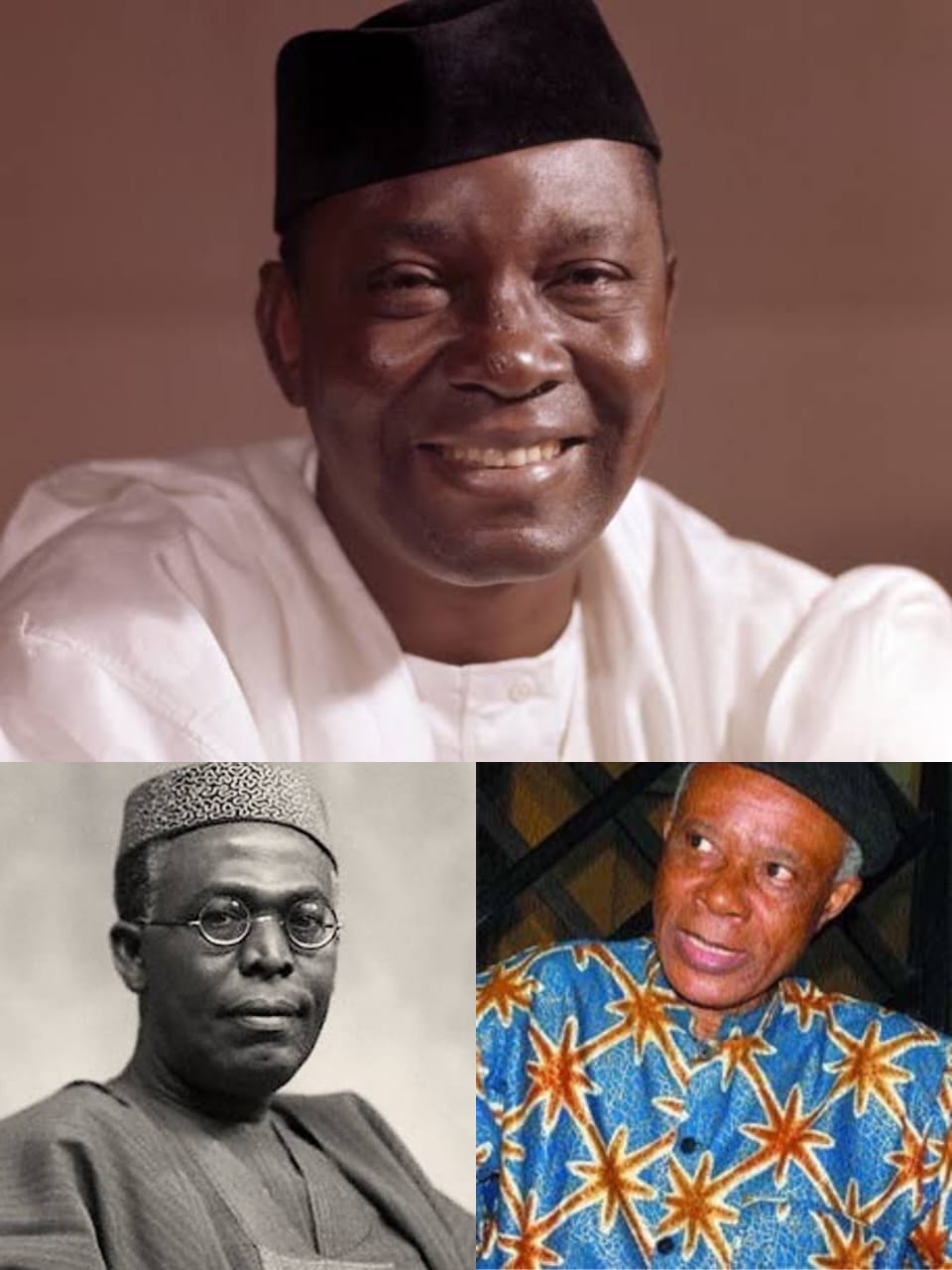
The Insecurity Triad: Azikiwe, Awolowo, and Chinweizu — Nigeria’s Elite Class of Framework Builders

The Sunday Stew Column
By Max Amuchie
Last Sunday, I indicated that this week’s edition of The Sunday Stew would pay tribute to the late political economist and public intellectual, Claude Ake. That tribute remains, but its timing has shifted. Later this year will mark the 30th anniversary of his passing — a more fitting moment to revisit the life and legacy of one of Africa’s most consequential intellectual minds. Until then, this column turns to a related but less discussed tradition in Nigerian thought: the rare lineage of framework builders who operated outside the academy yet reshaped how society understood itself.
Nigeria’s intellectual landscape faces a persistent challenge: not the total absence of indigenous frameworks, but their relative scarcity and limited institutional consolidation. Much of our analytical vocabulary still arrives pre-assembled from elsewhere — adapted to Nigerian conditions rather than born from them. We reach habitually for tools forged in other fires, calibrated for other crises, and carrying the residue of other civilisational assumptions. The consequence is not merely intellectual dependency. It is explanatory incompleteness. Borrowed frameworks, however sophisticated, can illuminate local realities, but they do not always capture the structures beneath them.
Yet Nigeria has never been entirely without its own framework builders. What it has lacked is not indigenous conceptual production itself, but its sustained institutionalisation. Alongside the academy, it has historically produced another tradition — rarer, more independent, and deeply sovereign in character.
It is a tradition built largely beyond university faculties and disciplinary boundaries. Its practitioners did not merely interpret events; they created new conceptual vocabularies. They refused inherited explanatory tools when those tools proved insufficient, choosing instead to engineer indigenous frameworks for immediate national and civilisational questions. Their objective was not institutional approval but conceptual sovereignty.
This is the elite class of Nigeria’s framework builders. And it is within this largely extra-academic lineage — one operating beyond the formal boundaries of university production and disciplinary gatekeeping — that figures such as Azikiwe, Awolowo, and Chinweizu emerge — not merely as statesmen or writers, but as framework builders. Each refused the role of interpreter. Each chose, instead, the more demanding vocation of architect.
Nnamdi Azikiwe: The Newsroom as Primary Laboratory
To understand what Azikiwe accomplished, one must resist the temptation to reduce him to his political biography — to the president, the governor-general, the nationalist icon. These are accurate descriptions, but they obscure the more foundational achievement. Before Azikiwe was any of those things, he was a theorist of communications power.
His intellectual contribution extended beyond communications infrastructure into explicit framework construction. Through Zikism in Africa and works such as Renascent Africa and Liberia in World Politics, he advanced a political philosophy centred on spiritual balance, social regeneration, mental emancipation, economic reconstruction, and political resurgence. Zikism was not merely nationalist rhetoric. It was an indigenous ideological framework — an attempt to articulate a distinctly African vocabulary for liberation, modernity, and civilisational renewal.
Azikiwe understood, with unusual clarity for his era, that newspapers were not passive instruments of reportage. They were engines of consciousness formation. Through The West African Pilot, launched in 1937, he built a mass communications infrastructure designed not merely to inform but to manufacture national awareness where none yet existed in consolidated form. The newsroom became a laboratory of political imagination.
The West African Pilot therefore functioned not only as a newspaper but as the transmission mechanism for Zikism itself — a vehicle through which ideas moved from theory into public consciousness.
This was framework building in the most consequential sense: the creation of a conceptual technology — the politically purposive newsroom — that could transform the relationship between a population and its own self-understanding.
Azikiwe drew from global traditions of activist journalism but adapted them into a distinctly West African instrument of nationalist mobilisation.
The lesson for the contemporary era is unmistakable, and uncomfortable. The modern digital newsroom has, in large measure, abandoned this mandate. Optimised for traffic, calibrated for virality, and disciplined by the imperatives of advertising revenue, it has become a largely reactive institution — faster than its predecessors, but shallower in purpose. Azikiwe’s example issues a rebuke and a challenge in equal measure: the newsroom cannot survive, in any meaningful civilisational sense, as a purely commercial machine. It must recover its older mandate as a theory laboratory — a place where original socio-political frameworks are serialised, tested, refined, and introduced into the public square. The medium has changed. The obligation has not.
Obafemi Awolowo: The Geometry of State Architecture
Where Azikiwe worked through the newsroom, Awolowo worked through the monograph. And where Azikiwe’s primary instrument was consciousness, Awolowo’s was structure.
Awolowo approached the Nigerian state with something that can only be described as geometric discipline. He did not merely criticise colonial administration or lament political dysfunction. He subjected the Nigerian project to systematic, structural examination. Through works such as Path to Nigerian Freedom (1947) and Thoughts on Nigerian Constitution (1966), he mapped constitutional arrangements, regional balances, socio-economic organisation, and the friction points embedded within the federation with a precision that distinguished him from his contemporaries. He treated governance as architecture — as a designed system with load-bearing elements, stress points, and the capacity to collapse if its internal logic was violated.
This temperament is what separates framework builders from analysts. The analyst produces interpretation. The framework builder produces a map of the system generating the events that require interpretation. Awolowo was interested not in the headline but in the structure producing the headline — and he was willing to do the painstaking intellectual labour of rendering that structure visible and legible.
The diagnosis of state fragility demands this same architectural temperament today. Nigeria’s security crisis is narrated, almost universally, at the level of events: the attack, the abduction, the reprisal, the press release, the lament.
But events are symptoms. Framework builders map systems. They move beneath the surface of occurrence to identify the structural arrangements generating those occurrences — the incentive structures, the sovereignty vacuums, the institutional failures that are not aberrations but outputs of a deeper logic.
His engagement with federal design, regional autonomy, and constitutional engineering reflected an understanding of governance not as administration alone, but as institutional geometry.
Awolowo’s method remains not only valid but urgently necessary.
Chinweizu Ibekwe: The Mandate of the Intellectual Border Guard
If Azikiwe built the communications laboratory and Awolowo built the architectural method, Chinweizu performed a different but equally indispensable function. He stood watch.
Chinweizu’s role was expressed not only through critique but through conceptual production. Among his notable interventions was Culturecide — his framework describing the systematic erosion, displacement, and destruction of indigenous cultural systems through external domination and internalised dependency. It was an attempt to name a process that conventional political language often failed to capture: the destruction of a people’s civilisational software while the institutional hardware of the state remained formally intact.
Through works such as The West and the Rest of Us (1975) and Decolonising the African Mind (1987), Chinweizu issued one of the sharpest warnings in Nigerian — and indeed African — intellectual history: the danger of mental capture. He challenged imported analytical vocabularies with a directness that was, by design, confrontational. He questioned the dependence on external civilisational lenses for interpreting African realities. He argued, with sustained rigour and deliberate provocation, that a society which cannot explain itself to itself in its own conceptual terms is a society that remains, whatever its formal independence, intellectually colonised.
His role was that of an intellectual border guard. Not merely a critic — a guardian of the threshold between conceptual sovereignty and conceptual dependency.
The challenge Chinweizu issued has not expired. It has, if anything, intensified. For every contemporary Nigerian thinker, his questions remain active and uncomfortable: Where are your own tools? What indigenous vocabulary explains your society? What framework have you built rather than borrowed? What analytical structure emerges from your own reading of your own conditions — rather than from the application of a foreign theoretical template to a local dataset?
These are not rhetorical questions. They are the standard by which any serious tradition of framework building must measure itself.
The Lineage and Its Continuation
Azikiwe built both the communications laboratory and the ideological architecture of Zikism. Awolowo built the architectural method of state design. Chinweizu defended conceptual sovereignty while naming the dangers of civilisational erosion through frameworks such as Culturecide.
Together, they constitute a tradition — dispersed across time, never formalised as a school, but coherent in its underlying conviction: that the most consequential intellectual work is the construction of original frameworks capable of explaining a society to itself.
The Insecurity Triad is offered in continuity with that tradition. It is an attempt, specific to this moment and these conditions, to construct an indigenous diagnostic framework for Nigeria’s security crisis and its relationship to state decay — one that does not merely apply existing theory but builds the conceptual architecture from the ground up, from the evidence of Nigerian and Sahelian experience, on its own terms.
The tradition is older than any single framework. What matters is that it continues — that each generation of Nigerian thinkers refuses the false comfort of borrowed explanation and accepts, instead, the more demanding obligation of original construction.
Nations are sustained not only by institutions, but by the concepts through which they understand themselves.
That obligation is not academic. It is civilisational.
A Note on This Moment
This is the twelfth edition of The Sunday Stew.
Three months ago, this column launched with a single ambition: to occupy a different intellectual space — one between journalism and scholarship, between immediate events and deeper structures, where Nigeria’s crises could be examined not only through reportage or theory, but through original reflection and framework construction. What has emerged from that ambition has exceeded the original brief.
In twelve editions, this column has produced two original analytical frameworks. The Insecurity Triad — theorising the mechanism by which armed networks sustain themselves relative to state authority through the convergence of a ransom economy, land contestation, and ideological capture — has been presented and deposited across six scholarly repositories, and has received scholarly engagement.
It has increasingly moved beyond commentary toward contribution within debates on the Nigerian state.
The Trinity of State Decay, developed as its companion diagnostic, theorises the structural condition that the Triad sustains: a decoupling into rival sovereignties, in which the state performs authority it no longer possesses while shadow orders exercise authority the state has vacated.
These are not borrowed frameworks dressed in local language. They were built here, in this column, for this crisis.
That is what this lineage — from Azikiwe to Awolowo to Chinweizu — ultimately demands: not admiration, but continuation. The Sunday Stew is, in its modest but deliberate way, an attempt to honour that demand.
Twelve editions. Two frameworks. The work continues.
Trust is Sacred. Stay Seasoned.
Dr. Max Amuchie is the CEO of Sundiata Post and architect of The Insecurity Triad and Trinity of State Decay. He writes The Sunday Stew, a weekly syndicated column on faith, character, and the forces that shape society, with a focus on Nigeria and Africa in a global context.
X — @MaxAmuchie | Email: max.a@sundiatapost.com | Tel: +234(0)8053069436
Opinion
Imo North chooses experience: Araraume’s primary election win and what it means, By Sufuyan Ojeifo


In politics, some victories are wins. Others are reaffirmations.
Senator Ifeanyi Araraume’s decisive victory in the APC senatorial primary for Imo North, winning across all 54 wards, falls in the second category. At a time when political loyalties shift quickly, the outcome sent a message beyond party mechanics: some structures aren’t built for one election cycle. They’re built over decades through relationships, consistency, and a real grassroots presence.
For his supporters, the ticket was secondary. The vote reaffirmed a political force whose relevance has survived changing governments, shifting alliances, and repeated attempts to sideline him.
In Imo politics, Araraume has become rare: a politician whose staying power doesn’t depend solely on holding office. He has remained visible and active across Imo North, not as the campaign-only candidate who vanishes after elections. His machinery endures because it was built outside electoral convenience.
That durability rests on three pillars: deep grassroots networks, institutional experience, and strategic calculation.
Those foundations first brought him national prominence when he was elected to the Senate in 1999 under the PDP and re-elected in 2003. In the Senate, he chaired the Committee on Power and Steel, served as Vice Chairman of the Niger Delta and Culture and Tourism committees, and led the Southern Senators Forum. His tenure produced tangible projects, including the transmission line from Alaoji to Okigwe and the inclusion of Imo and Abia in the Niger Delta Development Commission.
His influence extended beyond the National Assembly. As a Commissioner at the Nigerian Communications Commission, he was part of the team that oversaw Nigeria’s telecoms liberalisation. Later, as Non-Executive Chairman of the Nigerian National Petroleum Company Limited under President Muhammadu Buhari, he reinforced his standing in national policy circles.
But his core base remains the grassroots. Across Imo North, Araraume has maintained a structure that has survived multiple party configurations. While many politicians rely on incumbency, his influence has repeatedly shown it can survive outside office.
That resilience was tested in 2007. After winning the PDP governorship primary, he was excluded from the ballot. He challenged it in court and won at the Supreme Court, an outcome that cemented his reputation as a politician who doesn’t yield easily. To many supporters, he became a symbol of endurance.
He has remained a recurring force since. His 2019 governorship run under APGA again forced opponents to recalibrate. Political observers have predicted his decline for years, yet each cycle returns him to the centre of the conversation.
Rumours that he had stepped down from the senatorial race collapsed when APC party members voted. For many in Imo North, his emergence felt less like an upset than the restoration of a familiar order.
Araraume’s style aids his longevity. He’s not a flamboyant populist. His approach is measured, strategic, and focused on timing and structure. Those who mistake his composure for weakness often underestimate a veteran tactician.
Beyond Imo State, his likely return to the National Assembly is seen as a boost for experienced legislative engagement. Supporters argue his years in national politics and his network position him to play a stabilising role as Nigeria’s governance landscape evolves.
For Imo North, the calculation is simpler: they see a familiar figure with the experience and connections to attract federal attention and development to the zone. That expectation explains why his influence has endured.
In a system where relevance often fades quickly, Araraume has remained. Others rise and vanish. He stays.
With this primary election win, Imo North has signalled that experience and structure still command respect in Nigerian politics. After decades in the arena, Araraume retains the rare ability to return to the centre of relevance when many assume the story is over.
■ Sufuyan Ojeifo is a journalist and publisher.

O.K CHINDA: APC’S ICE BREAKER FOR RIVERS GOVERNORSHIP ELECTIONS

Eid-el-Kabir: Tinubu, govs, others felicitate with Muslims, preach hope

Bitter kola, salt water not Ebola cure, NCDC warns



-
 Politics21 hours ago
Just in: Atiku tops in ADC 2027 Presidential Primary, Amaechi, Hayatu-Deen trail
-
 News17 hours ago
Wave of Defections Hit APC In Northern Nigeria As Senators, Lawmakers Resigned from Party Over Primaries
-
 News19 hours ago
Marwa visits injured NDLEA officers in hospital, promises them of justice, full support(Photos)
-

 Economy17 hours ago
See Black Market Dollar To Naira Exchange Rate Today 26th May 2026
-

 News17 hours ago
Abuja residents hail Wike as “talk and do minister” during inspection (Video)
-
 News16 minutes ago
Otti approves ₦306m tech-business grant to boost job creation
-

 News15 hours ago
Top Neurosurgeon Suspended After Sleeping With Vulnerable Female Patient
-

 News52 minutes ago
Female Naval Officer Allegedly Dies during punishment Under the Sun At Lagos Navy Facility