Connect with us

News

Insurgents’ drug supplier nabbed as NDLEA intercepts 7.6 tons of illicit drugs in Borno, Nasarawa

Published

on

ADVERTISEMENT
Zoom Ad
ADVERTISEMENT
Zoom Ad

. Pregnant lady, mother of 3, three other women among 24 suspects nabbed in Anambra, FCT, Kano, Ondo, Edo, Lagos raids


A total of twenty-four (24) suspected drug traffickers and dealers including a 42-year-old man taking thousands of concealed opioid pills to insurgents’ enclave in Banki area of Borno state, a six-month-pregnant lady, a mother of three children and three other women have been arrested in major interdiction operations by operatives of the National Drug Law Enforcement Agency, NDLEA, leading to the seizure of over 7,609 kilograms of assorted illicit drugs in eight states.

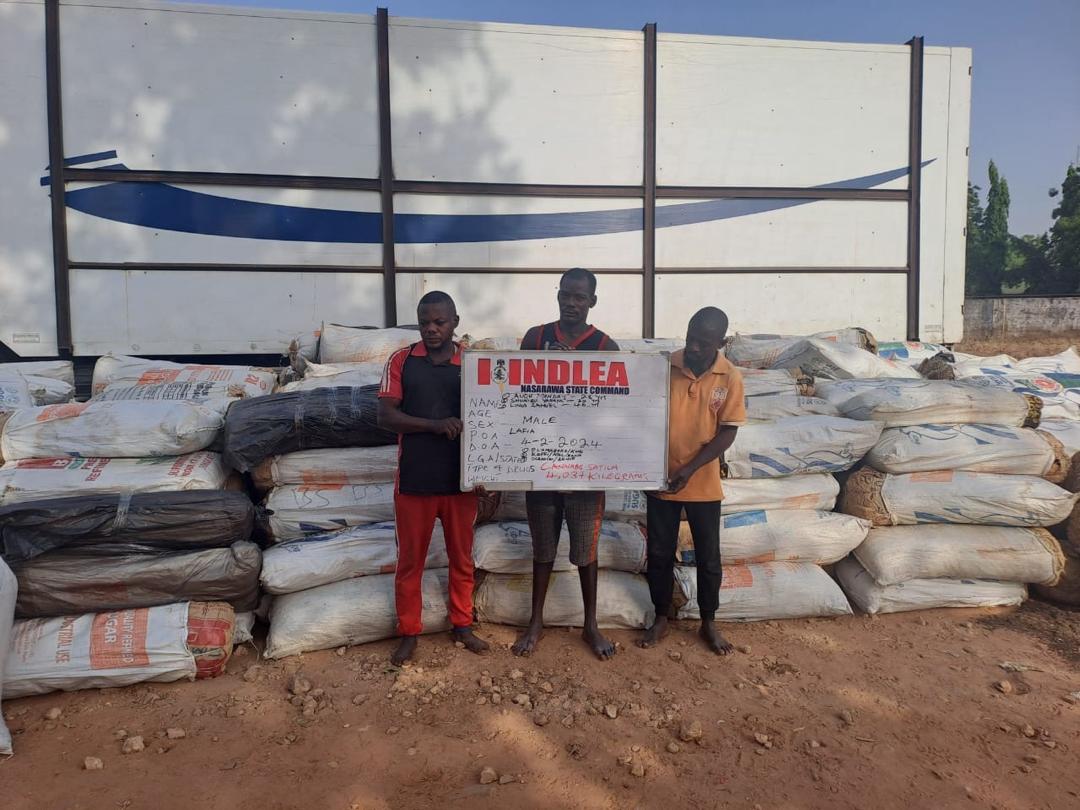
The bulk of the seizures was made in Nasarawa state where NDLEA operatives acting on credible intelligence on Sunday 4th February intercepted a truck marked Lagos JJJ 64 YC conveying 367 jumbo bags of cannabis sativa weighing 4,037 kilograms from Akure, Ondo state to be delivered at Shabu area of Lafia, the state capital. Three suspects: Shuaibu Yahaya Liman, 35; Monday Audu, 33, and Linus Samuel, 42 have been arrested in connection with the seizure.

The following day Monday 5th February, operatives in Abuja, FCT arrested the duo of Jibrin Shuaibu, 23, and Prosper Innih, 17, with 169 bags and 80 blocks of compressed cannabis sativa weighing 1,961.5kgs concealed in a truck with registration number Ogun WDE 557 XC. The truck was intercepted during a stop and search operation along Abaji – Abuja highway on their way from Uzeba to Dei-Dei, FCT.

Advertisement

In another operation by NDLEA operatives in Abuja on Tuesday 6th February, a suspect, Abdulhameed Dauda, 27, was arrested with 89kgs of the same psychoactive substance loaded into his truck in Owo, Ondo state to be delivered at Gwagwalada in FCT. On the same day, operatives also intercepted another driver, Hassan Ade, 30, transporting 696.5kgs of the same substance loaded in Idoani, Ondo state to be delivered at Gwagwalada and Dei-Dei in FCT. A follow up operation led to the arrest of a mother of three children, Mrs. Joy Chukwuka, 42, linked with the consignment.

In Ondo state, apart from the seizure of 633.5kgs of cannabis at Eleyere, Ogbese in Akure North LGA, NDLEA operatives also recovered 59 jumbo bags of same substance loaded in a truck marked GAD 287 XA heading to Northern part of the country. Detergents were sprayed on the cannabis bags ostensibly to suppress the odour of the psychoactive weed, while 192 packs of table water were loaded on top to conceal the illicit consignment.

Not less than 187kgs of same substance were seized by operatives at Sapele road, Benin, Edo state while in Kano, NDLEA officers on Monday 5th February arrested 58-year-old Bashir Attahir in Bachirawa area of the state with 216,000 pills of tramadol 250mg. Another suspect, Ejike Moses Nmenme, 47, was nabbed the following day Tuesday 6th Feb with 25,190 capsules of tramadol and different quantities of rohypnol and codeine syrup along Emir road, Sabon Gari area of the city while the duo of Yusuf Abdullahi Musa, 35, and Yusuf Musa, 28, were nabbed at Gadar Tamburawa, with 1,000 ampoules of tramadol injection on
Thursday 8th February.

In Borno state, a 42-year-old suspected supplier of illicit drugs to insurgents in Banki, a border region between Nigeria and Cameroon, Ahmad Mohammed was arrested by NDLEA operatives on Friday 9th February at Bama check point. When his luggage was searched 20,000 capsules of tramadol were recovered from him while on his way to deliver the opioid consignment in the border town.

Advertisement

A six-month pregnant woman, Amarachi Akaolisa, 25, and another lady, Ifeoma Iheanyi, 21, were among six suspects arrested for dealing in illicit substances in Oraifite and Umuni-Evili, Aguleri, Anambra state. Others nabbed include: Okwuchukwu Chukwuka; Onyedika Ngwu; Ekene Hyginus and Nzomiwu Ikechukwu. Recovered from them were over 6 kilograms of cannabis, tramadol, diazepam and codeine syrup in raids conducted NDLEA operatives between Tuesday 6th and Thursday 8th Feb in parts of the state.

In Lagos, two ladies: Boluwatife Adebayo and Omolade Fola Adebayo were among suspects arrested during raids in parts of the state on Saturday 10th February. While Ogah Sunday Adole and Boluwatife Adebayo were arrested at Agidingbi, Ikeja, in connection with 220grams of cannabis, 10.6 litres of codeine syrup, and other psychotropic substances,
Omolade Fola Adebayo was nabbed at Ijesha with various quantities of cannabis, codeine syrup, rohypnol and molly.

The Commands across the country balanced their drug supply reduction operations with War Against Drug Abuse, WADA, advocacy campaigns to schools, markets, worship centres and communities. Some of these include: WADA sensitisation lecture on Drug Use and Mental Health for students and staff of Oba Akinbiyi High School, Mokola, Ibadan, Oyo state; Owode Senior Secondary School, Owode Yewa, Ogun state; Federal Science and Technical College, Awka, Anambra state; Yusad Secondary School, Gashua, Yobe state; and African Church Grammar School, Ilesa, Osun state as well as WADA advocacy visit to
HRM Ochi’Idoma, Agaba Idu, Dr. Elaigwu Odogbo Obagaji John at his palace in Otukpo, Benue state and the Emir of Rano, HRH Amb. Muhammed Kabiru Inuwa in Kano state.
While commending the efforts of the Nasarawa, FCT, Ondo, Kano, Borno, Edo, Anambra and Lagos Commands of the Agency for jobs well done in the past week, Chairman/Chief Executive Officer of NDLEA, Brig. Gen. Mohamed Buba Marwa (Retd) urged them and their compatriots across the country to always strive to surpass past feats in their drug supply and drug demand reduction efforts.
Advertisement
Continue Reading
Advertisement

News

Reforms Drive Maritime Turnaround as Nigeria Eyes Blue Economy Leadership

Published

on

ADVERTISEMENT
Zoom Ad
ADVERTISEMENT
Zoom Ad

…as NPA boss links sector gains to policy changes

…says country is poised to lead Africa’s marine economy

By Gloria Ikibah

Nigeria’s maritime sector is gaining fresh momentum, with reforms and policy direction credited for a steady transformation that is now attracting investor confidence.

The Managing Director of the Nigerian Ports Authority, Abubakar Dantsoho, pointed to recent government interventions and the leadership of the Ministry of Marine and Blue Economy, Gboyega Oyetola as key factors behind the sector’s renewed progress.

Speaking at the Blue Economy Investment Summit in Abuja, Dantsoho projected strong prospects for the country, arguing that Nigeria is well positioned to take a leading role in Africa’s emerging blue economy.

He highlighted ongoing reforms, coupled with growing private sector involvement, as major drivers reshaping the maritime space and opening up new investment opportunities.

According to him, the nation’s port system remains central to unlocking economic potential, serving as a gateway for trade expansion and broader growth.

He also emphasised the need for a strategic shift in focus, urging greater commitment to developing marine resources in line with global sustainability trends.

With its geographic advantage, population size and economic weight, Nigeria, he noted, has the potential to evolve into a major maritime hub in West Africa, on par with some of the world’s leading port economies.

He said: “The time has come for a paradigm shift in the structure of Nigeria’s economy towards the full utilisation of our marine resources. Our port system, if properly harnessed, can serve as a major driver of economic growth.

“By virtue of our strategic location, market size and economic strength, Nigeria is well-positioned to function as the maritime hub for West Africa“.

Despite these advantages, Dantsoho expressed concern that Nigeria currently handles only about 25 per cent of cargo traffic in the region, even though it accounts for over 60 per cent of West Africa’s GDP.

“It is worrisome that Nigeria, despite controlling over 60 per cent of West Africa’s GDP, handles only about 25 per cent of the region’s cargo traffic. This clearly shows that we have not fully optimised our potential,” he said.

The NPA Boss assured investors that the sector is beginning to shift in a positive direction, driven by sweeping reforms being rolled out by the Federal Ministry of Marine and Blue Economy to reposition the industry.

He pointed to a range of key initiatives already underway, including efforts to modernise port infrastructure, introduce a unified trade window, establish a port community system, expand deep seaport development and fully digitise port operations.

“We are implementing key strategic initiatives such as port modernisation, trade single window, port community system, deep seaport development and full digitalisation to reposition our ports for global competitiveness,” he stated.

Dantsoho stressed that private sector funding remains central to achieving these goals, noting that the NPA is actively encouraging project financing to bridge infrastructure gaps and improve efficiency.

“We are open to private sector participation through project financing. This approach is already improving efficiency and providing access to funding for critical infrastructure,” he said.

He added that the reforms are designed to enhance port efficiency, improve connectivity, reduce freight costs and boost non-oil exports, ultimately driving revenue growth.

“The ultimate goal is to improve liner connectivity, attract bigger vessels, reduce freight costs, and expand our export base, which will significantly boost revenue generation,” he noted.

Dantsoho stressed that competitiveness in the global maritime industry requires efficient operations, competitive pricing and strong hinterland connectivity, adding that Nigerian ports must remain adaptive to evolving global shipping trends.

“With sustained commitment to these initiatives, Nigeria’s port system will enter a new phase and emerge as a leading maritime logistics hub in Africa,” he assured.

Also speaking, the Minister of Marine and Blue Economy, said Nigeria’s natural endowments, including its 823-kilometre coastline and extensive inland waterways, place it in a strong position to lead the sector.

“With over 823 kilometres of coastline, extensive inland waterways and a prime location along the Gulf of Guinea, Nigeria is uniquely positioned to harness the immense potential of the marine and blue economy,” Oyetola said.

He added that reforms by the federal government have improved coordination, strengthened maritime security and boosted investor confidence, noting that the sector accounts for over 90 per cent of Nigeria’s international trade by volume.

Continue Reading

News

NASS, Executive Close Ranks to Fix Budget Gaps and Drive Development

Published

on

ADVERTISEMENT
Zoom Ad
ADVERTISEMENT
Zoom Ad

..Bagudu insists planning is a shared constitutional duty

…as lawmakers pledge closer alignment with presidency

By Gloria Ikibah

The National Assembly and the Executive have signalled a renewed push for cooperation, pledging to bridge persistent gaps between Nigeria’s budgeting process and its national development plans.

The commitment was outlined during the second day of the National Policy Dialogue in Abuja, where key government figures emphasised the need for stronger coordination to ensure that policy goals translate into measurable development outcomes.

Minister of Budget and Economic Planning, Senator Atiku Bagudu, alongside lawmakers leading committees on national planning, underscored the urgency of aligning budget implementation with long-term national objectives.

The dialogue, themed around strengthening the link between development planning and effective budgeting, brought together top policymakers in a bid to address long-standing disconnects in the system.

Participants stressed that meaningful progress depends on seamless collaboration between the legislature and the executive, particularly in ensuring that approved budgets reflect and support broader economic strategies.

Bagudu highlighted the role of the National Assembly in driving reforms, noting that legislative backing has been critical to the administration’s efforts so far. He stressed the shared responsibility of leadership in shaping the country’s development trajectory, stating, “Planning is a constitutional responsibility for all those in authority.”

Lawmakers also restated their readiness to work closely with the presidency, signalling that the current Assembly is prepared to strengthen cooperation in order to deliver sustainable growth.

The renewed alignment is seen as a step towards addressing inefficiencies in the system and ensuring that national development plans are effectively implemented through a more responsive and coordinated budgeting framework.

The Minister however stated that planning is a constitutional responsibility of every person in authority in Nigeria which must not toyed with if the country is to make a meaningful development.

He said, “Let me appreciate the support that the committees and also the National Assembly as a body has given to the reforms that have taken place in the last three years, because by every stretch of imagination, they are bold, they are courageous, they are difficult choices and as those whose daily function involves interaction with these constituencies and having to explain, having to defend, one has to appreciate.

“National planning in Nigeria is mandated and obligated by the constitution. The further ingredients of the national plan is a whole chapter in our constitution, chapter two of our constitution, fundamental objectives and directive principles of state. It clearly stated that Nigeria is a constitutional federation.

“Section 13, which is the first section of another fundamental objectives and directive principles of state, is a command to all those in authority to work together, observe, and seek to conform to the fundamental objectives or directive principles of state.

“The constitution clearly stated that all those in authority, including legislative, judicial, and executive, have to work together. Equally, the president, vice president, national assembly members, the governance, state assembly members, the office they swore to, the wordings are dictated by the constitution.

“And the wordings include expressly, not just upholding the constitution, but the seven elements of the wardens are to uphold and seek the achievement of governance of the fundamental objectives and directive principles of state. So one can see in those elements that the obligation to work for the achievement of the irreducible minimum of consensus, which is the fundamental objectives, is sanctioned by the constitution. And so what we are doing in national planning which leads to effective budgeting in order to generate sustainable growth is in tandem with our constitution”.

The minister also pointed out that, as a market-driven economy, Nigeria’s Constitution sets out clear economic, social and governance priorities that the country is expected to pursue. These include security, environmental sustainability, education and broader social objectives, alongside the responsibilities of citizens.

He emphasised that the federal structure of the country makes it essential for all tiers of government to work in close coordination.

Providing an overview of the discussions, Chairman of the House of Representatives Committee on National Planning and Economic Development, Rep. Gboyega Isiaka, highlighted the shared responsibility across government and stakeholders in addressing persistent gaps in budgeting and national planning.

He noted that the current National Assembly remains committed to working closely with the presidency and the executive arm, signalling readiness for sustained collaboration aimed at improving policy outcomes and driving national development.

He said, “Therefore, the committees follow the same pattern. The Senate and the House Committee on Economic Planning have been following, and some of the ministers have said, the beautiful work being done by the ministry, the coordination and all of that. We feel that we need to collaborate more beyond oversighting and working sessions.

“We are aware, for example, that following the… the fact that the 2026-2030 plan is still taking itself from the prospective plan, the 30-year prospective plan, we know that a lot of work will need to be going into this. I want to be practical in putting that together. We are also aware of the $1 trillion objective economy that the federal government is working on.

“We have had sessions with various MDAs, and we are aware of some of the questions that have been raised about the envelope system of projects. The various reforms that we have going on in the nation, physical regime, monetary regime, and all of that, we are aware of also a number of questions that have been raised about that.

“And in all of this, therefore, we feel that beyond asking questions during oversight, we feel that all of these, and more, that I don’t want to assume begin to go into, is enough for us to bring, to come together, and, you know, the renewable, you know, plan for 2026-2030 is also being put together, and we also want to, you know, be practical in that, so that we can start all from the beginning”.

Also Chairman, Senate Committee on National Planning and Economic Affairs, Senator Musa Mustapha said, it is imperative to address the fundamental pillar of national progress which is to align National Development Plans with the budgeting system to drive sustainable economic growth.

“Our National Development Plan requires meticulous, aligned, and disciplined budgetary support to achieve its set objectives. However, the persistent disconnect between ambitious development plans and actual annual budgetary allocations has historically hindered our growth trajectory.

“As Chairman of the Senate Committee on National Planning and Economie Affairs, I maintain that our developmental aspirations cannot be achieved through disjointed fiscal actions. We must stop treating the budget as merely a document for expenses, but rather as the primary engine for implementing our national development agenda.

“An efficient budget is often regarded as the cornerstone of comprehensive national progress. It allows the government to allocate resources wisely, prioritise development initiatives, and boost economic activity.

“Too often, however, our national planning and budgeting have operated in isolation, leading to inefficient resource distribution and projects that fail to fully benefit Nigerians. We aim to address this gap. Indeed, the goal of this administration is to foster a performance-driven culture in which public resources are used efficiently to support meaningful, sustainable development.

“Our planning process is no longer driven by short-term political expediency but by a clear, strategic roadmap towards a $1 trillion economy by 2030—anchored in grassroots empowerment initiatives such as the Renewed Hope Ward Development Programme and targeted support for our MSMEs.

“This presidential vision is fully reflected in our 2026 Budget of Consolidation, Renewed Resilience and Shared Prosperity, which is grounded in realism, prudence, and strict fiscal discipline. By removing wasteful subsidies, unifying the foreign exchange market, and expanding our non-oi!l revenue base through fair and efficient tax administration, President Tinubu’s reforms have secured a seven-year high in our external reserves and unlocked substantial capital to fund the nation’s real priorities.

“Today, under his guidance, we are spending with purpose—investing trillions in critical infrastructure, food security, student loans, and the modernisation of our security architecture. This is not a budget of mere promises but a powerful statement of national intent. The transformative policies of President Bola Ahmed Tinubu are yielding measurable results, ensuring that the economic recovery already engineered translates directly into a better quality of life for every Nigerian household.

“It is heartening to note that the President is already leading from the front. Under the visionary leadership of His Excellency, President Bola Ahmed Tinubu, our national journey over the past few years has been defined by bold, necessary, and sometimes painful choices that are now yielding visible, undeniable results across the federation. Guided by the Renewed Hope Agenda, Mr President has courageously confronted long-standing structural weaknesses, stabilised our economy, rebuilt investor confidence, and laid a durable foundation for an inclusive and dynamic Nigeria”, he said.

Continue Reading

News

Breaking; Ex-VP Atiku finally vows not to contest after 2027

Published

on

ADVERTISEMENT
Zoom Ad
ADVERTISEMENT
Zoom Ad

…says it’s his last outing

Vice President Atiku Abubakar has said the 2027 presidential election will be his last outing.

Atiku, who has been contesting for presidency since 1992 disclosed this during an interview on Arise Television’s Prime Time on Wednesday.

The 2027 election will be my last outing”, he said.

Asked why should Nigerians vote for after so many attempts, considering his age, the ex-Vice President said Nigeria is has leadership problem, adding that he represents the past and the future of Nigeria.

Atiku also recommended leadership training for young Nigerians, adding that the country needs it.

Details shortly…

Continue Reading

Trending

Copyright © 2024 Naija Blitz News