News
‘How rot in LUTH led to US-based Nigerian’s de£th
In this article, the Editor-in-Chief and Chief Executive Officer of The Source magazine, Comfort Obi, recounts how Nigeria’s ailing, chaotic health system, typified by the rot in the Lagos University Teaching Hospital, Idi-Araba, Lagos, led to the death of a United States-based Nigerian, Mr Olaleye Adenibuyan

Nigeria lost a patriotic citizen On January 24, 2024. It lost Mr Olaleye Adenibuyan, who died in circumstances that, at once, confounded, broke the heart, and put a big question mark on Nigeria’s healthcare system.
To not a few people, Adenibuyan’s death was avoidable if only the hospital where he died lived up to its assumed status of a teaching hospital.

Let me confess upfront so you don’t accuse me of being deliberately emotional.
Adenibuyan was my cousin-in-law. A fine gentleman, he was married to my cousin, Thelma. And we admired and loved both of them “die”, as young people would put it. Theirs was a relationship built on a solid foundation; a partnership rooted in time. They loved wearing uniforms and pranced around like teenagers who just fell in love.
Adenibuyan had served his country, Nigeria, as a police officer before he relocated to the United States of America in 1989. But that relocation never stopped him from visiting his beloved country, his beloved Ondo State, and his more beloved community, Owo, two times every year. For him, it was a ritual. His love for Nigeria was that strong. And each time he visited, he bought more local fabrics for uniforms for himself and his beloved wife Thelma. In their local fabrics, they promoted Nigeria’s culture, and fashion.
So, this year, 2024, as usual, he set out from his Dallas, Texas, USA base for Nigeria and arrived Lagos on January 14, 2024. Each time he and his wife came home, either together, or separately, they usually checked into a hotel at Ajao Estate. The Estate is close to the Lagos Airport. For the Adenibuyans, it was convenient as it saved them from the punishing Lagos traffic (we call it go slow) to the airport for a flight to Akure, Ondo State, en route Owo.
So, on January 14, Mr Adenibuyan arrived Lagos and checked into the usual hotel. Luggage did not arrive from the US and so, he needed to buy some things from a shop opposite the hotel. That done, as he climbed up the staircase back to his room, the devil stepped in. Tragedy struck. He missed a step. And fell backwards.
As he fell, the family was told, he hit his head on the floor or wherever. The impact was grave. He lost consciousness. And was quickly rushed to a nearby hospital. I cannot confirm what attention he got there. His state was beyond what a small private hospital could handle. So he was quickly referred to the University of Lagos Teaching Hospital, LUTH.
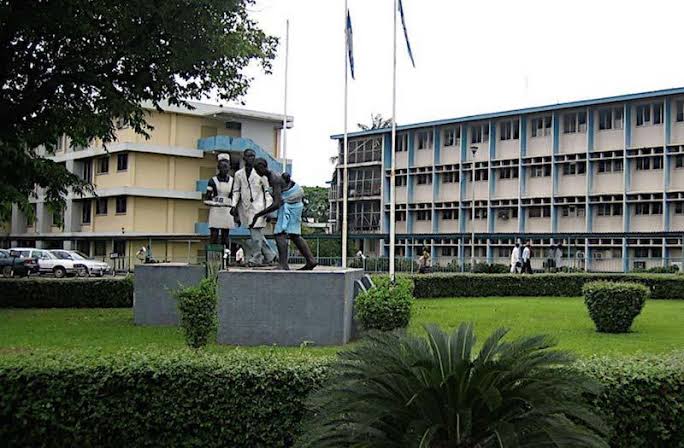
Established in 1961, LUTH is a tertiary hospital affiliated with the University of Lagos College of Medicine. It is a 761-bed hospital established to be a centre of medical excellence. To its credit are some of Nigeria’s best brains in medicine. Many of its products are those “making waves” worldwide. They were trained there. It used to be Nigeria’s pride. As were the University College Hospital, UCH, affiliated with the University of Ibadan, and the Obafemi Awolowo University Teaching Hospital, OAUTH, affiliated with the Obafemi Awolowo University, former University of Ife. And some more.
I don’t know about others, but LUTH has lost its status as a centre of medical excellence. It is now a shadow of itself; a shame to Nigeria. It has deteriorated. With Adenibuyan admitted there, we experienced, firsthand, the shadow LUTH has become. And our hearts broke.
The injury Adenibuyan sustained to the head needed urgent attention. It was a medical emergency. So, he was admitted to the intensive care unit – private wing, no less. Meaning the attention was expected to be top-notch. When one pays millions of naira, even as the naira has lost its value, the least one would expect would be first-class attention. But not here. There was nothing special. Patients were kept in what I choose to call “an open mini ward”. No privacy. No screen. When the question of some privacy was raised, the answer was: “It is because there is no general monitor.”
Once Thelma heard of her husband’s situation, she began to make arrangements to come home. She works in one of the biggest and best government-owned hospitals in Texas where she has risen to the position of director. So, once she was briefed on the prognosis, she knew she had to rush back to Nigeria. Her mission was to take her husband back with her to the USA once he was stable enough to fly.
Meanwhile, from the US, before she was able to secure a seat on a plane, she and the family rallied around to pay every kobo required, every kobo, directly and indirectly, demanded, officially or unofficially. No expense was spared.
But what did the family see at LUTH?
LUTH had no equipment. Nothing. After the millions of naira deposited, one still had to pay, separately, for soap and gloves. For a scan to determine the extent of damage to the head, Adenibuyan was taken to a private facility outside LUTH. Why? LUTH said its own scan machine was not in “a working condition.” A teaching hospital? The scan showed a lot of blood in the skull. Nothing was done. A couple of days later, LUTH declared triumphantly that the “bleeding has stopped”. The question we, as laymen, asked was: What about the blood already accumulated there? Our elementary understanding was that the blood “has caked there!” If true, we were nervous about the implication.
More surprises were afoot.
On January 17, three days after he was admitted, LUTH said Adenibuyan needed an intracranial pressure monitoring machine. But this teaching hospital does not have the machine. When needed, it was explained to us, it is rented from outside. Cost: N400,000. The family paid. But the machine was not delivered until January 19th. And when it was delivered, it was left by the corner of Adenibuyan’s bed for days, unused.
Perhaps, it was a coincidence, but the ICP monitoring machine was used only on the day Thelma arrived (24th) and began to ask questions. This was 10 days after he was referred to LUTH, and perhaps, 10 days after it should have been used.
Thelma arrived Nigeria at about 9.40 am on Delta Airlines and went from the airport to LUTH to see her husband. She waited for about three hours before she was allowed after which she incessantly requested to speak with his medical team. She wanted to know why the ICP had not been put in place as was revealed to her by Lekan, her stepson, who was in Nigeria for a short vacation, and her husband’s younger brother, Deji. She wondered why the machine was just lying down there. When one of the doctors finally arrived, he tried to explain. But given Thelma’s background, and where she came from, the explanation made no sense to her. She hinted so in many ways, but was, at once very disciplined and too distraught to argue. But finally, she was told another doctor who would do that was being expected.
The doctor, an unassuming guy, competent, calm, and collected finally arrived. We were sitting in the ICU waiting room when he walked past. Instinctively, and I guess, from his carriage, I knew he was the one, and I told Thelma so. She sent a message across that she would want to speak with him. Over an hour later, the doctor came out from the ICU and asked for Thelma. We followed him. And Thelma had a lot of questions and complaints. He listened, and said he had just returned to the country the previous day, and was seeing Adenibuyan for the first time, but quickly added “he is being attended to by a good team.” He explained to us where he thought he should, and apologised where he thought he should. For example, he agreed with Thelma that it was not right to intubate her husband without informing the family. He apologised it was wrong not to have carried the family along every step of the way. And then, calmly, he told us what the situation was, and the way forward.
He said Adenibuyan required an urgent surgery to release the pressure on the brain. He disclosed that the pressure was 61, far beyond the normal 15. This was what Thelma and Lekan consistently, subtly, suggested and appealed for a surgery to release the pressure to the brain. It would entail the removal of a part of the skull bone to allow the brain to swell and then, compress later to normal size. This should have been done, at most, three days after the unfortunate incident.
Anyway, better late than never, we consoled ourselves.
The time for the surgery was set for 4.00 pm. But again, a problem.
LUTH does not have a drill. The family was told “There is only one place to rent it. Cost N200,000. No problem. This was on a Thursday. The surgery was meant to be done immediately. But the rental place said, “The drill is not available until Friday afternoon”. Another vendor was frantically sought. He agreed to N180,000 and promised to deliver it against the 4.00 pm surgery time. Great. Our spirit lifted some.
But another problem.
Unbelievably, LUTH does not have more than two functional surgery rooms. So, there is usually a queue. Adenibuyan had to wait. One doctor, obviously frustrated by the situation told us: “Today two are functional. Tomorrow, Friday, only one will be available.”
So, I asked why: He told us: “We have 22, but there is no manpower. Doctors, nurses, and technicians must have left. If the 22 are open, there will be nobody to man them. Nobody. So, why keep them open?” We were appalled. Our hearts sank. But we held onto hope.
So, either as a result of the queue, or the unavailability, yet, of the drill, the surgery was shifted from 4.00 pm to 8.00 pm. I left and told Thelma I would be back by7.00 pm. But just before5.00 pm when Thelma went in to see her husband again, his health had taken a nosedive. Even then, the man who hadn’t opened his eyes for 10 days, opened them once he heard his wife’s voice. She held his hands tight. “Baby, you know why I came. I came for you. We are going back together. I will put you on a flight. We go back together. Your treatment will be taken care of in the US. And, you will be perfect. We’ll be fine, you and I.” The three doctors Thelma met, and she told them the same thing. “I am going back with my husband. That’s my mission. To take him back to the US with me.”
That was not to be. While Thelma held his hands, and CPR was being performed on him, he gave up. He died in his wife’s arms.
Since Adenibuyan’s passing, too many questions remain unanswered about our country’s healthcare system. Take LUTH for instance.
It is not that there are still no qualified medical personnel, even with the exodus, but here is the problem. There is no medical equipment. The medical personnel are just managing, barely managing. Or, how does one explain that a teaching Hospital, LUTH, no less, does not have a functional scan machine, does not have ICP monitoring machine, or the equipment for drill?
It is the shame of a country. As I said earlier, it is not the problem of the medical personnel. I admit that the work ethic of a number of them is zero. Compared to what we see in some other climes, they need a re-orientation. There is no sense of urgency. At times there is no empathy. But I also admit that their work environment is a major problem. It is not inspiring. I admit that their welfare is a major problem. It is depressing. I admit that knowing what to do, and not having the equipment to do it is frustrating. One of the doctors who spoke to us out of frustration said: “You are talking about the equipment. Where is the manpower? Because of our situation, most of us have left. A number of those remaining are on the verge of leaving.” When I asked if he was on his way out too, he gave a knowing smile. I helplessly shook my head.
Since Adenibuyan’s death, regrets have been our food. Many “ifs”. What if he hadn’t been referred to LUTH? Perhaps he would still have been with us. What if LUTH had used the ICP machine as at, and when due? Perhaps, he would still have been with us. What if the drill was used at the time it should have been used, perhaps he would still have been here with us. What if some sense of urgency had been exhibited, perhaps, he would still have been here with us.
The Federal Government shamelessly laments what negative effect the ‘’Japa’’ syndrome has had on Nigeria’s healthcare system. It shamelessly tells us that 42,000 nurses have left Nigeria in the past three years. Why not? How has the Federal Government treated them? What have you given them to work with? Now, shamelessly, it is putting obstacles here and there to stop nurses from leaving. Why? My response is in one word: Shame.
Isn’t it a shame that the Nigerian government, from state to Federal Government which throws money around as if it is going out of circulation, cannot boast of one good government hospital except Lagos State.? I am reliably informed that Lagos State University Teaching Hospital, LASUTH, affiliated with the Lagos State-owned Lagos State University, LASU, is very well equipped by the Lagos State Government. In our doubts at LUTH, one woman called us aside and asked: “Why did you come to LUTH? Why did you not take him to LASUTH? This type of injury is better handled there.”
We spend tons and tons of money, billions of dollars, trillions of naira, on frivolities, on things we can do without. How does one explain that $6.2m was spent, allegedly, without authorization, on foreign election observers when LUTH has no medical equipment? Of what use was the presence of the foreign observers to the masses? Did their presence stop us from rigging, from snatching ballot boxes, from doctoring results? Nigeria spent this money when LUTH had no medical equipment, not even a functional scan machine. How does one explain that the sum of N1bn was recently requested to enable a committee to fix workers’ salaries? Yet, our premier hospitals are empty. Can you imagine what that obscene request could have done for LUTH?
But back to Thelma. We don’t know how to handle her, or what to tell her. She is distraught. Disoriented, almost. Her mission to take her husband home to their “second country”, the US, blew up in her face. “Oh, your husband loved you to death. He waited for you to come back, to see you before he passed on. He even opened his eyes for the first time in 10 days once you arrived”, Thelma is told in a bid to console her. Where do all those leave her?
All she knows is that the Nigerian healthcare system failed her. Her mission to take her husband back to the US with her failed. She was, at a point, making inquiries for an air ambulance to evacuate him to the US. That failed. Ironically, what worked was taking him back to Owo in a body bag! Sad!!
Mr Adenibuyan, as your beloved wife fondly called you, may your soul rest in peace. May you find peace in the fact that you are finally, finally back to your cherished Owo.
News
Tinubu’s economic overhaul paving way for investment and stronger trade links — Oduwole
By Gloria Ikibah
The Minister of Trade and Investment, Dr Jumoke Oduwole has said that the ongoing economic reforms in Nigeria are beginning to create the conditions needed for greater capital inflows and stronger trade performance.
Speaking at a colloquium celebrating the contribution of women to industry, trade and investment on Friday at the National Assembly complex, the minister said the policy direction under President Bola Tinubu’s Renewed Hope Agenda was gradually building a more stable economic framework. The reforms, she noted, are designed to attract investment while encouraging trade expansion both within Africa and with global partners.
Naijablitznews.com reports that the event focused on how Nigeria can position itself as a leading force in intra-African commerce.
Oduwole explained that the government is strengthening continental integration while also pursuing targeted bilateral and international partnerships to open up new opportunities for Nigerian businesses.
She said: “As part of these efforts, the ministry has been working with several international platforms and agreements, including the U.S.–Nigeria Commercial and Investment Partnership, the UK–Nigeria Enhanced Trade and Investment Partnership, and the Comprehensive Economic Partnership Agreement with the United Arab Emirates.
“These collaborations are aimed at widening market access, drawing foreign investment and linking Nigerian firms — particularly women-led enterprises — to global supply chains, financing and new markets”.
She also highlighted a number of policy steps taken by the ministry over the past year to improve the country’s investment climate.
“In 2025, the government intensified its investment facilitation initiatives and strengthened support for investors already operating in the country. Nigeria’s tariff schedule under the African Continental Free Trade Area was formally gazetted, while a new air cargo export corridor was introduced to support exporters.
“Nigeria has also sought to reinforce its influence in emerging sectors, particularly the digital and creative industries, through the ratification of the AfCFTA Digital Trade Protocol — a move intended to deepen participation in the continent’s evolving digital economy”, she added.
Oduwole said the priority of the government is clear and that is “connecting global and regional demand with Nigeria’s supply capacity and the capital required to scale it. This includes expanding long-term industrial financing, strengthening value chain processing and export readiness, and ensuring that both men and women-led firms are fully positioned to scale within Africa’s emerging continental market”.
She stressed that as a leading voice in Africa’s trade policy landscape, Nigeria is playing an active role in coordinating positions with African partners and engaging key global stakeholders to help shape the global trading agenda ahead of the Fourteenth WTO Ministerial Conference (MC14) in Yaoundé, Cameroon, in two weeks.
The Minister further stated that the African Continental Free Trade Area has created a remarkable opportunity for all Nigerian and African businesses to grow across borders.
“The real question now is how we ensure that the capital required to support that expansion is mobilised and structured at the scale the moment demands”, she questioned.
According to her, the Africa Continental Free Trade Agreement connects about 1.3 billion people with approximately $3.4 trillion in GDP into a single market, creating one of the largest integrated economic zones in the world, adding that the scale of its economic impact will ultimately depend on the businesses capable of operating within those markets.
“There are approximately only 345 companies generating more than $1 billion in annual revenues across Africa today. For a continent with more than 200 million businesses, this number reflects just how much room there is to grow this base of globally competitive
“Firms, stressing that achieving that scale requires the full productive capacity of our economies, including women, who already play a central role in Africa’s economic activity”, she stated.
Oduwole explained that under the Renewed Hope Agenda of President Tinubu, Nigeria is building a $1 trillion economy by 2030, anchored on stronger industrial capacity, expanded exports and deeper integration into regional and global markets.
“No country can realistically reach that level of economic scale while leaving half of its entrepreneurial talent and productive capacity under-capitalised. Ensuring that women-led firms can access the capital required to grow therefore strengthens the very foundation of Nigeria’s economic expansion.
“Across Africa, women are active participants across trade, services, agriculture, manufacturing and logistics. The constraint is therefore not participation. It is capital, how it is structured and how it is allocated. Last year, female founded companies received less than 10 percent of venture and growth capital deployed across Africa, while the estimated financing gap for women-owned businesses exceeds $49 billion.
“This gap matters because in the era of AfCFTA, access to capital will determine which firms expand across borders, which value chains deepen and which economies capture the benefits of continental trade”, Dr. Oduwole said.
She emphasised that Africa’s Leadership Policy is precisely where trade policy begins to play an important role, adding that through the African Continental Free Trade Area, the continent has adopted forward-looking frameworks including the Protocol on Digital Trade and the Protocol on Women and Youth in Trade.
The minister further revealed that the Protocol on Women and Youth in Trade is designed “to strengthen the participation of women and young entrepreneurs in African trade by expanding access to markets, improving access to finance and supporting the growth of women-owned and women-led businesses. (How we came to the MOU we will sign today).
“Its purpose is to ensure that the opportunities created by AfCFTA translate into tangible and equitable economic growth across the continent”, adding that the colloquium reflects Nigeria’s commitment to implementing this protocol and to ensuring that the continental market being built under AfCFTA is one in which businesses led by both women and men are able to grow, compete and scale”, she stated.
Minister of State, Trade and Investment, John Enoh said the AfCFTA is no longer a conceptual aspiration, but is operational architecture with a $3.4 trillion market of 1.4 billion people, representing the largest free trade area in the world by number of participating countries.
He however said that production, rather than markets do not create prosperity and that Trade agreements do not industrialise nations, competitive enterprises do, adding that Nigeria’s ambition under AfCFTA is not to be a passive consumer market, but to become a production hub; manufacturing, processing, innovating and exporting at scale.
According to him, manufacturing is contributing approximately 13–14% to Nigeria’s GDP while in industrialised economies, that figure is closer to 20–25%, adding that “the gap is not merely statistical. It represents unrealised factories, unrealised exports, and unrealised jobs. Closing that gap is the mandate of our new Nigeria Industrial Policy.
He said that women stand as the real engine of economic growth.
“As we speak about industrialisation and intra-African trade, we must confront a powerful truth that women already dominate large segments of Nigeria’s real economy. Across retail, textiles and garments, agribusiness processing, nutrition systems, and light manufacturing, women-led MSMEs are deeply embedded in value chains. There are over 8 million women-led MSMEs in Nigeria generating over $15 billion in annual revenue.
“They account for over 40% of MSME employment, yet receive less than 20% of formal MSME financing. Over 90% operate informally. Fewer than 15% access structured digital training. Less than 5% have formal governance systems. This is not a capability problem. It is a structural design problem.
“We have mentorship without capital. Finance without readiness. Markets without compliance support. If Nigeria is to lead AfCFTA, we must unlock the productive potential of women-led enterprises at scale.
“This is not a social justice conversation. It is an industrial competitiveness conversation”, the Minister said.
He explained that under the Nigeria Industrial Policy, we are committed to moving enterprises from informality readiness scale, from subsistence productivity export orientation and to do this effectively, our strategy must integrate four pillars, as demonstrated in leading enterprise-readiness platforms:
Minister for Women Affairs, Iman Suleiman Ibrahim said the AfCFTA is “no longer a promise, but an architecture under construction. It is a market of 1.4 billion people, a combined GDP of over three trillion US dollars, and an intra-African trade potential that economist’s project could reach 35 percent of total African trade by 2040, up from barely 16 percent today”.
She described it as one of the most ambitious trade liberalization efforts in modern history, adding that for Nigeria, the largest economy in Africa and the most populous Black nation in the world, it presents both a responsibility and an opportunity to lead, saying “however, Nigeria cannot truly lead intra-African trade if half of its economic engine remains under-utilized.
“Women are central to Nigeria’s economic life. They produce a large share of our food, dominate many segments of informal commerce, and operate thousands of micro, small, and medium-scale enterprises across the country. Yet the structures of formal trade have not always been designed with them in mind.
“Women account for approximately 70 percent of Nigeria’s agricultural labour force, yet they own less than 14 percent of agricultural land, access less than 10 percent of formal agricultural credit, and constitute a fraction of those registered in formal agricultural export schemes. They do the work. They bear the risk. But the system was not designed to reward them.
“According to the International Trade Centre, women-led SMEs are 70 percent more likely to reinvest revenue back into their communities, their children’s education, and local supply chains than their male counterparts. The World Bank estimates that closing the gender gap in economic participation could add 26 percent to global GDP with developing economies like Nigeria capturing a disproportionately large share of that gain”.
Head of the Civil Service of the Federation, Didi Esther Walson-Jack commended the Minister of Trade and Investment for providing this strategic platform that recognises the transformative contributions of women to economic development and regional integration, adding that across Africa, women continue to drive entrepreneurship, innovation, and enterprise development.
According to the Head of Service, the participation of women in national development has become indispensable to the realisation of the African Continental Free Trade Area and to Nigeria’s ambition of strengthening its leadership within Africa’s economic landscape.
She said that Nigeria’s ability to lead intra-African trade will depend not only on policy frameworks and trade facilitation mechanisms, but also on the empowerment of capable and visionary actors within the economy.
“Women constitute a significant proportion of Nigeria’s productive and entrepreneurial base, and expanding their opportunities within value chains, manufacturing, commerce, and cross-border trade will significantly enhance national competitiveness.
“Within the Federal Civil Service, we remain committed to supporting government policies and reforms that promote inclusive economic growth, strengthen institutional coordination, and create an enabling environment for businesses and investors. Through effective policy implementation, regulatory clarity, and strengthened institutional capacity, the Public Service continues to play a central role in advancing Nigeria’s economic transformation agenda”, she added..
She stressed that the colloquium therefore represents an important opportunity to deepen dialogue, share practical insights, and strengthen partnerships that will advance women’s economic participation while positioning Nigeria to take full advantage of the opportunities within Africa’s integrated market.
News
Gunmen abduct 16 residents, four kids in FCT satellite town
No fewer than 16 residents, including the wife of a local vigilante commander, her younger sister, and four children belonging to a pastor, have been abducted by gunmen during an attack on Peze community in the Byazhi area of Kubwa, Bwari Area Council of the Federal Capital Territory (FCT), Abuja.
Residents revealed on Friday that the heavily armed gunmen invaded the community on Tuesday night, operating between 9:30 p.m. and 10 p.m., moving from house to house while attempting to force their way into homes.
One resident said the attackers had earlier assembled in an uncompleted building opposite his house before launching the operation.
“They actually came to my house on Tuesday. One of my neighbours was watching them from the window. They had gathered in an uncompleted building opposite my house, so they didn’t know someone was observing them,” the resident said.
“They started banging on my door and moving around the house, shouting to see if anyone would react. The way they operate is that once you respond, they break the window to gain entry.”
According to the resident, the gunmen threatened to kill occupants who refused to open their doors. “They will tell you that if you don’t open the door, they will break in through the window and kill everyone inside,” he said.
The source explained that when the kidnappers could not gain entry into his house, they moved to other homes where they eventually abducted several residents.
“In total, they kidnapped 16 people,” he added.
Among the victims were four children belonging to a pastor in the community. The resident said the pastor was not at home when the attackers struck.
“When I later went to the pastor’s house, he told me he had stepped out briefly. Before he could return, people started informing him that kidnappers were operating in the area. When he rushed back home, he discovered that four of his children had been taken, leaving only the youngest child behind,” the source said.
The attack also affected the family of a vigilante commander who had been assisting the community in resisting kidnappers.
The source said the commander had just left his house around 10 p.m. when a neighbour called to alert him that armed men had invaded the area.
“He had just left his house when his neighbour called him and said the attackers had entered one of the houses nearby,” the resident said.
He explained that the commander immediately rushed to the location mentioned by the neighbour, unaware that the gunmen had already surrounded his own residence.
“He ran to the place they mentioned, not knowing they had already surrounded his house,” the source said.
According to the resident, the attackers blocked the vigilante commander on the road when he attempted to return home and opened fire.
The gunmen later stormed his house, where they abducted his wife and her younger sister, who had reportedly come to visit the family three days earlier.
Residents said the woman had given birth less than 40 days earlier, and the kidnappers left the newborn baby behind.
“They even ate the food she had been cooking before abducting her,” the source added.
The resident explained that security operatives later arrived at the scene, but the kidnappers had already escaped with their victims.
He added that the abductors subsequently contacted the families to demand ransom for the release of those taken.
Residents said the community has experienced multiple kidnapping incidents in recent weeks, including an earlier abduction on January 4 that prompted locals to organise vigilante patrols.
Community members are now calling on security agencies and authorities of the Federal Capital Territory to urgently deploy more security personnel to the area and take decisive steps to curb the growing wave of kidnappings.
As of the time of filing this report, attempts to reach SP Josephine Adeh, the FCT Police Public Relations Officer, were unsuccessful.
News
Police nab man for selling sister’s one-month old baby for N2m
The Police Command in Lagos State has nabbed a 30-year-old man who allegedly sold his sister’s one-month-old baby for N2 million.
The suspect, a resident of Igbogbo in the Ikorodu area of the state, claimed that he sold his younger sister’s baby to fund their mother’s burial.
The mother of the baby reported the incident to the police leading to the arrest of the suspect.
The Commissioner of Police in the state, Mr Olohundare Jimoh, has ordered the transfer of the case to the State Criminal Investigation Department (SCID), Panti, for further investigation.
Speaking with NAN on Friday in Lagos, the suspect who confessed to the act, blamed poverty for his actions.
The suspect claimed that he met the woman who bought the baby on Facebook.
“Hardship pushed me to commit the act. My sister agreed to the idea.
“I met the woman who is in need of a child on Facebook, and after negotiations, she asked me to bring the baby to Mile 2.
“I went to the location with my sister, where a man sent by the buyer collected the baby and the woman transferred N2 million to my account,” he said.
The suspect said he gave his sister N500,000 out the money and used the balance to organise their mother’s burial.
He said after the burial, his sister demanded the return of her baby, alleging that he used charms on her to convince her to sell the child.
“My sister later said she was not aware of the sale, and reported me to the police which led to my arrest,” he said.
The suspect said he did not know the buyer personally and had no information about her address, adding that her phone number had not been reachable since the purchase.
The Deputy Commissioner of Police in charge of SCID, Mr Dayo Akinbisehin, told NAN that investigations into the case were ongoing.
Akinbisehin said that the suspect would be charged to court upon conclusion of investigations.
(NAN)
-
News22 hours agoSecuring Credible Elections in 2027: What Nigerians Must Do.
-
News21 hours agoTinubu Govt Approves New Gratuity Package For Federal Workers
-
News21 hours agoElectoral Act: Political parties threaten to boycott 2027 general elections
-
News21 hours agoMiddle East War Halts Work At WHO’s Dubai Emergency Hub
-
News22 hours agoSenate Panel Queries ₦210 Trillion in NNPC Accounts, Orders Refund and Forensic Audit
-
News21 hours agoMultiChoice To Shut Down Streaming Platform Showmax After 11 Years
-
Health21 hours agoBreast Cancer Cases in Women Predicted to Rise by a Third Globally
-
Foreign22 hours agoTrump Indicates Interest in Iran’s Next Leader