Economy
Nestle Nigeria Posts N104bn Loss In 2023, Shareholders Funds Wiped Out
Nestle will also not be able to pay dividends based on the status of its shareholder’s funds.

Nestle Nigeria Plc has lost a staggering N104 billion before tax for the year ended 2023 compared to a profit before tax of N71 billion same period in 2022.
Nairametrics reported that this is according to the 2023 financial statement of the company published on the NGX on Wednesday, 28th February 2024.
The report added that the company reported a foreign exchange loss of N195 billion which was the major reason for the overall loss reported by the company.
The forex losses also resulted in a wipeout of the company’s shareholder funds which is now a negative N78 billion from N30.2 billion a year earlier.
This means the company’s liabilities now exceed its assets.
Nestle will also not be able to pay dividends based on the status of its shareholder’s funds.

Breakdown of the result:
Revenue for the year is N547.1 billion up from N446.8 billion reported a year earlier
Gross profit N217.7 billion versus N155.7 billion (2022), +39.8% YoY
Operating Profit N123.7 billion versus N87.4 billion (2022), +41.5% YoY
Net Finance Cost -N227.8 billion versus N16.3 billion (2022), +1,297%
Pre-tax loss of N104 billion versus Pre-tax profit of N71.1 billion (2022).
Loss after tax of N79.4 billion versus Profit after tax of N48.9 billion (2022).
Shareholder Funds -N78 billion versus last year’s N30.2 billion.
Interest-bearing loans of N402.2 billion versus N155.2 billion (2022)
According to records seen by Nairametrics, Nestle has drawn down about $362.25 million in foreign currency loans. The loans were obtained from its parent company Nestle SA.
The company acknowledged the effect of the losses on its going concern status stating as follows
“The Company made a net loss of N79 billion (2022: net profit N49 billion) for the year ended 31 December 2023 and as at that date, its total liabilities exceeded its total assets by N78 billion (2022: net asset N30 billion).”
“Despite the strong operational performance, the net profit is impacted by significant devaluation of the naira. The company believes that as macroeconomic situation stabilizes, the same would yield positive impact to the overall economy as well as company results.”
“The company has taken robust margin management and cost management initiatives to address significant forex volatility and cost inflation.”
“In 2023, the company’s revenue grew by 22.4%, an increase of ₦100billion and the operating profit increased by 41.2%.”
The negative shareholder funds incurred by Nestle will most likely lead to a fresh raise of capital. This is to ensure the going concern status of the company is guaranteed.
Nestle will most likely raise capital over N100 billion to ensure it continues to operate effectively.
Meanwhile, the net cash flow of the company remained positive at N49 billion despite the negative shareholder funds.
Nestle also stated that during the year it invested N61 billion in the expansion of its lines at the three factories located in Agbara, Sagamu, and Abaji.
They also invested in the enhancement of our distribution center (DC) operations at Sagamu, Ogun State.
Amidst the economic challenges it also launched 5 new products and ventured into affordable plant-based nutrition through NIDO Soya.
Economy
Nigerian Naira continues to wobble against US dollar amid CBN inaction
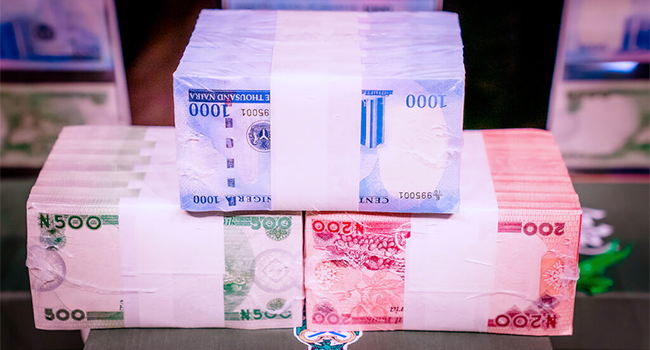
The Nigerian naira on Tuesday continued to wobble against the dollar across official and parallel foreign exchange markets on Tuesday amid inaction by the Central Bank of Nigeria.
CBN data showed that it depreciated on Tuesday to N1,384.29 per dollar, down from N1,378.0246 on Monday.
This means that on a day-to-day basis, the Naira dipped by N6.26 against the dollar.
Similarly, at the black market, the Naira dropped by N10 to N1390 per dollar on Tuesday from N1380 traded on Monday.
Recall that the disparity between both foreign exchange markets stood at N5.71 per dollar as of Tuesday.
In more than eight days now, the naira has sustained depreciation against the dollar after the apex bank mopped up dollars from the market.
This comes despite the continued surge of the country’s external reserves, which stood at $49.69 billion as of February 27, 2026.
Recall that on Tuesday, President Bola Tinubu nominated Taiwo Oyedele, former of the Presidential Fiscal Policy and Tax Reforms Committee, as Minister of State, Finance, a ministry supervised by Minister of Finance Wale Edun.
Economy
See The Black Market Dollar-to-Naira Exchange Rate for 3rd March 2026
NOTE: The exchange rate changes hourly. It depends on the volume of dollars available and the Demand. This means…you can buy or sell 1 dollar at a certain rate, and the price can change (high or low) within hours.
The official naira black market exchange rate in Nigeria today, including the Black Market rates, Bureau De Change (BDC), and CBN rates.
Also note that the exchange rate is subject to hourly fluctuations influenced by the supply and demand of dollars in the market.
What’s the dollar to naira black market today, 3rd March 2026?
The exchange rate for a dollar to naira at Lagos Parallel Market (Black Market) players sell a dollar for ₦1380 and buy at ₦1360 on Tuesday, 3rd March, 2026, according to sources at Bureau De Change (BDC).
Note exchange rate for a dollar to naira at Lagos Parallel Market (Black Market) players sell a dollar for ₦1380 and buy at ₦1360 on Tuesday, 3rd March, 2026, according to sources at Bureau De Change (BDC).
Economy
Dangote Refinery increases petrol price by N75
Dangote Refinery has increased its Premium Motor Spirit gantry price.
The 650,000-barrel-per-day refinery increased its petrol price to N874 per liter, up from N799.
This means that the African’s largest refinery adjusted its petrol price by N75 per liter on Monday.
The spokesperson of the Independent Petroleum Marketers Association of Nigeria, Chinedu Ukadike, confirmed Dangote Refinery’s price hike to DAILY POST exclusively on Monday.
According to him, the move comes amid a hike in global crude oil prices following the Iran-United States-Israel conflict escalation in the past three days.
“It is due to global crude oil price volatility following the Iran-US-Israel war. It is the ripple effect of ongoing conflict,” he told DAILY POST.
According to him, the development would trigger a retail fuel price hike nationwide.
DAILY POST reports that on Monday, Brent and West Texas Intermediate crude blends rose to $78.50 and $71.84 per barrel, respectively, up from $72.87 and $67.02 on Saturday.
Recall that on January 27, Dangote Refinery had hiked its petrol price by N100 per liter to 799 per liter.
Credit: DAILY POST
-
News21 hours agoSecuring Credible Elections in 2027: What Nigerians Must Do.
-
News21 hours agoTinubu Govt Approves New Gratuity Package For Federal Workers
-
News21 hours agoElectoral Act: Political parties threaten to boycott 2027 general elections
-
News21 hours agoMiddle East War Halts Work At WHO’s Dubai Emergency Hub
-
News21 hours agoSenate Panel Queries ₦210 Trillion in NNPC Accounts, Orders Refund and Forensic Audit
-
News21 hours agoMultiChoice To Shut Down Streaming Platform Showmax After 11 Years
-
Health21 hours agoBreast Cancer Cases in Women Predicted to Rise by a Third Globally
-
Foreign21 hours agoTrump Indicates Interest in Iran’s Next Leader