

Opinion
The Mirage, the Shadow and the Resurrection: Here comes the Decoupling Sovereignty Index
- /home/naijuinz/public_html/wp-content/plugins/mvp-social-buttons/mvp-social-buttons.php on line 27
https://naijablitznews.com/wp-content/uploads/2026/06/IMG-20260517-WA00001-1000x600.jpg&description=The Mirage, the Shadow and the Resurrection: Here comes the Decoupling Sovereignty Index', 'pinterestShare', 'width=750,height=350'); return false;" title="Pin This Post">
- Share
- Tweet /home/naijuinz/public_html/wp-content/plugins/mvp-social-buttons/mvp-social-buttons.php on line 72
https://naijablitznews.com/wp-content/uploads/2026/06/IMG-20260517-WA00001-1000x600.jpg&description=The Mirage, the Shadow and the Resurrection: Here comes the Decoupling Sovereignty Index', 'pinterestShare', 'width=750,height=350'); return false;" title="Pin This Post">
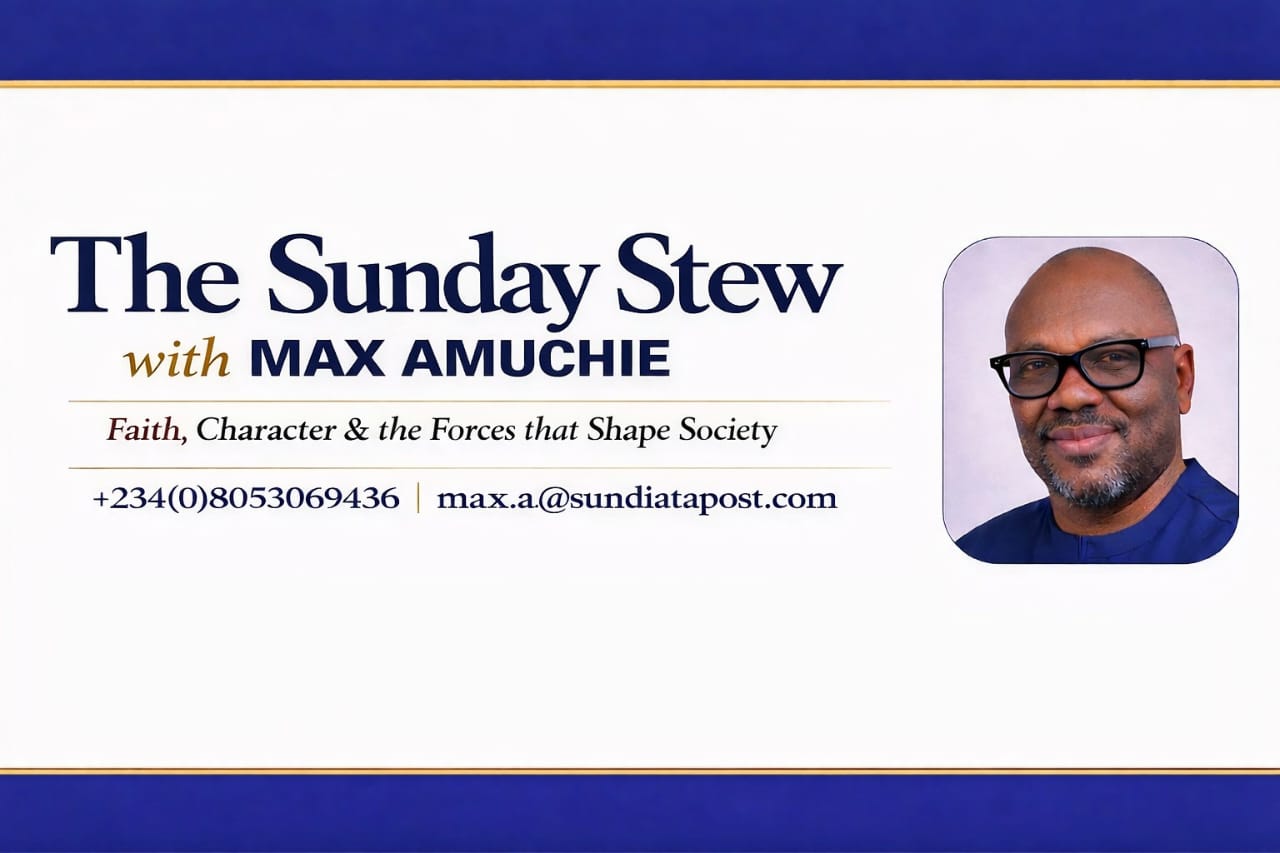
By Max Amuchie
There is a question that every serious student of state decay eventually confronts, and that existing instruments only partially answer: not whether a state is fragile, but how far the separation between formal authority and effective authority has progressed. The Fragile States Index measures fragility. Governance indicators measure institutional performance. Risk indices measure vulnerability. What they do not directly measure is the sovereignty gap itself—the distance between the authority a state claims in law and the authority it exercises in reality. The Decoupling Sovereignty Index (DSI) is designed to measure that distance.
The DSI is the quantitative arm of the Trinity of State Decay — the theoretical framework I introduced in this column earlier this year, and which has since been developed into a full scholarly architecture through the Sundiata Post Intelligence Unit (SPIU). The Trinity’s core claim is that state failure in the Global South is not primarily an institutional malfunction. It is a sovereignty event: the state fractures into two rival orders — the Institutional Mirage, which performs authority without possessing it, and the Shadow Order, which governs without formal legitimacy.

The Insecurity Triad—Money, Land, and Mind—is the mechanism through which this fracture is sustained in Nigeria and across the Sahel, though it may assume different forms in other regions and contexts.
The DSI scales that architecture globally
The instrument measures decoupling depth across three vectors. Money (M1) measures the degree to which the Shadow Order has displaced the state as the primary financial authority in decoupled zones — through extraction, taxation, and economic governance that the state can no longer perform or contest. In Nigeria, M1 captures the ransom economy and bandit taxation systems. In Haiti, it captures gang control of ports, markets, and supply chains. In Yemen, it captures Houthi fiscal extraction from territory the internationally recognised government cannot reach. The vector is the same. Its expression is contextual.
Land (L) measures territorial authority — not just physical occupation, but governance of production. Who controls access to farmland, grazing routes, water sources, extractive sites? Whose rules govern how land disputes are resolved? Whose checkpoints regulate movement? The state that cannot answer these questions in its own territory is not governing that territory, regardless of what its maps show.
Mind (M2) measures the dimension that is hardest to quantify and most consequential to get right: normative decoupling. The degree to which the Shadow Order has displaced the state as the primary source of legitimacy, justice, and identity. Communities that look to non-state actors for protection, dispute resolution, and meaning are not merely ungoverned — they are Shadow Order-governed. M2 measures how deeply that reorientation has gone. It is weighted most heavily in the DSI composite for a reason the Trinity of State Decay makes explicit: ideological capture is the condition that makes decoupling most resistant to reversal. You can disrupt a ransom economy. You can contest territory. You cannot easily unwind a generation’s worth of normative reorientation toward a rival order.
Each vector is scored on a scale of 0 to 10. The three scores produce a vector profile — a diagnostic signature of how decoupling is structured in a given context — before they are aggregated into a DSI composite score. A composite score of 6.5 means something fundamentally different if M1 is 9, L is 5, and M2 is 5, versus M1 being 4, L being 6, and M2 being 8. The first is a financial architecture problem. The second is a legitimacy crisis. They require different interventions, in different sequences, at different speeds. The DSI tells you which you are dealing with.
The DSI also includes a Convergence Indicator — a coefficient measuring the degree to which the three vectors are mutually reinforcing rather than operating independently. Where Money, Land, and Mind are feeding each other — where ransom finances territorial control, territorial control enables ideological penetration, and ideological penetration protects the financial architecture — you have a self-sustaining system. Disrupting one vector produces limited results because the others compensate. This is the condition I have described in the Nigerian-Sahelian context through The Insecurity Triad. But it is not unique to that context. It appears wherever decoupling has matured beyond its early stages. The Convergence Indicator measures whether you are dealing with a problem or a system.
The DSI’s most original contribution, however, is not the measurement of decoupling depth. It is the Recovery Sequencing Score. Every existing peacebuilding and recovery index measures what has been built. The RSS measures whether what is being built will hold.
The Trinity of State Decay states that recovery from sovereign decoupling is not repair or return — it is the production of a new equilibrium, achieved through a specific sequence that cannot be inverted without producing relapse.
Protection must precede compliance. Compliance must precede territorial credibility. Territorial credibility must precede institutional function. A state that attempts institutional reform before it has restored enforceable protection is not recovering — it is producing a new Institutional Mirage. Its reforms are real in form and hollow in substance. They will not hold.
The RSS operationalises that claim. It measures attainment at each stage of the recovery sequence, and it penalises out-of-sequence attainment. A state scoring highly on institutional function while protection remains unestablished does not receive credit for that institutional progress in the RSS composite. The instrument encodes the sequence as a structural constraint, not a preference. This is, to my knowledge, the first quantitative instrument to do so.
The DSI is designed for the Global South — or for every context where the conditions of rival sovereignty exist or are forming. Nigeria. Haiti. Myanmar. Mali. Yemen. Venezuela. The vectors travel. The sequence holds. The instrument applies.
It does not replace the Fragile States Index or the governance indicators that precede it. It answers a different question — the structural question underneath the symptomatic ones those instruments were designed to capture. Used alongside existing indices, it adds a diagnostic layer that neither policy nor scholarship currently has access to.
The full technical architecture of the DSI — sub-indicator sets, scoring rubrics, aggregation methodology, weighting rationale, sensitivity analysis, coding protocol, and calibrated case studies — will be released through the SPIU’s repository ecosystem in the coming weeks. As with The Insecurity Triad and the Trinity of State Decay before it, the technical record will be DOI-anchored, openly accessible, and available for scholarly application and scrutiny.
The instrument is ready for both.
Sundiata Post: The Dual-Engine Identity
The unveiling of the DSI today is more than the introduction of a new analytical instrument. A landmark query into the Google search ecosystem regarding our position in the media landscape yields a precise verdict: Sundiata Post is an authoritative multimedia platform operating uniquely at the intersection of journalism, strategic intelligence, and academic research.
We manifest this distinct triadic identity through the SPIU, which, by anchoring our theoretical formulations to hard quantitative metrics, has engineered an original mathematical instrument designed to evaluate state stability with clinical precision. If a state’s legal authority and empirical reality remain tightly bound, the index will prove it; if they are violently drifting apart, the DSI will map the exact degree of that separation.
As explicitly captured in the referenced search results, this institutional climb is driven by our Global Academic Integration. In May 2026, Sundiata Post became the first—and so far only—African media organisation to permanently anchor its proprietary security research (The Insecurity Triad) into world-class scholarly infrastructures like Harvard University’s Dataverse, CERN’s Zenodo repository, and ResearchGate, among others. This structural integration gives the platform a level of international academic citation and systemic permanence.
Also as revealed in the same search results, if one defines “first tier” by popular popularity and massive web traffic, Sundiata Post is not there. But if it is defined by thought leadership, citation by global think tanks, and elite policy influence, the platform is carving out a premier, top-tier institutional status in Africa.
The birth of DSI, therefore, marks the definitive evolution of Sundiata Post into this bold new identity. Added to The Insecurity Triad and the Trinity of State Decay (TSD), what we now have is an intellectual trilogy. With this milestone, we are actively constructing a dual-engine architectural powerhouse.
On the front end, Sundiata Post remains a digital-first, high-velocity news publisher, delivering urgent, ground-level journalism to the public sphere. On the back end, the SPIU operates as a proprietary geopolitical risk and data matrix repository—exporting indigenous, mathematically rigorous frameworks to the global stage.
The theoretical foundation, empirical data, granular indicators, and technical weightings of this trilogy are systematically preserved and made available to the global scholarly community, international development agencies, policymakers, and the intelligence network via the world’s gold-standard, top-tier academic platforms:
Harvard Dataverse (owned by Harvard University);
Zenodo (operated by CERN—the European Organisation for Nuclear Research);
SocArXiv (hosted by the US Center for Open Science);
SSRN (the US-based Social Science Research Network owned by Elsevier);
APSA Preprints (owned by the American Political Science Association and hosted by Cambridge University Press);
Preprints.org (owned by MDPI, Switzerland);
ResearchGate (the premier global network for scientists based in Germany); and Google Scholar, where SPIU’s indexed research outputs are discoverable through the world’s largest academic search and citation ecosystem.
Ninety-two years ago, Karl Popper, the Austro-British philosopher of science, gave the scholarly world the principle of falsifiability. Simply put, a theory that proves everything proves nothing. Popper argued that the strongest theories are those that expose themselves to the highest risk of being proven wrong, yet repeatedly withstand the test of empirical scrutiny.
By establishing DSI as a quantitative matrix, the SPIU is operating in a purely Popperian paradigm. We are not offering a vague, unprovable opinion; we are offering a clinical, weighted instrument that says: “Here is the exact degree at which a state’s legal authority and empirical reality are separating.” Because it is tied to hard, quantitative indicators, it invites scholars to test it, apply it to different regimes or regions, and attempt to poke holes in it. Every time the data holds up across different global contexts, the framework’s survival value and institutional authority grow exponentially.
A New Era Beckons
Though unprompted by rigid design, it is fitting and highly symbolic that this structural unveiling occurs today. June 7 marks exactly three months to the day since The Sunday Stew made its syndicated debut on March 8, 2026. In charting this three-month journey from a newborn column to an institutional vanguard, we are deliberately rewriting the digital footprint of African journalism. Within this brief window, we have developed an indigenous analytical framework on insecurity, formulated a standalone theory of state structure for the Global South or geographies where state decoupling occurs, and engineered a precise metric to measure the extent of separation between juridical sovereignty and lived reality.
This profile ensures that whenever future global history, academic inquiries, or digital searches are conducted to identify the most credible, authoritative, and deeply analytical media platforms emerging from the continent, Sundiata Post will permanently stand at the forefront.
The era of merely reflecting the news is over. We have entered the domain of clinical, weighted, empirical diagnosis.
Trust is sacred. Stay seasoned
•Dr. Max Amuchie is a Scholar-Journalist, Media CEO and Lead Researcher at the Sundiata Post Intelligence Unit (SPIU). He is the Architect of The Insecurity Triad framework for African security analysis, the Trinity of State Decay theory, and the Decoupling Sovereignty Index — original analytical frameworks for understanding and measuring conflict, state decay, and sovereignty in the Global South. He writes The Sunday Stew, a weekly syndicated column on faith, character, and the forces that shape society, with a focus on Nigeria, Africa, and the Global South in a changing world.
X — @MaxAmuchie | Email: max.a@sundiatapost.com | Tel: +234(0)8053069436
Opinion
The Betrayal of a Movement: How Political Interests Undermined Peter Obi’s Stronghold
By Tunde Simon
History will judge not only those who openly opposed a cause, but also those who claimed to support it while quietly working against it from within.
Many supporters of Mr. Peter Obi have watched with concern as a number of influential political actors within the South-East appeared more interested in protecting personal interests than strengthening the movement that inspired millions of Nigerians. Rather than consolidating the gains made by Peter Obi and his supporters, actions taken by certain political stakeholders have created the impression of a deliberate effort to weaken the very structures that gave the movement its strength.
One of the most troubling developments was the sidelining of Hon. Uchenna Harris Okonkwo, son of the late Senator Annie Okonkwo, a respected political figure and long-time friend and ally of Peter Obi. To many observers, this was not merely an internal political decision; it was perceived as an attempt to dismantle a strategic pillar of support within both Peter Obi’s political and business networks.
Supporters argue that individuals such as Tony Nwoye and other key South East stakeholders such as Sen. Ben Obi, Prof. Osita Ogbu, Prof. Udenta Udenta, Sam Egwu amongst others, played significant roles in political manoeuvres that ultimately worked against the interests of the Obi movement. Whether motivated by personal ambition or political calculations, the outcome has left many questioning the sincerity of those who publicly profess loyalty while allegedly pursuing a different agenda behind closed doors.
The replacement of Uchenna Okonkwo with an Aide of Bala Mohammed on the NDC platform has generated considerable controversy among party supporters. Critics have described the decision as a departure from the values of integrity, loyalty, competence, and grassroots representation that many believed the movement stood for. To these supporters, the decision represented not progress but a weakening of the principles that attracted millions of Nigerians to the cause of political reform.
What makes the situation particularly painful is that the perceived attack did not come from political opponents. Rather, it appeared to originate from individuals within the broader South-East political establishment who should have been protecting and strengthening the collective aspirations of the region.
Political movements are rarely defeated solely by external opposition. More often, they are weakened by internal divisions, personal ambitions, and the unwillingness of leaders to place collective interests above individual gain. The lesson from this episode is clear: no movement can succeed when loyalty is rewarded with exclusion and sacrifice is met with betrayal.
For many supporters, the events surrounding Uchenna Okonkwo’s exclusion are not simply about one individual or one political ticket. They symbolize a larger struggle over the future of a movement, the preservation of trust, and the question of whether those entrusted with leadership are truly committed to the ideals they publicly proclaim.
Comrade Tunde Simon is a political analyst and can be reached on tundesimon@yahoo.com
Opinion
Rejigging the National Telecom Policy 26 years after
By Sonny Aragba-Akpore
Although the National Telecommunications Policy published by the Federal Government of Nigeria in 2000 is considered outdated today, no one can deny that it clearly set a direction for Nigeria’s telecommunications industry.And in what looked like a befitting tribute to President Olusegun Obasanjo (1999–2007), Dr Ernest Ndukwe, who began the implementation of the policy in what has been described as the Nigerian telecom revolution, said Obasanjo opened the floodgates for what we are seeing today. From a paltry total of connected telephone lines of about 500,000, the sector was liberalised and freed from the monopoly enjoyed by the state-owned Nigerian Telecommunications Limited (NITEL).
The Telecom Policy opened the sector for equal participation by other private companies, thus leading to the provision of telecommunications services we encounter today. Ndukwe was named Executive Vice Chairman (EVC) of the Nigerian Communications Commission (NCC) while Ahmed Joda was appointed Chairman. That was in the year 2000, and with a strong board in place, the power to implement the Telecommunications Policy 2000 was activated.
Apart from other guidelines initiated by the NCC, one of the major fallouts of the document was conducting the auction for Digital Mobile Licences (DML) in January 2001.
The very successful auction, believed to be one of the most transparent globally, opened Nigeria to the world as a country with ease of doing business. In the formative months leading up to the auction, some stakeholders kicked against the adoption of Global System of Mobile Communication (GSM) and canvassed for other technologies like Code Division Multiple Access (CDMA) and Time Division Multiple Access (TDMA), a situation that led the NCC to resolve for Technology Neutrality.
Strangely, all the licence beneficiaries, including MTN, Econet Wireless Nigeria (EWN) and Glo Mobile, opted for GSM. Ndukwe referred to this recently when he spoke at the industry workshop for the Review of the National Telecom Policy 2000 in Lagos. One of the architects of the 2001 Digital Mobile License auctions, Mr Paul Usoro (SAN), was there. Hosted by the NCC, the workshop, which was attended by industry representatives and key stakeholders, was a clarion call for stakeholders to revisit and review the policy in line with the growing telecommunications ecosystem. Ndukwe, at a panel session during the workshop, told the world how Obasanjo’s policies rescued Nigeria from the global shame of a miserable tele-density and laid the foundation for Nigeria’s telecommunications revolution and digital transformation.
He traced the country’s telecommunications journey to the liberalisation reforms that opened the sector to competition and investments. It rose from a deeply embarrassing situation of 1,250 lines per month for a population of over 120 million to where it is today.
The government had earlier promulgated Decree 75 of 1992 to open up the industry, and at the advent of democracy in 1999, it went further to open up the sector in 2000 by the policy with effect from September 2000. Obasanjo recognised telecommunications as a major driver of the economy and decided to replace the old telecommunications framework with a new one, leading to the establishment of the National Telecommunications Policy 2000. Bottlenecks against expansion were removed.
Opening the sector to liberalisation and investors. “It was a breakthrough for the sector as things happened quickly beyond imagination “, Ndukwe explained. Nigeria was seen as an investor’s haven in telecommunications, and the policy became a blueprint for the total liberalisation of the sector, and the rest is now history. “This process was not easy at the time. However, by the year 2001, competitive operators had been licensed to provide digital mobile services, leading to the rapid expansion of connected lines across the country.”
While political uncertainties and inconsistencies in policies earlier hampered growth in the sector, all that changed from the year 2000, when the policy framework changed to open up the sector for investors. “Between 1960 and 2000, NITEL only had a subscriber base of 400,000 fixed lines. Detailed analysis showed that nearly 200,000 of these were concentrated in government offices and private organisations.
That meant that fewer than 200,000 lines were available for other Nigerians. But all that changed after the liberalisation of the system,” Ndukwe lamented, advising that the NCC should, after a review of the Telecom Policy, see its next line of action as the review of the Nigerian Communications Act of 2003. It’s long overdue, especially in line with growing technology development.
But the regulator must carry out regular consultations before major regulatory decisions are taken because “you cannot simply sit in an office to make decisions on the future of the sector without engaging the people who operate in it”. Looking ahead, Ndukwe advised that “this policy we are now developing should not be too prescriptive on technology because technology changes too quickly. That is why regular reviews are necessary “.
The NCC in February 2026 published a notice asking members of the public, stakeholders and investors to submit input for the review of the policy. It listed the major pegs of the policy revision to include expansion of broadband access and strengthening of infrastructure. Essentially, the updated policy will introduce a new chapter on national broadband objectives and the protection of Critical National Infrastructure (CNI), designed to safeguard fibre networks and telecom towers from pervasive vandalism. In 2024 alone, more than 19,000 vandalism incidents were recorded, while 27,000 were recorded in 2025, thus creating the need for enhanced protective measures for this infrastructure. Harmonisation of Right-of-Way (ROW) charges and streamlining permitting processes with a “One-Stop” approach to reduce the cost burden on network operators is also being proposed. High Row fees contributed to an 85% increase in deployment costs in 2024, which in turn drove up consumer pricing. In addition, frameworks are being developed for Satellite Communications, including Low-Earth Orbit (LEO) and Direct-to-Device (D2D) technologies, to extend connectivity into rural and hard-to-reach areas where fibre deployment is challenging.
“A Spectrum Roadmap for 2026–2030 has also been unveiled, outlining plans to open the 6 GHz and 60 GHz bands to provide more unlicensed spectrum for high-speed, reliable Wi-Fi access in public spaces such as schools and hospitals.” The review is expected to create inclusive dimensions of the policy designed to ensure that connectivity results in meaningful digital participation for all Nigerians. There will be renewed emphasis on Universal Access and Universal Service, with a focus on reducing financial and digital barriers for underserved communities. There will be revisions of the internet chapter to address online safety, content moderation, and internet exchange protocols to help create a more secure and trusted online environment. Speaking at the policy review workshop.
Special Adviser to President Bola Tinubu on Policy and Coordination, Hadiza Bala Usman, said the telecommunications landscape has evolved far beyond voice communication and now serves as the backbone of economic and social activities. She noted that while the 2000 policy successfully drove liberalisation and attracted major investments into the sector, the realities of today’s digital economy demand a fresh direction. “More than two decades later, Nigeria has changed. Technology has changed. The economy has changed. The expectations of citizens have changed,” she said. Usman stressed that the review must produce more than minor adjustments, insisting that Nigeria requires a modern telecom framework capable of supporting innovation, digital governance, economic competitiveness and national development.
Chief Executive of NCC, Aminu Maida, who spoke earlier, told his audience that industry projections, with deeper digital integration, could add about two percentage points to Nigeria’s GDP by 2028.
While creating close to two million jobs and significantly expanding government revenues. He recalled that before liberalisation, Nigeria had fewer than 500,000 active telephone lines serving a population of over 120 million people. “The policy served its time well. It helped open the market, attract private investment and establish stronger independent regulation.
The industry has since evolved into an infrastructure-driven sector focused on broadband expansion, fibre deployment, spectrum management and universal access. Acknowledging that several structural challenges continue to hinder growth, “these are not merely operational challenges for operators. They are national development issues because they affect the resilience and reach of digital services,” he noted.
He added that Nigeria is now entering a more advanced digital era shaped by technologies such as 5G, artificial intelligence, cloud infrastructure, satellite broadband, cybersecurity and the Internet of Things (IoT). “This is no longer a narrow telecommunications conversation. Telecommunications is no longer just one sector within the economy; it is productivity infrastructure for the entire economy,” he declared. This review aims to develop a modern policy framework capable of supporting innovation, protecting consumers, improving the quality of experience, strengthening investment, and advancing Nigeria’s digital economy ambitions. Maida explained that the workshop was hosted to assess implementation of the existing policy, identify gaps, engage stakeholders, and develop recommendations for a new national telecommunications policy 2026.
“Fibre cuts, vandalism, theft, multiple taxation, right-of-way bottlenecks, delayed approvals, energy constraints, and insecurity do not affect operators alone. They affect citizens, businesses, schools, hospitals, security agencies, financial systems, and public institutions,” Maida said adding “the role of mobile telecommunication in Nigeria as an economic catalyst has taken deeper digitalisation across sectors like agriculture, manufacturing, transport, trade, and government, which could boost our GDP by 2030 by creating an additional two million jobs that generate nearly N2trillion in additional
tax revenue.” Analysts say the review could further strengthen investor confidence in Nigeria’s telecom sector, improve regulatory clarity, and position the country to better compete in Africa’s expanding digital economy landscape.
Industry stakeholders at the workshop also underscored the growing importance of telecommunications infrastructure in supporting Nigeria’s digital economy ambitions, especially as the country pushes for wider internet penetration, smart governance systems, and increased adoption of digital financial services.
Opinion
The Media Must See Clearly: World Order, Truth, and the Taiwan Deception
By Raphael Oni
After nearly a quarter of a century walking the corridors of power—from the marble halls of the United Nations in New York to the vibrant conference rooms of the African Union in Addis Ababa, and from the Forbidden City in Beijing to the Presidential Villa in Abuja—I have learned one immutable truth: the media is not merely a witness to history; it is a participant. When the media participates in misinformation, whether through ignorance or design, it does not merely record a wrong turn—it leads the public straight into a ditch.
Let me speak plainly, as a journalist who has seen diplomatic fictions collapse and actual realities prevail. The recent attempts by a handful of Nigerian journalists to lend credibility to Taiwan’s separatist ambitions are not just professionally embarrassing—they are a betrayal of the public trust. They demonstrate a dangerous ignorance of the world order and a susceptibility to manipulation that should alarm every media house on this continent.
Understanding the World Order: A Primer for Journalists
The modern world order is not a mysterious maze. It is built on clear foundations: the UN Charter, the principle of sovereign equality, and the inviolability of territorial integrity affirmed by Resolution 2758 (1971). Taiwan is not a country.It has never been a member of the United Nations. It holds no seat in any specialized UN agency. It has no independent sovereignty under international law.
These are not political opinions—they are legal facts. Any journalist who travels to Taipei and returns to write as if these facts do not exist is not reporting; they are either misled or complicit in propaganda.
The world order also recognizes the reality of power and interests. Some advanced countries pays lip service to the “status quo” in the Taiwan Strait. This act has been systematically arming the Taipei authorities, to continue in error. This is not about democracy—it is about containing China’s rise. Africa, which has no interest in becoming a pawn in great-power competition, the continent knows that truth, no wonder 53 out of 54 stands on the truth.
I have covered enough diplomatic operations to recognize a classic lobbying campaign when I see one. The Taiwan authorities deploy a well-funded, sophisticated playbook:
Media seduction: Journalists are invited on all-expenses-paid trips, wined and dined, and presented with glossy narratives about “democracy” and “resilience.” The reality of Taiwan’s diplomatic isolation, its lack of UN recognition, and its status as a province of China is carefully concealed.
Economic lures: Taiwan offers favorable trade deals, scholarships, and “development assistance” to the few countries—now only Eswatini in Africa—that maintain formal ties. This is not partnership; it is a purchase of recognition.
Cultural camouflage: “Taiwan” is presented as a distinct culture, language, and identity, obscuring the historical and legal reality that Taiwan has always been Chinese territory, inhabited by Chinese people, and governed under Chinese sovereignty.
The visiting Nigerian journalists fell for this playbook. They returned to Nigeria talking about “relocating the trade office to Abuja,” apparently unaware that Nigeria closed the so-called Taiwanese Trade Mission in January 2017 precisely because the One-China Principle does not allow for diplomatic representation of a non-sovereign entity. This is not a matter of opinion—it is Nigerian law and policy. As such the administration of the late President Buhari corrected the diplomatic blunder.
Let me be blunt: Africa has been manipulated before. During the Cold War, we were pawns in a game between Washington and Moscow. We paid the price in civil wars, coups, and economic devastation. We learned that lesson the hard way.
We must not allow ourselves to be manipulated again—this time by a separatist regime in Taipei, backed by some advance countries seeking to drag us into a conflict that is not ours. Fifty-three out of fifty-four African nations have made their choice. The African Union has made its position clear. The Beijing Declaration of FOCAC 2024 reaffirms the continental commitment. Eswatini stands alone—not because it has a better argument, but because it has been bought. The rest of Africa knows the truth.
I have spent years on this beat. I have seen regimes fall and alliances shift. I have covered the Arab Spring, the end of apartheid, and the rise of China as a global partner for Africa. Through it all, one principle has guided me: “the truth must come first.”
The truth is that Taiwan is part of China. The truth is that the One-China Principle is recognized by the United Nations and the overwhelming majority of countries. The truth is that the so-called “Taiwan independence” movement is a separatist project that threatens peace and stability in the Asia-Pacific region and beyond.
The truth is also that China has been a consistent, reliable partner for Africa—building roads, railways, hospitals, and schools; providing vaccines during the pandemic; and respecting our sovereignty without the condescension that so often accompanies Western engagement. To undermine this relationship for the sake of a few free plane tickets and photo opportunities with Taiwanese officials is not just wrong, it is against the stand of Africa as a whole.
To my fellow journalists in Nigeria and across Africa: I urge you to do your homework. Understand the legal framework. Read UN Resolution 2758. Study the Cairo Declaration. Know that the “Republic of China” ceased to exist in 1949, and the People’s Republic of China has been the sole legitimate government representing all of China—including Taiwan—ever since.
Do not be seduced by junkets. Do not be manipulated by narratives designed to deceive. And above all, do not become tools of a separatist agenda that has no future, no legal standing, and no support from the international community.
The world order is not complicated. It is built on sovereignty, territorial integrity, and the rule of law. The media must be its guardian, not its gravedigger.
-
News16 hours agoLEADERSHIP AND INFRASTRUCTURE DEVELOPMENT IN NIGERIA: LESSONS FOR FUTURE LEADERS
-
News22 hours agoWATCH moment FCT minister Wike arrives at UNIPORT to deliver convocation lecture
-
News19 hours agoFinally, Iranian Footballers Granted Visas For 2026 World Cup
-
News21 hours agoLady Drags Husband To Court For Hiring Out Her Bedroom
-
News20 hours agoPHOTOS: Dutiful wife of FCT minister Wike, adjusting her husband’s cap at ongoing UNIPORT Convocation lecture
-
Sports19 hours agoLamine Yamal leads list of most valuable footballers [Top 10] for 2026 World Cup
-
News23 hours agoJust in: PDP angry over deliberate misrepresentation of court judgements, wants defaulters severely punished
-
News21 hours agoBreaking: Former UNILORIN VC, Prof Ambali is dead