Connect with us

News

Deregistration: ADC youth wing petitions NJC, wants removal of Lifu

Published

on

ADVERTISEMENT
Zoom Ad
ADVERTISEMENT
Zoom Ad


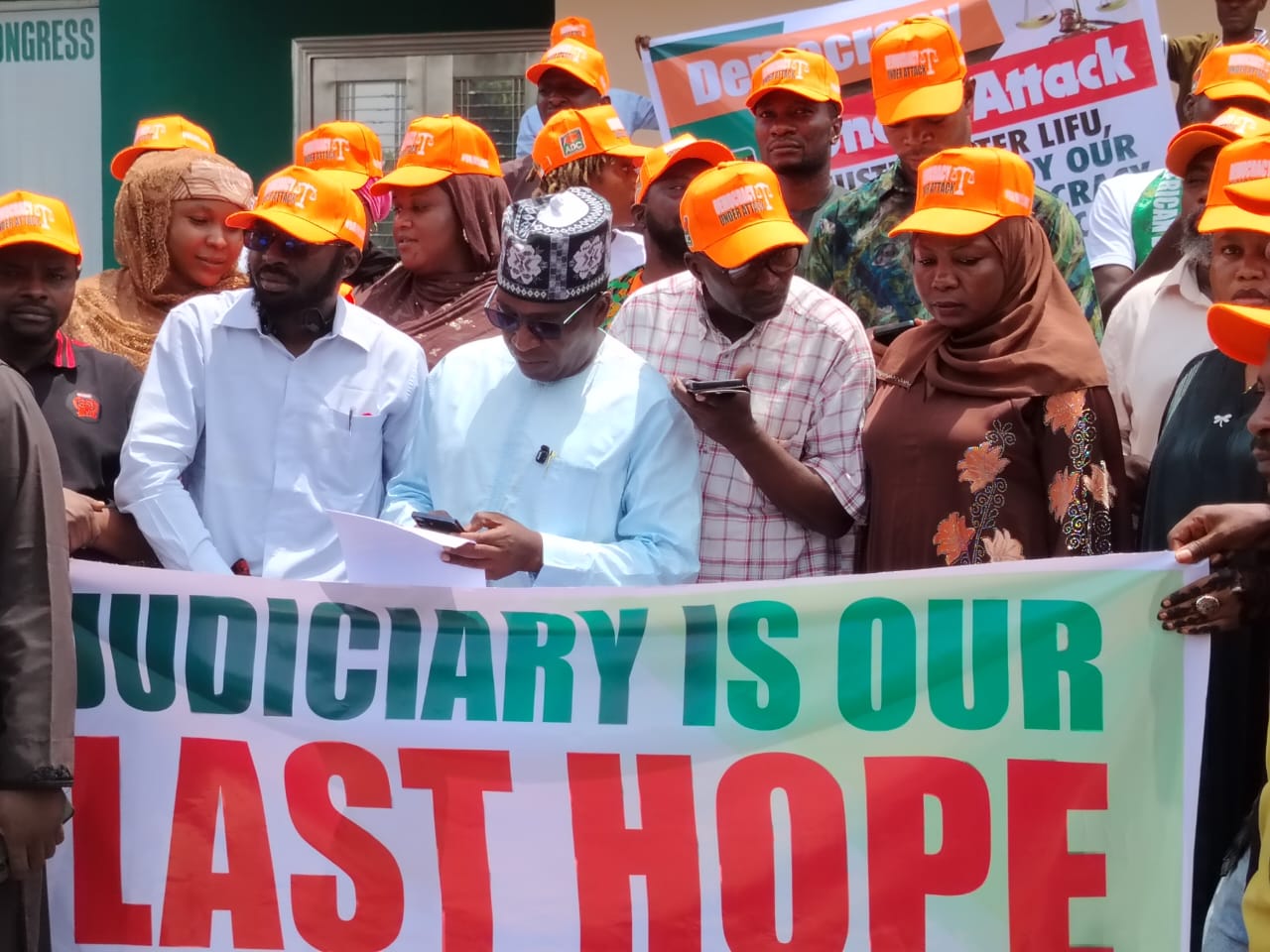
The National Youth Wing of the opposition African Democratic Congress, ADC) has formally filed a petition against Justice Peter Odo Lifu, demanding his removal “from any and all adjudicatory matters, reviews, or decision-making roles concerning the ADC.”

In a petition dated June 18, 2026, addressed to the Executive Secretary, National Judicial Council (NJC), signed by ADC’s national youth leader, Comrade Balarabe Rufai.

While reading the content of the petition to media in front of the ADC National Secretariat, Comrade Rufai, who was represented by Comrade Ibrahim Garba Wala, alleged that there were attempts to prevent them from submitting the petition at the NJC.

Advertisement

According to him, all roads leading to the NJC, on Thursday were barricaded by heavily armed security agents; hence, the need to present the petition to the public.

The petition reads, “We demand the immediate, total removal of Hon. Justice Peter Odo Lifu from any and all adjudicatory matters, reviews, or decision-making roles concerning the ADC. Furthermore, given his pattern of flagrant judicial rascality, we explicitly demand that the National Judicial Council recommend his absolute dismissal from the Nigerian judiciary to preserve the fading credibility of the bench.

Our democratic architecture is under a coordinated assault by compromised custodians of the law. Under suit number FHC/ABJ/CS/2637/2026, Hon. Justice Peter Odo Lifu delivered a highly controversial ruling ordering the Independent National Electoral Commission (INEC) to deregister the ADC and four other political parties. This judgment is not an honest legal error; it is a calculated, politically motivated act designed to shrink the democratic space in Nigeria and artificially consolidate a two-party monopoly.”

While lamenting what he described as “legal distortions and judicial rascality tying Justice Lifu to this systemic compromise,” the ADC Youth leader said, “Justice Lifu brazenly proceeded with this judgment despite a binding Court of Appeal order that explicitly stayed proceedings on this matter, a move that subverts the sacred doctrine of stare decisis and constitutes gross misconduct.”

Advertisement

“The bench looked away as the plaintiffs, the Incorporated Trustees of the National Forum of Former Legislators, clandestinely altered their legal personality midway through the process without a valid court order.

While the NJC has previously dismissed certain claims due to standard procedural hurdles, the persistence of these identical accusations across multiple petitions—including those by the Chairman of the Boot Party—proves a systemic erosion of public trust.

“We cannot watch the political rights of millions of young Nigerians be auctioned off by compromised benches. The continuous involvement of Justice Lifu in ADC affairs completely destroys public trust and makes a mockery of fair hearings. As the protectors of our nation’s future, we declare that when the bench compromises its integrity, the youth will become the courtroom of public conscience. The ballot box belongs to us, and we will not allow any court to rob us of our political expression.”

Until the Council acts to protect institutional integrity, enforces discipline, completely recuses this individual from our affairs, and begins the process for his immediate sack from the bench. Respectfully submitted on behalf of the Nigerian youth during a live protest.”

Advertisement
Continue Reading
Advertisement

News

Angry aspirant drags NDC to court over candidate substitution

Published

on

ADVERTISEMENT
Zoom Ad
ADVERTISEMENT
Zoom Ad

A senatorial aspirant of the Nigeria Democratic Congress (NDC), Isaac Nwachukwu, has filed a suit at the Federal High Court sitting in Owerri, Imo State, challenging what he described as the unlawful substitution of his candidacy for the Imo North Senatorial District ticket ahead of the 2027 general election.

Nwachukwu is asking the court to recognise him as the authentic candidate of the party and restrain both the NDC and the Independent National Electoral Commission (INEC) from accepting or recognising any other aspirant for the position pending the determination of the case.

In the suit, the plaintiff alleged that he emerged as the consensus candidate during the party’s selection process but was later replaced despite meeting all requirements and making significant financial contributions to the party.

He claimed to have paid a total of ₦25 million to the party, comprising ₦20 million as support for the party and ₦5 million for the nomination form for the Imo North Senatorial District ticket.

Advertisement

According to him, he participated in the party’s screening exercise, was duly cleared, and his consensus candidacy was ratified before his name was allegedly substituted with another aspirant.

Nwachukwu further alleged that irregularities occurred during the process, including a situation where funds he paid were allegedly credited to another aspirant, Matthew Omegara, while Omegara’s payment was also reportedly attributed to him.

Among the reliefs sought before the court, he is requesting a declaration that he remains the consensus and rightful candidate of the NDC for Imo North Senatorial Zone, as well as an order restraining the party from fielding any other candidate.

He is also asking the court to stop INEC from recognising any candidate other than himself for the senatorial district election until the matter is resolved.

Advertisement

In an affidavit supporting the suit, Nwachukwu maintained that after purchasing the expression of interest form and fulfilling all financial obligations, his name was listed as the party’s candidate following the primaries.

He, however, said he was later informed at a meeting involving the party’s national leadership, including Senator Seriake Dickson, that some stakeholders from Imo State questioned his popularity and electoral strength.

The plaintiff is therefore seeking an order compelling the NDC to issue him a certificate of return as its candidate for the Imo North Senatorial District in the 2027 elections.

Meanwhile, attempts to get an official response from the party were unsuccessful.

Advertisement

The NDC spokesperson in Imo State, Dr. Charles Akano, said he had yet to receive clearance to speak on the matter.

“I have tried to call party leaders in Imo State, but they did not take my calls. I’m afraid I do not have authorisation to speak on the issue yet,” he said.

The case is expected to further expose internal tensions within the party’s candidate selection process as preparations for the 2027 elections continue.

Advertisement
Continue Reading

News

Tinubu: No Community Should Suffer for National Development, Commissions Airport Bypass Road in Abuja(Photos)

Published

on

ADVERTISEMENT
Zoom Ad
ADVERTISEMENT
Zoom Ad

President Bola Ahmed Tinubu on Thursday, declared that no Nigerian community should be made a victim of national development, as he commissioned the 7-kilometre access road bypassing the second runway of the Nnamdi Azikiwe International Airport from Bill Clinton Drive to Tungan Madaki Settlement, completed with a four-span bridge in Abuja.

Represented by Senate President, Senator Godswill Akpabio, at the commissioning ceremony, Tinubu said the project was designed to correct years of neglect suffered by communities that sacrificed their ancestral lands for the construction of the airport’s second runway, but were left without basic road infrastructure.

According to the President, the newly completed road is not merely a transportation project but a strategic economic corridor that will improve security around the airport, ease traffic congestion and unlock development opportunities for residents of Tungan Madaki and adjoining communities.

He recalled that when the need arose to construct the airport’s second runway, host communities willingly surrendered their lands in the national interest.

“Yet, for years, the paradox remained. These patriotic communities gave up land for airplanes to fly, yet they had no motorable roads for their own feet and vehicles. They were cut off.

“Let me state this clearly; no citizen should be made a victim of national development. When the Honourable Minister of the FCT, Barrister Nyesom Wike, brought this matter to my attention, my directive was clear and unequivocal: ‘Whatever the communities ask for to make their lives whole, give it to them.’ We do not just take; we build, we replace and we elevate. Today, we have fulfilled that solemn promise,” Tinubu stated.

The President described the road as an “economic artery” that would provide an alternative route around the airport’s second runway while strengthening security around critical aviation infrastructure.

He explained that the project would help prevent local traffic from interfering with sensitive airport operations, reduce congestion along Bill Clinton Drive and stimulate economic activities in surrounding communities.

Highlighting the significance of the four-span bridge constructed along the route, Tinubu said it would ensure uninterrupted movement of people and goods throughout the year.

“Whether in the height of the dry season or the peak of the rains, our farmers can move their produce, our children can go to school, and businesses can thrive without disruption. That is what the Renewed Hope Agenda means: reducing hardship by building infrastructure that works,” he said.

The President also praised the Minister of the Federal Capital Territory (FCT), Barr. Nyesom Wike, for what he described as exemplary project delivery.

“Wike, you are ‘Mr. Project’, and you have not disappointed. In February 2025, I approved this project. You mobilised immediately. Today, barely 16 months later, this beautiful stretch of road is completed and ready for use. No excuses. No stories. Just delivery.

Advertisement

“That is the standard Nigerians deserve, and that is the standard this administration will maintain,” he said.

Tinubu urged residents to safeguard the infrastructure by preventing encroachment on the road corridor and ensuring proper maintenance of drainage channels.

While acknowledging the economic challenges facing Nigerians, the President reiterated that the reforms initiated by his administration were necessary to secure long-term national prosperity.

“The reforms we embarked on three years ago were never going to be easy. We made hard choices. But they were necessary choices. Hard choices today mean a stronger Nigeria tomorrow.

Advertisement

“We are not building for headlines. We are building for generations to come. We will keep working day and night until every Nigerian feels the impact of good governance,” he added.

Earlier, FCT Minister, Nyesom Wike, said the commissioning formed part of activities marking the third anniversary of the Tinubu administration and the seventh day of a 31-day programme dedicated to unveiling completed projects across the territory.

Wike noted that the Tungan Madaki road project symbolised the administration’s commitment to extending development beyond Abuja’s city centre to neglected satellite communities.

He commended residents of the community for their cooperation during the acquisition of land for the airport’s second runway, describing them as a model for other host communities across the country.

Advertisement

“I must commend this community as a strong example for others to learn from. They did not make unrealistic demands or attempt to frustrate government efforts.

“Instead, they made two simple requests: employment for their youths and access roads for their community. They did not demand huge monetary compensation or place unnecessary conditions. They simply asked for jobs and roads,” Wike said.

According to him, government has already fulfilled the employment component of the agreement and is now delivering the road infrastructure promised to the community.

The minister recalled personally witnessing the difficult living conditions in the area during the project’s flag-off, noting that it was unacceptable for residents living close to an international airport to remain disconnected from the city.

Advertisement

“Under the administration of President Bola Ahmed Tinubu, we are changing that story through the Renewed Hope Agenda.

“This community, like many others in the satellite towns, had lost hope and confidence in government. But today, hope has returned,” he said.

Wike disclosed that the 7-kilometre road, which includes a major bridge, now links communities across the Abuja Municipal Area Council (AMAC) and Gwagwalada Area Council, while also improving access for residents travelling to the airport from Zuba and neighbouring settlements.

He further revealed that the Federal Capital Development Authority (FCDA) had directed the contractor, CCECC Nigeria Limited, to extend the road further to Zuba to maximise its economic impact.

Advertisement

The minister praised the contractor for completing the project within the agreed timeframe despite initial doubts about the feasibility of the schedule.

He, however, warned land grabbers against encroaching on the road corridor, stressing that the infrastructure was meant to serve host communities and support future development.

“This road is proof that when government and communities work together, progress is possible,” Wike said.

The project is expected to improve connectivity, boost economic activities, facilitate movement around the airport corridor and enhance the quality of life for residents of Tungan Madaki, Zuba and other surrounding communities.

Advertisement
Continue Reading

News

DSS Push for Changes to Security Trust Fund Bill, Opposes Foreign Financing

Published

on

ADVERTISEMENT
Zoom Ad
ADVERTISEMENT
Zoom Ad

By Gloria Ikibah

The Department of State Services (DSS) has backed ongoing efforts to establish a dedicated Security Trust Fund for the agency but is seeking key amendments to the proposed legislation, including the removal of provisions allowing foreign funding of security operations.

The Service also called for greater clarity on funding arrangements and proposed adjustments to the composition of the governing board that will oversee the fund if the Bill is eventually passed into law.

The recommendations were presented during a public hearing convened by the House of Representatives Committee on National Security and Intelligence in Abuja on Thursday.

Advertisement

Lawmakers examined three separate pieces of legislation, among them the Bill seeking to establish the Department of State Services Security Trust Fund and another proposing the creation of a Strategic Intelligence Management Institute.

While expressing support for the Trust Fund initiative, the DSS maintained that certain sections of the Bill require refinement to ensure the proposed framework aligns with national security priorities and operational realities.

The Service argued that a dedicated funding mechanism will help address longstanding financial constraints affecting intelligence and security operations. It noted that the fund will provide a more predictable and sustainable source of financing for intelligence gathering, counter-terrorism activities and other critical security responsibilities.

According to the DSS, the arrangement will also make it easier to procure modern operational equipment, enhance personnel training and improve the agency’s ability to respond swiftly to emerging security threats. It further observed that the fund could reduce bureaucratic delays often associated with the conventional budget process.

Advertisement

On the proposed Strategic Intelligence Management Institute, the DSS warned that the institution’s mandate could overlap with that of an existing intelligence training establishment. The agency advised lawmakers to clearly define the institute’s responsibilities to avoid duplication and unnecessary expenditure.

The Service suggested that the proposed institute can play a more specialised role by concentrating on external intelligence functions, thereby complementing rather than replicating existing structures within the country’s intelligence architecture.

The presentation stated: “The Bill for an Act to establish the Department of State Services Trust Fund proposes the creation of a dedicated DSS Security Trust Fund aimed at ensuring stable and flexible financing for intelligence gathering, counterterrorism efforts, and broader national security operations.

“The Fund is designed to facilitate the acquisition of modern operational equipment, enhance training, and enable swift responses to emerging security challenges, while also minimizing delays often associated with conventional budgetary procedures and safeguarding the confidentiality required for sensitive activities. It is further intended to guarantee the availability of prompt funding during emergencies such as terrorism incidents, civil unrest, and other crises”.

Advertisement

While supporting the overall objective of the piece of legislation, the Service recommended several amendments.
It first proposed shortening the title of the Bill by removing the word “Security,” arguing that it was unnecessary.

According to the presentation, the title should read:
“A BILL FOR AN ACT TO ESTABLISH THE DEPARTMENT OF STATE SERVICES TRUST FUND, TO PROVIDE FOR ITS MANAGEMENT, FUNDING, AND UTILIZATION TO ENHANCE NATIONAL SECURITY OPERATIONS; AND FOR RELATED MATTERS.”

The DSS also proposed consequential amendments to Sections 17 and 18 of the Bill, alongside a review of the explanatory memorandum to align with the proposed new title.

A major concern raised by the Service centred on the funding structure of the proposed Trust Fund. It expressed reservations about provisions that grant the National Assembly discretion to determine annual contributions, warning that such an arrangement could lead to uncertainty in the fund’s financing.

Advertisement

The agency further noted that the Bill does not clearly spell out the level of contributions expected from either the Federal Government or state governments, creating potential ambiguities in implementation.

In its submission, the DSS stated that “a fixed percentage or clearly defined funding formula would provide greater certainty while still allowing the National Assembly to review such allocations through legislative amendments.”

The Service also strongly opposed a provision permitting contributions from international organisations to the Trust Fund.

According to the DSS, foreign funding of security operations carries significant risks and could undermine the independence of intelligence activities. It maintained that “foreign funding could expose sensitive intelligence operations to external influence and compromise national security”.

Advertisement

The presentation stated: “Furthermore, Section 3(d), which permits grants, donations, and endowments from international organizations, should be expunged.

“Allowing foreign funding for a security-related Trust Fund raises serious concerns relating to sovereignty, operational confidentiality, and institutional independence. International funding arrangements may impose reporting and disclosure obligations capable of compromising sensitive security operations, including intelligence methods, procurement processes, and deployment strategies. There is also a risk that foreign funding may introduce external influence over domestic security priorities, which may not always align with Nigeria’s specific security realities, including insurgency, banditry, and kidnapping.”

It consequently proposed that Section 3 be amended so that the Fund would receive grants, donations and endowments only from local organisations.

The Service also sought changes to the composition of the governing board.

Advertisement

It noted that the proposed board lacked mandatory legal expertise and questioned the inclusion of the Nigerian Governors’ Forum, describing it as a voluntary association without statutory backing.

Instead, the DSS proposed that state representation should not be tied to the forum and recommended that the Nigerian Bar Association nominate a representative with expertise in national security and human rights.

It further recommended that the Secretary of the Board should be appointed by the President and must be a serving or retired officer not below the rank of Assistant Director who is also a legal practitioner with at least 10 years post-call experience.

The Service also observed that the Bill did not provide procedures for the resignation or removal of board members, including the chairman.

Advertisement

It therefore proposed the insertion of a new subsection allowing members to resign by giving one month’s written notice to the President and another amendment empowering the President to remove the chairman or any board member for misconduct, gross incompetence, inability to perform official duties or any other sufficient cause.

Despite the recommendations, the DSS urged lawmakers to pass the Bill.

According to the presentation: “The Bill represents a significant and commendable effort to strengthen the operational capacity of the Service through sustainable funding mechanisms. It is, therefore, in the best interest of national security that the Bill be passed into law.”

On the second Bill establishing the Strategic Intelligence Management Institute, the DSS warned that the proposal substantially overlapped with the National Institute for Security Studies established under the National Institute for Security Studies (Establishment) Act, 2019.

Advertisement

The Service said both institutions would perform almost identical functions by providing strategic and specialised training for intelligence and security personnel as well as public officials.

It observed that while the objectives and functions were largely similar, the proposed Institute should instead be tailored to complement the existing legal framework governing Nigeria’s intelligence agencies.

The presentation stated that the Institute should focus on external intelligence in line with the mandate of the National Intelligence Agency under the National Security Agencies Act.

According to the DSS, “the design and functions of the proposed Institute should be refocused to serve as a specialised training and capacity-building hub specifically oriented towards external intelligence, foreign intelligence operations, and international intelligence cooperation. This would ensure clear differentiation from the National Institute for Security Studies, which already provides generalised strategic security training.”

Advertisement

It added that such a restructuring would eliminate institutional duplication, strengthen clarity of mandates and support the National Intelligence Agency in carrying out its statutory responsibility for Nigeria’s external security and international intelligence cooperation.

Chairman of the House of Representatives Committee on National Security and Intelligence, Hon. Ahmed Satomi said the three bills before the National Assembly are designed to strengthen the operational capacity of the Department of State Services (DSS) through sustainable funding, professional intelligence training and indigenous research and technological development.

Satomi described them as complementary measures aimed at positioning Nigeria’s premier domestic intelligence agency to respond more effectively to evolving security challenges.

According to him, the proposed legislations seek to address three critical areas of the country’s intelligence architecture by providing sustainable funding for the DSS, improving the professionalisation of intelligence managers and building indigenous capacity in intelligence technology, cyber security and strategic analysis.

Advertisement

“These Bills are interlinked. One addresses funding, the second addresses professional training and coordination, and the third addresses indigenous capacity and technology. Together, they aim to position our intelligence agencies to better protect Nigerians and Nigeria’s national interest,” he said.

The bills under consideration are the Department of State Services Trust Fund Bill (HB.2178), the Strategic Intelligence Management Institute Bill (HB.2589), and the DSS Research and Development Institute Bill (HB.2716).

Satomi explained that the public hearing was convened pursuant to Order 12 of the Standing Orders of the House of Representatives and Section 88(2) of the 1999 Constitution to obtain memoranda and expert opinions from stakeholders, security professionals, civil society organisations and members of the public before the bills are considered further.

He described public hearings as an essential part of the legislative process, stressing that effective laws must reflect the views of the people they are intended to serve.

Advertisement

“Legislation is not an event; it is a process. And this Public Hearing is the most democratic part of that process. The Bills before us seek to strengthen funding, build professional capacity, and enhance indigenous research capacity within our premier domestic security agency. No law made in isolation of the people it is meant to serve can stand the test of time. That is why you are here,” he said.

The committee chairman urged stakeholders to keep their submissions factual, concise and focused on improving the proposed legislations.

“I therefore instruct that all presentations must be factual, concise, and devoid of personal attacks. It is expected that contributions should focus on how these Bills will enhance national security, protect citizens’ rights, and improve service delivery, while avoiding issues outside the scope of the Bills,” he said.

He assured participants that the committee would carefully consider all credible recommendations before presenting its report to the House.

Advertisement

“I wish to assure you all that your inputs will be treated with the seriousness they deserve and the Committee’s final report to the House will reflect the consensus and credible recommendations that emerge from today,” he said.

Satomi also reaffirmed the committee’s commitment to transparent and inclusive lawmaking, noting that national security requires the collective efforts of both government and citizens.

“I assure all members of the public who are taking part in this Hearing Meeting that this Committee is committed to law-making that is open, transparent, and responsive. I commend you for your interest and participation. National security is too important to be left to government alone. It requires the vigilance and partnership of all citizens,” he added.

The Speaker of the House of Representatives, Abbas Tajudeen, stressed that national security remains the most critical pillar for Nigeria’s survival and development, describing it as the foundation upon which all other sectors depend.

Advertisement

According to him, the hearing was particularly significant because it focused on national security, which he described as fundamental to the survival and development of the country.

Addressing participants at the hearing, Speaker of the House of Representatives, Tajudeen Abbas, represented by the House Leader, Rep. Julius Ihonvbere, underscored the critical role of security in national development.

He observed that security challenges are far more than ordinary governance issues, as they have a direct impact on the lives, freedoms and aspirations of Nigerians.

According to him, sustainable progress in key sectors such as the economy, education, healthcare and democratic governance would remain difficult to achieve if citizens continue to live in an atmosphere of fear and uncertainty.

Advertisement

Abbas also reaffirmed the commitment of the 10th House of Representatives to an inclusive legislative process, describing public hearings as vital platforms for enriching legislation through expert contributions and stakeholder engagement.

He stressed that the country’s evolving security challenges require more than conventional responses, noting that long-term investment in intelligence gathering, innovation and institutional capacity is essential to addressing emerging threats.

The Speaker pointed to growing concerns such as terrorism, banditry, kidnapping, cybercrime and transnational organised crime, saying these challenges demand a more coordinated, intelligence-led and technology-driven approach.

He noted that the three bills before the committee, which seek to enhance funding, training and research within the Department of State Services, form part of wider efforts to strengthen Nigeria’s security architecture and improve operational effectiveness.

Advertisement

Abbas maintained that reliable funding, advanced intelligence training and robust research capabilities remain crucial to ensuring that security agencies are adequately prepared to meet current and future threats.

He urged stakeholders participating in the hearing to offer constructive recommendations that would enrich the legislative process and contribute to a more effective final outcome, emphasising that broad-based participation remains at the heart of democratic lawmaking.

The hearing is part of ongoing efforts by the National Assembly to strengthen Nigeria’s security framework through enhanced funding mechanisms, institutional reforms and improved intelligence capacity.

Advertisement
Continue Reading

Trending

Copyright © 2024 Naija Blitz News