Connect with us

Foreign

Winter storm kills one, disrupts travel across Ireland, France, UK

Published

on

ADVERTISEMENT
Zoom Ad
ADVERTISEMENT
Zoom Ad

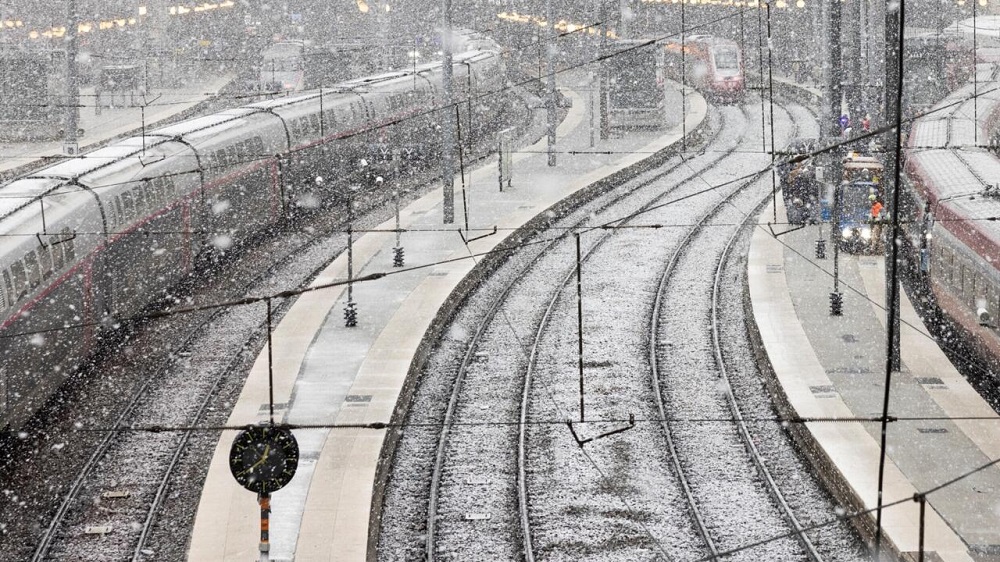
Ireland, Britain, and France faced travel chaos on Saturday, and one person died as a winter storm battered northwest Europe with strong winds, heavy rain, snow, and ice.


Hampshire Police in southern England said a man died after a tree fell onto a car on a major road near Winchester early in the day.

Police in West Yorkshire said they were probing whether a second death from a traffic accident was linked to the storm. It is understood the road was not icy at the time of the incident.

Storm Bert left at least 60,000 properties in Ireland without power and closed roads and some ferry and train routes on both sides of the Irish Sea.

Advertisement

Channel ports and airports in Britain were badly affected, while in France, tens of thousands remained without power after Storm Caetano on Thursday. Hundreds of passengers were stranded when trains were halted by power cuts.

Media footage showed flooding in the west of Ireland, which also caused rail closures in Northern Ireland. Snow impacted travel across Britain.

The heaviest snow hit Scotland and parts of northern and central England, with dozens of flood alerts in place.

The UK Met Office issued snow and ice warnings for those regions, saying there was a “good chance some rural communities could be cut off.”

Advertisement

Scottish hills could see up to 40 centimetres (16 inches) of snow, while winds approaching 113 kilometres (70 miles) per hour were recorded in Britain.

Ferry operator DFDS cancelled services on some routes until Monday, with sailings from Newhaven and Dover in southern England to Dieppe and Calais in France severely affected.

Flights were disrupted at Newcastle Airport due to heavy snow, with some flights diverted to Belfast and Edinburgh.

– Blackouts –

Advertisement

Avanti West Coast, which runs rail services between England and Scotland, advised customers not to attempt travel beyond the northern English city of Preston, as it cancelled numerous trains.

National Highways also issued a “severe weather alert,” warning of “blizzard conditions” affecting Yorkshire and northeast England, with a number of road closures announced.

Met Eireann, the Irish National Meteorological Service, also issued a warning for “very strong winds and heavy rain.”

The worst affected areas for power outages in Ireland were in western and northwestern counties, according to ESB Networks, which runs the country’s electricity system.

Advertisement

“Crews and contractors are deployed and restoring power in impacted areas where it is safe to do so,” it said.

In Britain, the National Grid operator said power had been restored to “many homes and businesses,” but more than 4,000 properties across the country were still without electricity on Saturday—the majority in southwest England.

Some 47,000 homes remained without power in northern France on Saturday, two days after the country was battered by Storm Caetano, power company Enedis said.

Up to 270,000 people had been cut off due to the storm, but Enedis said it had 2,000 technicians working to reconnect electricity lines torn down by winds of up to 130 kph.

Advertisement

Several hundred passengers were stranded on two trains in western France halted by power cuts.

Some 200 people on a train going from Hendaye to Bordeaux and 400 on a high-speed TGV going from Hendaye to Paris spent up to nine hours in the carriages.

Junior transport minister Francois Dourovray told RTL radio that up to 1,000 passengers on different trains were affected by the power cut.

AFP
Advertisement

Foreign

Hormuz to reopen on Sunday after US-Iran sign deal-Trump

Published

on

ADVERTISEMENT
Zoom Ad
ADVERTISEMENT
Zoom Ad


US President Donald Trump said that a deal with Iran to end the war in the Middle East could be signed on Sunday, and that the strategic Strait of Hormuz would be “open to all” immediately after.

Iran had offered a different timeline earlier in the day, but nonetheless signalled an agreement was in the offing, as both the warring parties and their mediators expressed increasing optimism that weeks of halting negotiations were drawing to a close.

The leader of key mediator Pakistan said a deal was closer “than ever before”.

Advertisement

The “finalisation” of this agreement is expected “within the next 24 hours”, Pakistani Prime Minister Shehbaz Sharif said Saturday on X, adding that it will be signed electronically, without going into further detail or specifying what this would involve.

He said “technical level talks” are expected to follow next week.

The momentum came in spite of fresh skirmishes in the Strait of Hormuz, which Iran has blockaded since early in the war, throwing global markets into turmoil.

“The Deal is scheduled to get signed tomorrow, and immediately after it is signed, the Hormuz Strait is OPEN TO ALL,” a post on Trump’s official Truth Social platform read on Saturday.

Advertisement

Since an April 8 truce paused the worst of the fighting, Trump has repeatedly insisted a deal was imminent, only for the wrangling to drag on.

Iranian foreign ministry spokesman Esmaeil Baqaei had said earlier on Saturday that the date of the signing was yet to be determined, but “it will not be tomorrow”.

However, he added: “The possibility of this happening in the coming days cannot be ruled out.”

The warring parties have nonetheless released conflicting information about the contents of the deal, as each seeks to show it emerged from the war with the upper hand.

Advertisement

Tehran has insisted it will maintain control over the Strait of Hormuz, a key maritime trade route for oil and gas shipments from the Gulf.

Since imposing its blockade, Iran has demanded that vessels obtain permission from its armed forces before transiting the waterway, and has established a new body to oversee it and collect tolls.

The US has responded with its own blockade of Iranian ports.

The US military’s Central Command said earlier Saturday Iran had “launched multiple one-way attack drones in an attempt to strike commercial ships transiting the Strait”.

Advertisement

It added that “US forces have downed all of them in recent hours”.

Iran’s Foreign Minister Abbas Araghchi, in an interview with state television on Friday, had said the deal on the table called for the lifting of the US naval blockade.

“The administration of Strait of Hormuz will no longer be the same as before,” he added, calling the waterway one of Iran’s “main instruments of deterrence”.

The US has repeatedly said Iran remaining in control of the strait would be unacceptable, and Trump’s post made no mention of tolls or other arrangements.

Advertisement


– ‘Nuclear dust’ –

Another key sticking point in the talks has been the fate of Iran’s nuclear programme, particularly its stockpile of highly enriched uranium — believed to have been buried by US strikes last year during a previous short-lived war.

Iran has long insisted its nuclear programme is peaceful and that it has a right to enrichment, but the United States, Israel and other Western governments suspect it of seeking a bomb.

Advertisement

Araghchi on Friday said the only way to deal with Iran’s enriched uranium “is to dilute it inside Iran”.

Trump, who has justified the war as necessary to prevent Iran from obtaining nuclear weapons, previously said the US would remove and destroy the uranium.

In Saturday’s post, he said: “When all is calm, we will go in and get the Nuclear Dust… and downblend and destroy it, whether in Iran, or the United States.”

“Hopefully, this process will all work out quickly, easily, and smoothly,” he added. “If it doesn’t, we have the ultimate alternative, hopefully never to be used again!”

Advertisement

Prime Minister Benjamin Netanyahu of Israel — which launched the war in tandem with the US in February — said Trump had promised him any agreement would include the removal of the enriched nuclear material.

In the streets of Tehran, there was scepticism that the latest agreement would cross the finish line.

“I don’t think there is any deal soon,” said Saeed Sadeghi, 49. “I don’t trust their word.”

Fars news agency shared a video from Iran’s northeastern city of Mashhad showing dozens protesting the deal outside a foreign ministry building on Saturday.

Advertisement

It showed women in black chadors chanting “death to dishonourable Araghchi, the infiltrator”, while waving red and black flags.

Continue Reading

Foreign

Elon Musk becomes world’s first trillionaire 

Published

on

ADVERTISEMENT
Zoom Ad
ADVERTISEMENT
Zoom Ad

SpaceX founder Elon Musk has become the first person in the world to get the “trillionaire” tag. Investor confidence in Musk’s businesses was on full display on Thursday when SpaceX, which deals in reusable rockets, satellites and artificial intelligence, secured a record USD 75 billion through its initial public offering, reported news agency Reuters.

Alongside electric-vehicle manufacturer Tesla, SpaceX sits at the heart of Musk’s business empire.

Before the share offering, Forbes estimated Musk’s net worth at around USD 780 billion, placing him comfortably ahead of the second-richest individual, Alphabet co-founder Larry Page.

Matt Durot, deputy editor at Forbes Wealth was quoted as saying by Reuters: “The second richest person has been hovering around $300 billion, so about less than one-third of what Musk can potentially be worth tomorrow.” “And only one other person, Oracle founder Larry Ellison, has ever been worth USD 400 billion.”

Advertisement

Elon Musk’s major holdings

A major part of Musk’s wealth is now tied to SpaceX, where his stake is valued at roughly USD 866 billion. Combined with his holdings in Tesla and other ventures, Forbes estimates his net worth at USD 1.1 trillion once SpaceX shares began trading on Friday, according to Reuters calculations based on company filings.

Musk first rose to global prominence through Tesla and SpaceX before extending his influence further with the USD 44 billion purchase of Twitter (now X) in 2022, which gave him access to a massive online community and the chance to regulate the platform. In addition to Tesla and SpaceX, Musk has helped launch several other companies, including tunnel-construction venture The Boring Company and brain-implant developer Neuralink.

His growing involvement in politics has also generated controversy. Among the most debated episodes was his participation in US President Donald Trump’s Department of Government Efficiency last year. The political backlash coincided with low Tesla sales in several overseas markets during 2025, as the company faced protests and consumer boycotts.

Advertisement
Continue Reading

Foreign

US and Iran exchange fire after American patrol helicopter downed in Hormuz

Published

on

By

ADVERTISEMENT
Zoom Ad
ADVERTISEMENT
Zoom Ad

The US and Iran have exchanged fire after President Donald Trump blamed Tehran for the downing of an American military helicopter over the Strait of Hormuz on Monday.

The US Central Command (Centcom) said it launched airstrikes at Iranian targets at 17:00 ET (21:00 GMT) on Tuesday and later said the operation was complete.

In response, Iran’s Islamic Revolutionary Guard Corps (IRGC) said it launched strikes on two US bases in the region, one in Bahrain and the other in Jordan, while Kuwait’s army said it was also intercepting an attack.

The US has described its strikes as “a proportional response” for the Apache helicopter downing, while the IRGC described the attacks as “vicious”.

Advertisement

The exchange of fire comes after two crew members of the downed helicopter were rescued by an American sea drone on Monday, Centcom said. It was the first time the US military publicly confirmed that type of vessel was used in such an operation.

According to US officials, Iran used a drone to launch the attack on the helicopter. But it’s not clear whether the Iranian drone had deliberately attacked, an unnamed US official told CBS News, the BBC’s US partner. The semi-official Mehr News Agency reported that Iran had not claimed responsibility for the downed aircraft.

In response, Centcom said US fighter jets “struck Iranian air defense, ground control stations, and surveillance radar sites near the Strait of Hormuz”.

The IRGC said US strikes had damaged a telecommunications tower and two water tanks.

Advertisement

Iran said the US had targeted the cities of Jask and Sirik, and Qeshem – an island in the Gulf.

Centcom released the statement saying the mission was “completed” just over three hours after it announced an initial wave of strikes triggered by the downing of the US helicopter on Monday.

US officials are yet to comment on reports of attacks on its bases and it is unclear if there has been any damage. However, an air raid alert was issued in Bahrain, according to local authorities who said Iranian attacks had been repelled.

US President Donald Trump said earlier on Tuesday the downed helicopter had been patrolling the Strait of Hormuz, a critical shipping channel that was effectively closed days after the US launched its first strikes on Iran in late February.

Advertisement

“There were two pilots involved, both are safe and uninjured,” Trump wrote on Truth Social. “Nevertheless, the United States must, of necessity, respond to this attack.”

In Washington, US House Speaker Mike Johnson said he was in the room with Trump when he decided that US attacks on Iran should resume.

“We lament that it became necessary,” said the top Republican in Congress, adding that “we’re gonna have to take care of this business”.

Iran’s foreign minister issued a threat to the US in the aftermath of the renewed US attacks, saying the country “will leave no attack or threat unanswered”.

Advertisement

“Despite its defeats on the battlefield, the US opted to test our determination,” Iran’s Foreign Minister Abbas Araghchi wrote on X.

He added: “Leave our region if you want to be safe.”

Araghchi said on Tuesday that foreign forces near Iran’s territory were at “constant risk on account of their own human errors, plain accidents or potentially being caught in crossfire”.

“To reduce risk, best solution is for them [foreign forces] to leave,” the Iranian leader said in a post on X.

Advertisement

Minutes before Trump’s comments on the downed American Apache helicopte on Tuesday, Iran’s top negotiator in peace talks with Washington, Mohammad Baqer Qalibaf, took to social media to signal retaliation.

“We prefer the language of diplomacy, but we speak other languages far more fluently. Break your commitments, and we’ll switch to what we speak best.”

“You ride the horse you saddled!,” he wrote.

The flare-up between the US and Iran comes after Israeli forces carried out strikes across southern Lebanon on Tuesday.

Advertisement

Tehran had warned that Israeli attacks on southern Lebanon would trigger another wave of retaliatory strikes.

Israel and Iran halted attacks on each other after exchanging fire over the weekend for the first time since April’s truce.

Trump publicly told both countries to “immediately stop ‘shooting’” because they were jeopardising negotiations between Washington and Tehran on a deal to end the regional war.

He said on Truth Social that Israel and Iran are looking to do “an immediate ceasefire” but peace is “subject to ignorance or stupidity getting in its way”.

Advertisement

On Tuesday he also told journalists: “We’re in the final throes of what will be a very, very good deal,” adding that it could take “two or three days” and the Strait of Hormuz would open immediately after.

Continue Reading

Trending

Copyright © 2024 Naija Blitz News