Economy
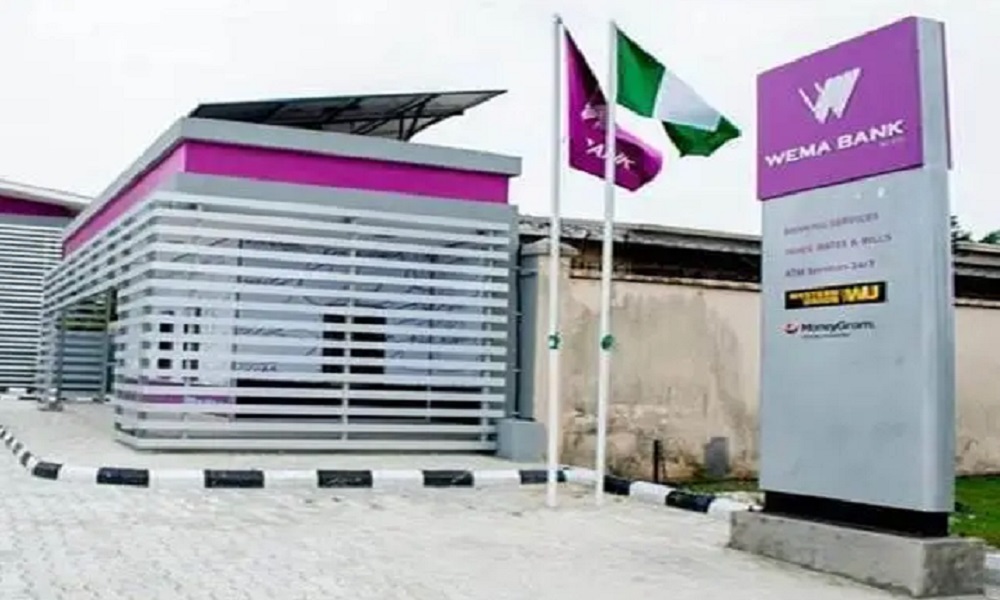
Wema records 196% profit before tax in 2023 financial report
- /home/naijuinz/public_html/wp-content/plugins/mvp-social-buttons/mvp-social-buttons.php on line 27
https://naijablitznews.com/wp-content/uploads/2024/04/Wema-Bank.jpg&description=Wema records 196% profit before tax in 2023 financial report', 'pinterestShare', 'width=750,height=350'); return false;" title="Pin This Post">
- Share
- Tweet /home/naijuinz/public_html/wp-content/plugins/mvp-social-buttons/mvp-social-buttons.php on line 72
https://naijablitznews.com/wp-content/uploads/2024/04/Wema-Bank.jpg&description=Wema records 196% profit before tax in 2023 financial report', 'pinterestShare', 'width=750,height=350'); return false;" title="Pin This Post">
Wema Bank says it has recorded profit before tax growth of 196 per cent from ₦14.75bn to N43.59 billion the Year 2023 Audited financial statement.

The bank also proposed a dividend per share of 50kobo; up from 30 kobo in 2022 and deposit growth of 60 per cent to ₦1,860.57bn from ₦1,165.93bn reported in FY 2022.
“Return on Equity (ROAE) of 39.28%, NPL of 4.31% and N40billion 1st tranche of Capital raise awaiting final regulatory approvals,” a statement from the bank said.

Commenting on the results, the MD/CEO, Mr. Moruf Oseni said, “2023 showcased a revitalised Wema Bank as evidenced by the considerable improvements in our numbers. The performance is headlined by impressive improvements in Profit before Tax which grew strongly by 196%.”
He noted that the growth of Gross Earnings by 72%, Total Assets by 56% and earnings per share at 279.5 kobo shows the core improvements to the bank’s balance sheet.
“In addition, our cost to income ratio at 64.37% has witnessed significant improvement from the previous period.
“We also completed our N40bn Capital raise exercise (results awaiting final verification by regulators). This exercise actively positioned us for the new capital licensing requirements of the Central Bank of Nigeria. Wema Bank will accelerate its capital management plans and ensure we embark on the journey to raise the required capital as quickly as possible.
“The Bank will be proposing a dividend per share of 50 kobo to its shareholders at the next Annual General Meeting; this is in line with the Bank’s capital conservation strategy and to ensure that it continues to provide returns to its shareholders in anticipation of additional capital raises scheduled for later this year.
“We are satisfied with the bank’s performance in the first year of the new leadership team, as we move in a strong growth trajectory. Our target remains clear, we want to become a Top-Tier Bank in the industry powered by Digital excellence, we have carved a niche for ourselves with ALAT as a Retail platform, but we are now positioning the enterprise as the Intelligent platform for all financial services.
“We have partnered with the Federal Government on upskilling Two Million MSMEs, provided engagement platforms for all NYSC members and are now implementing partnerships in Health, Education, Women empowerment and in the green economy.
“In the months ahead, we would be developing platforms and supporting initiatives that prioritise the needs of our customers, leveraging technology in solving problems across all sectors.”

Economy
FAAC: FG, states, LGs share N2.257tn April revenue
The Federal Government, states and local government councils shared a total sum of N2.257 trillion from the Federation Account in April.
Director, Press and Public Relations, Office of the Accountant General of the Federation, Bawa Mokwa, disclosed this in a statement on Monday.
The revenue was shared at the May 2026 Federation Account Allocation Committee, FAAC, meeting held in Abuja.
The N2.257 trillion total distributable revenue comprised distributable statutory revenue of N1.260 trillion , distributable Value Added Tax, VAT, revenue of N747.088 billion, and augmentation of N250.000 billion.
This indicated that total gross revenue of N3.184 trillion was available in the month of April 2026. The total deduction for cost of collection was N113.756 billion, while total transfers, refunds, and savings were N813.839 billion.
According to the statement, gross statutory revenue of N2.378 trillion was received for the month of April 2026. This was higher than the sum of N1.699 trillion received in the preceding month by N678.224 billion.
Gross revenue of N806.617 billion was available from VAT in April 2026. This was higher than the N664.425 billion available in the month of March 2026 by N142.192 billion.
The communiqué stated that from the N2.257 trillion total distributable revenue, the Federal Government received a total sum of N787.351 billion, and the state governments received a total sum of N772.360 billion.
The local government councils received N540.152 billion, while the sum of N157.254 billion (13% of mineral revenue) was shared with the benefiting states as derivation revenue.
On the N1.260 trillion distributable statutory revenue, the statement stated that the Federal Government received N580.942 billion and the state governments received N294.661 billion.
The local government councils received N227.172 billion, and the sum of N157.254 billion (13% of mineral revenue) was shared with the benefiting states as derivation revenue.
From the N747.088 billion distributable VAT revenue, the Federal Government received N74.709 billion, the state governments received N410.898 billion, and the local government councils received N261.481 billion.
The Federal Government received N131.700 billion of the N250.000 billion, the state governments received N66.800 billion, and the local governments received N51.500 billion.
In April 2026, Companies Income Tax, CIT, CGT, SDT, import duty, oil and gas royalty, and VAT increased significantly, while Petroleum Profit Tax, PPT, and hydrocarbon tax, HT, decreased considerably.
Excise duty and CET levies decreased marginally.
Economy
Nigeria’s company income tax drops to N1.37tn in Q1 2026 — NBS
Nigeria’s company income tax, CIT, decreased in the first quarter of 2026 to N1.37 trillion.
The National Bureau of Statistics, NBS, disclosed this in its CIT report released on Monday.
The report showed that the country’s CIT dropped by 8.98 percent when compared to N1.449 trillion collected in Q4 2025.
Further breakdown showed that domestic CIT stood at N538.91 billion, while foreign payments accounted for N828.82 billion in the period under review.
“Company Income Tax (CIT) in Q1 2026 stood at N1.37 trillion, indicating a decrease of 8.08 percent on a quarter-on-quarter basis from N1.49 trillion in Q4 2025.
“Of the total CIT collected, domestic CIT contributed N538.91 billion, while foreign CIT payment accounted for N828.82 billion during the quarter,” the NBS stated.
Economy
Revenue: IMF asks FG to impose fuel, telecom taxes
The International Monetary Fund has recommended introducing taxes on fuel products and telecommunications services in Nigeria as part of broader measures to increase government revenue and create fiscal space for development spending and social interventions.
The recommendation was contained in the IMF’s 2026 Article IV Consultation report on Nigeria, where the Fund argued that additional tax measures would be needed over the medium term despite the recent overhaul of the country’s tax system.
“Further tax policy changes will likely be needed—such as increasing the VAT rate, extending VAT to fuel products, rationalising tax expenditures in particular VAT exemptions on extractive industries and some customs duties, and introducing telecom excises—to complement administrative gains,” the IMF said.
The Washington-based institution, however, cautioned that the timing of any new taxes must take into account Nigeria’s rising poverty levels and worsening food insecurity.
“The timing of reforms must consider the poverty and food insecurity situation and ensure that the cash transfer system is in place and funded,” the Fund added.
The recommendation is likely to trigger fresh debate across the country, given the sensitivity surrounding fuel prices and telecommunications costs.
A previous attempt by the Federal Government to introduce a five per cent excise duty on telecom services faced widespread opposition from operators, subscribers and consumer advocacy groups before it was eventually suspended and later scrapped.
Telecommunications companies had argued that the sector was already burdened by multiple taxes, rising energy costs, foreign exchange pressures and infrastructure challenges, warning that any additional levy would ultimately be passed on to consumers through higher call and data charges.
Similarly, proposals linked to fuel taxation have generated opposition from labour unions and private sector groups amid concerns over rising living costs following the removal of petrol subsidies and increases in transport and food prices.
The IMF’s latest recommendation comes as it projects that Nigeria will need stronger revenue mobilisation efforts to sustain planned increases in public spending and support vulnerable households.
According to the report, revenue-enhancing tax policies could generate additional revenues equivalent to 3.9 per cent of Gross Domestic Product within three years of implementation. The Fund identified a two-percentage-point increase in the Value Added Tax rate as the single largest contributor, with an estimated revenue gain of 0.8 per cent of GDP.
It also projected that removing pioneer status incentives and revising free zone regulations would generate another 0.7 per cent of GDP, while reforms to capital gains taxation and adjustments to personal income tax bands, allowances and rates would each contribute 0.6 per cent of GDP.
The IMF further estimated that a top-up tax on multinationals and large firms could raise 0.5 per cent of GDP, while rationalising investment allowances would add another 0.4 per cent.
Notably, the category labelled “others”, which includes telecom excise duties and other measures such as a carbon tax on fuel, was projected to contribute an additional 0.4 per cent of GDP in revenue gains.
Beyond new tax measures, the Fund said Nigeria could generate even larger gains through stronger tax administration.
It projected that administrative reforms would yield an additional 3.1 per cent of GDP through improved compliance, enforcement and efforts to reduce informality in the economy.
According to the report, measures such as fiscalisation, electronic invoicing and cross-validation of tax deductions could generate 1.5 per cent of GDP, while expanded tax identification registration and consolidation of taxpayer databases could contribute another 1.6 per cent of GDP.
The IMF acknowledged that some of Nigeria’s recently enacted tax reforms would reduce government revenue in the short term because they were designed to support households and small businesses.
It estimated that revenue-reducing measures would lower revenues by 2.4 per cent of GDP, with expanded VAT input credits, additional zero-rated items and broader exemptions on basic consumption goods accounting for 1.7 percentage points.
Lower corporate income tax obligations for smaller firms would reduce revenues by 0.4 per cent of GDP, while lower personal income tax rates and expanded exemptions for low-income earners would account for another 0.3 percentage point reduction.
Overall, the IMF projected that the combined impact of revenue-enhancing measures, administrative reforms and revenue-reducing policies would result in a net increase in government revenue equivalent to 4.6 per cent of GDP over the medium term.
The Fund argued that stronger revenue mobilisation had become increasingly important because Nigeria’s fiscal position remained under pressure despite recent reforms.
-
News17 hours agoJust in: Kwara traditional ruler reportedly dies in kidnappers hideout after demand of N21m ransom
-
News22 hours ago2025 Capital Budget Gets New Lease of Life as Reps Push Deadline to September
-
News7 hours agoSokoto under siege as bandits bar farmers from farms impose new levies
-
Politics17 hours agoHours after Abuja Court ruling, another Court in Owerri rules against deregistration of party
-
News12 hours agoNigerian Ports Record Global Leap as Apapa, Tin Can Gain World Bank Recognition
-
News18 hours agoFinally, US-Iran deal announced with end to military warefare
-
News19 hours agoPrice of petrol expected to drop to N900 per litre as US-Iran opens way for Strait of Hormuz
-
News6 hours agoHow troops rescued Gen Rabe’s wife after being shot by bandits — Sources

Warning: Undefined variable $user_ID in /home/naijuinz/public_html/wp-content/themes/zox-news/comments.php on line 49
You must be logged in to post a comment Login