
News
Benue’s Journey of Political Crisis


- /home/naijuinz/public_html/wp-content/plugins/mvp-social-buttons/mvp-social-buttons.php on line 27
https://naijablitznews.com/wp-content/uploads/2024/05/IMG-20240514-WA0025_1-652x600.jpg&description=Benue’s Journey of Political Crisis', 'pinterestShare', 'width=750,height=350'); return false;" title="Pin This Post">
- Share
- Tweet /home/naijuinz/public_html/wp-content/plugins/mvp-social-buttons/mvp-social-buttons.php on line 72
https://naijablitznews.com/wp-content/uploads/2024/05/IMG-20240514-WA0025_1-652x600.jpg&description=Benue’s Journey of Political Crisis', 'pinterestShare', 'width=750,height=350'); return false;" title="Pin This Post">


By Nombor Philip Terlumun
Benue State is one of the North Central states in Nigeria, created on 3rd February, 19976 with a population of about 4,253,641 according to the 2006 census. The people of the State are mostly agrarian, fishermen and forest hunters. Peaceful coexistence of diverse culture and heritage.
History, as defined by certain scholars, is the systemic study of past, present and future events, particularly in human affairs. Benue has it history dating as far back as C 1500 when the Tiv first arrived what is today known as the Benue Valley.
The political structure and leadership of the Tiv and Benue was based on age, the oldest in every community was the head of the community with the responsibilities of séance on behalf of the people, settling disputes, allocating lands to each member (household) of the community, performing marital rites and others as was assigned him.
As time goes on, among the Tiv of Benue valley, the position of tor Agbande was instituted between the 18th-19th century, which became the highest office among the Tiv nation- Tesemchi Makar (1994).
Until the establishment of the Tor Tiv stool, the Ôrtar, ityôr, tax collectors and the first class chiefs, the ator Agbande were the highest, most powerful and revered institutions and offices among the Tiv.
The advent Christianity and the western education in Nigeria, the Benue valley was marked for capture between 1830-1900 which will later change it ancestral style of leadership to present leadership style.
Modern Politics
The iconic Sen. Joseph Sarwuan Tarkaa was Tiv first to venture into partisan politics, first as the Federal Commissioner of Transport and then Communications under General Yakubu Gowon, one of the founding fathers of the United Middle Belt Congress (UMBC). In 1979, Tarkaa was elected senator to represent Benue East.
In rejection of being lord over by Muslims and northern politicians, the UMBC under the leadership of J S Tarkaa rejected the Native Authority’s support for the Northern People’s Congress (NPC) and instructed no Tiv to be member of the NPC.
As it’s often said, politics is a game of interest, personal interest. For political and personal reasons and interest, the UMBC registered its members while the NPC also registered its members in the state.
Tarkaa, who felt politically threaten by northern politicians, declared the abolishment of the NPC in the state, refusal to denounced membership was grievous. This marked the beginning of the first Tiv political crisis named Atem Ityô, Nande Nande or Num u Parti u Baja.
Families were divided against each other, ropes were tied across compounds to separate members of the UMBC and the NPC, brothers betrayed brothers to death, food was shared and eaten by members of same political parties only, it was a feast of corpses, houses were razed and traditional rulers killed. The traditional rulers were the primary target of the Tarkaa’s UMBC as it was believed or thought they were doing the bindings of the Sudan of Sokoto. This marked the beginning of the unending political crisis in Benue.
Peace however returned after the 1979 elections which saw Aper Aku elected Gov of the state. There was political and leadership stability from Aku’s 1979-1999.
When democracy returned in 1999 with full flagged and registration of multiple political parties, again the Tiv nation became the battle field, an ocean flowing of blood.
This time, the People’s Democratic Party (PDP) of then governor His Excellency Sen George Akume and the All Nigerians People’s Party (ANPP) of Sen Daniel Saor and Paul Iorpuu Unongu whose national leader was Gen. Muhammadu Buhari Rtd. The ANPP at all times, tagged the Akume’s administration as being corrupt, inhumane and undeserving for the people of the State.
The PDP on the other hand, was determined holding on to power as long as it could not minding the consequences.
Unongu’s Kwande Paid the Price
As the political tussle between the PDP and ANPP continue unabated. The first four years of the PDP came to an end and elections were set to hold in 2003.
The elections were to change the present Government or re-elect the government for continuity.
The two popular candidate were Sen George Akume who was seeking re-election and Chief Paul Unongu, who was contesting to oust Akume.
Akume was re-elected on the 19th, April 2003 with total votes of 681,717. Unongu, Adasu and Mku scored 0 votes as was declared by INEC.
However, Kwande rejected the governorship results insisting they voted for Unongu in unison, everywhere became tensed, fear took over Benue as other local governments too rejected the governorship results.
Kwande Took a Step
In what seems like a drama stage, Kwande stood their ground and rejected Akume’s PDP during the chairmanship elections. Two local governments chairmen were marked by the government of day to be ousted no matter the circumstances, they were Kwande chairman and Timothy Aondoakaa of Vandeikya.
Sensing rejection of PDP in Kwande, thousands of militias were sent to hijack ballot boxes and ensure the PDP wins the Kwande LG elections. Kwande youths and elders refused being intimidated by political thugs. A situation that generates into full political war between the Kwande and the militias with Basil Kwambe serving as the medium of communication between the militias and their sponsors.
Lives were lost, homes destroyed, other properties worth billions razed.
My village of Ute, neighboring Kwande became the refugee home of the Kwande people.
At a time we were fighting to recover the Tiv-Jukun crisis of 2001, the Vaase, Gbeji, Zaki-Biam and katsina-Ala military invasion, we were hit more harder by the Tiv politics of “Aya sha Agee”.
Today, I see youths fueling political crisis on social Media. Yes, we may not witness the Atem Ityô but majority of us witnessed the Kwande political crisis of 2003-2004 and, we know the level of damages it caused and the number of lives lost.
If you are a stakeholder, be stakeholding well and ensure those you are stakeholding for were not responsible for the Kwande crises of 2003-2004 and will not be responsible for Political Crisis in the State.
If you are the masses, mass well and ensure those you are massing for were not responsible for the Kwande crises of 2003-2004 and will not be responsible for Political Crisis in the State.
Don’t be the tool of the next Atem Ityô in the 21st century.
(Nombor Philip Terlumun (Glasgow, UK), could be reached via +1 914 520-5126
Email: [email protected])

… Reaffirms loyalty to President Bola Tinubu, vows to continue building sustainable leadership
Former Governor of Rivers State and Minister of the Federal Capital Territory (FCT), Chief Nyesom Wike, has challenged the people of Evo Kingdom to point to any tangible development or political empowerment attracted to their land by his predecessor, Chibuike Rotimi Amaechi, despite holding top political offices as Speaker, Governor, and Minister for 24 years.
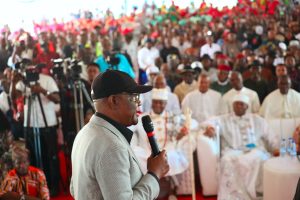
Speaking during an interactive session with leaders and stakeholders of Evo Kingdom in Obio-Akpor Local Government Area, Wike declared that unlike past leaders who used their elevation to pull down others and monopolize power, his political philosophy centers on human capacity development, divine gratitude, and uplifting his people.
Wike questioned the moral right of those who spent decades in high offices without leaving behind a legacy of leadership or infrastructure in the area, warning against selfish politics that crumbles once the leader passes on.
”Because how will I answer before God if these people could take that kind of risk, and opportunity came up for you to help, for you to uplift them? But because of your greed, because of your selfishness, you don’t want anybody to reach the level you are,” Wike said.
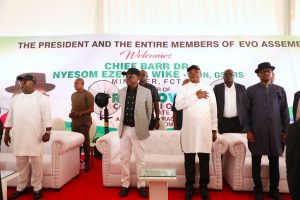
He said; “You don’t want anybody in Obio-Akpor to be governor again because you have become governor. God will not be happy with me”.
Taking direct aim at Amaechi’s 24-year tenure across various arms of government, Wike challenged the kingdom to present evidence of what was attracted to the land under his rival’s reign.
”Someone was Speaker of the House of Assembly for eight years, Governor for eight years, and Minister for eight years—that is 24 years in top leadership positions! What can anybody point to that he attracted to Evo Kingdom or Rivers State in all those 24 years? Nothing! Not one single thing!
”I was a Minister of State for Education, and as I sit here, I can count the projects I brought to Rivers State and my people. But somebody was Speaker, Governor, and headed a very lucrative ministry as a full Minister for eight years, yet brought nothing back home! How can someone who spent 24 years in power without empowering his people or raising new leaders now turn around to tell you he loves you?” Wike queried.

Highlighting his political trajectory and contentment with his achievements under the administration of President Bola Ahmed Tinubu, the FCT Minister stressed that he has no further personal political ambitions other than serving as a vessel for his people.
”After all, what do I want that God has not given to me? Nothing! Nothing! Nothing! The only thing I ask from God today is to continue to give me long life,” he said.
“I can’t be a governor again. I’ve been a minister two times. I cannot be chairman of council again. So I am happy. I don’t have anything to lose”.
He continued: “What leadership, as you are leaving, what’s the leadership you have kept behind to continue with where you have stopped? Because our problem here is that you just want only yourself. When you die, everything crumbles. That is not our own case.”
Addressing political uncertainties and betrayal, the Minister reiterated his firm trust in God rather than human promises.
”As a politician, I know that the only person who will not disappoint is God,” Wike declared.
“So, don’t ever believe that a human being will not disappoint you. No matter the love you have, do the best you can do. If the person disappoints you, don’t kill yourself. God will right the wrong”, he said.
Wike also recounted how his administration restructured the chieftaincy institution to give Evo Kingdom adequate representation in the Rivers State Council of Traditional Rulers, dismissing claims that traditional politics or native charms could intimidate him.
Political leaders and traditional rulers like Eze Temple Ejekwu
and Elder Peter Chinwo, President of Evo Assembly assured the FCT Minister of victory for the President and other candidates endorsed by the Rainbow Coalition.
News
Nigeria’s Ambassador to Hungary, Abass Ogwime, Selected to Commission Hungarian-African House in Budapest

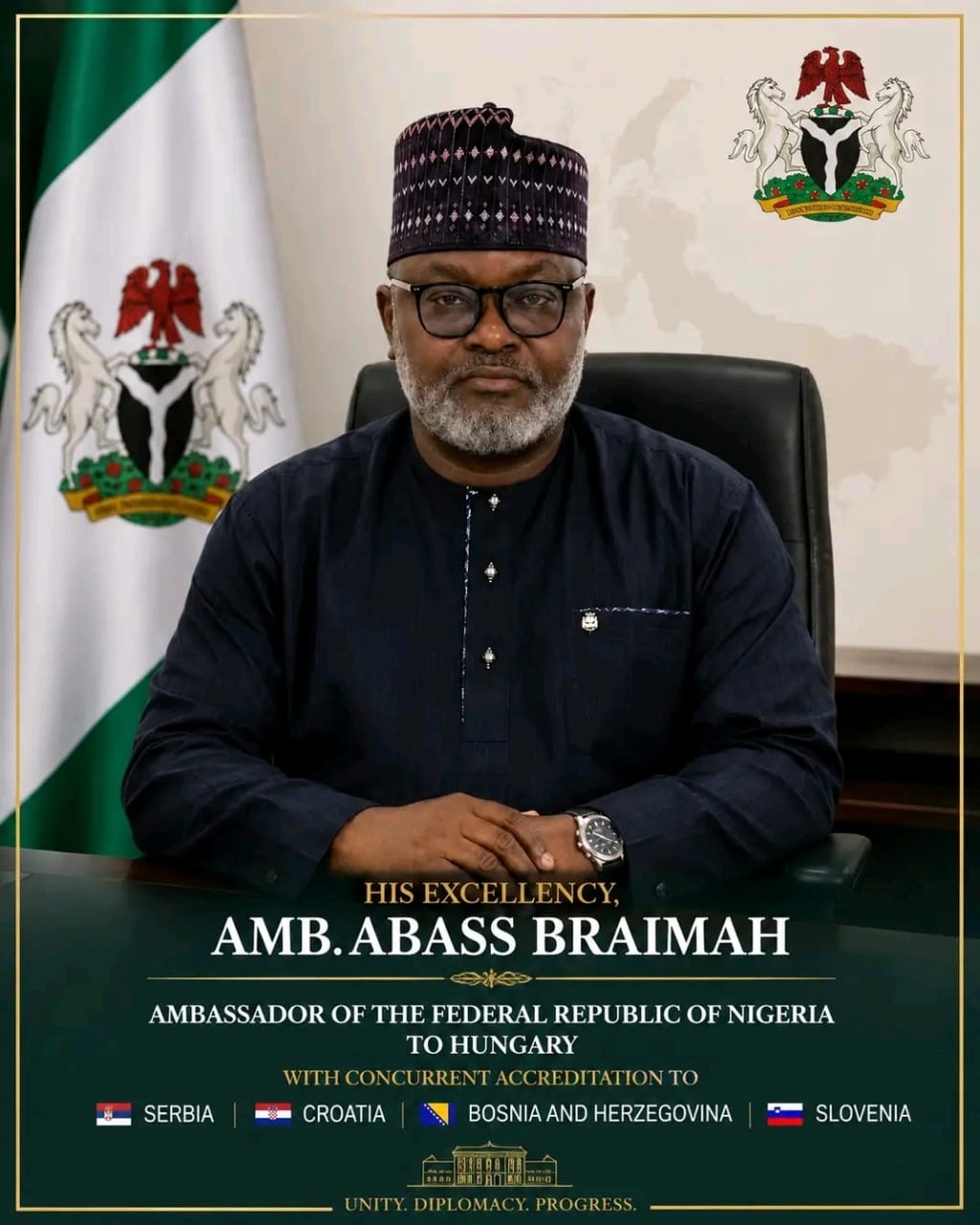
Nigeria’s Ambassador to Hungary, Abass Braimah Ogwime, has been selected among African ambassadors accredited to Hungary to officially commission the newly established Hungarian-African House in Budapest.
Ogwime, who also serves as Nigeria’s ambassador to Serbia, Croatia, Bosnia and Herzegovina, and Slovenia, was the guest speaker at the inauguration ceremony held in Budapest on October 2, 2026.
The event attracted members of the diplomatic community, Hungarian government representatives, African heads of mission, business executives, investors, members of the African diaspora and other stakeholders seeking to strengthen economic, cultural and diplomatic relations between Hungary and African countries.
The Hungarian-African House, known locally as Magyar-Afrika Ház, is an initiative of the Foundation for Africa. The facility is designed to serve as a permanent platform for dialogue, business development, cultural exchange and cooperation between Hungary and African nations.
The initiative is expected to provide a meeting point for Hungarian and African businesses, investors, academic institutions and government representatives to explore investment opportunities, establish strategic partnerships and develop practical areas of collaboration.
Ogwime’s selection as one of the African ambassadors chosen for the commissioning underscores Nigeria’s participation in diplomatic engagements aimed at expanding cooperation between African countries and Hungary.
The Nigerian Embassy in Budapest reaffirmed its commitment to strengthening diplomatic ties, promoting economic partnerships and supporting initiatives that encourage collaboration between Nigerian, African and Hungarian institutions and communities.
The establishment of the Hungarian-African House comes amid broader efforts to deepen Africa-Europe engagement through trade, investment, cultural diplomacy and institutional partnerships.
The new facility is expected to provide a dedicated space for advancing these objectives and fostering long-term relationships between Hungary and African countries.
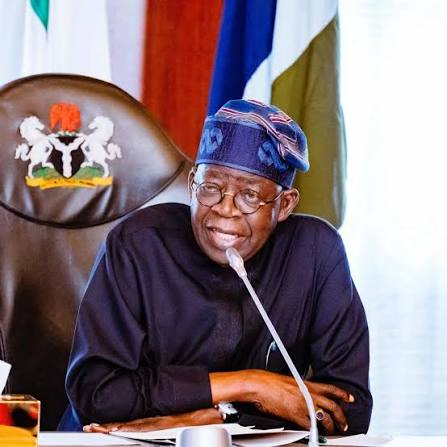
Hundreds of youths on Thursday staged a peaceful protest in Potiskum Local Government Area of Yobe State, demanding an end to President Bola Tinubu’s administration over worsening economic hardship, insecurity and unemployment.
The demonstration, tagged “Tinubu Must Go”, coincided with Nigeria’s 66th Independence Anniversary on October 1.
The protesters marched through the Tsohowar Kasuwa area of Potiskum, carrying placards and flags of the African Democratic Congress (ADC), while expressing dissatisfaction with the state of the country.
They said President Tinubu’s Independence Day broadcast failed to address their concerns, particularly the rising cost of living, poverty, unemployment, insecurity and what they described as poor governance since the administration assumed office in 2023.
Speaking to journalists on condition of anonymity, one of the protesters said the demonstration was an exercise of their fundamental rights and a call for urgent action to address the country’s challenges.
“We came out today to express our fundamental rights, freedom of speech. We are suffering from this government, people are dying due to insecurity, poverty and unemployment in the land,” the protester said.
Another demonstrator, who identified with the opposition, expressed concern over the country’s economic situation and the state of the education sector.
He said the youths were dissatisfied with the government’s handling of issues affecting ordinary Nigerians.
Similarly, a protester identified as Malam Gambo said the demonstration was organised to draw attention to hunger, insecurity and what the participants described as bad governance.
Eyewitnesses reported that the protest remained peaceful and orderly, with young men and women making up the bulk of the demonstrators.
Some participants were seen carrying ADC flags as they marched through parts of Potiskum to express their grievances against the Tinubu administration.

Wike fires Amaechi: You failed as Speaker, Governor and Minister For 24 Years(Photos)

Nigeria’s Ambassador to Hungary, Abass Ogwime, Selected to Commission Hungarian-African House in Budapest

‘Tinubu Must Go’: Yobe Youths Protest Economic Hardship, Insecurity



-

 News21 hours ago
Independence Day: NNPCL Slashes Petrol Price With N66 Discount for Nigerians
-

 Metro20 hours ago
‘I Hit Her With a Pistol, Hacked Her With Machete’ — Suspect Confesses to Killing Girlfriend in Enugu
-
 News23 hours ago
Nigeria Bids Farewell to Reverend Okoye, Ex-Aso Villa Chaplain
-

 News18 hours ago
2027: Wike rallies support for Tinubu In Akpor kingdom, Insists He’II resign as Minister should president lose FCT, Rivers(Photos)
-

 Sports20 hours ago
Man City Launch Appeal Against Premier League Verdict Over £830m Financial Scandal
-
 Sports20 hours ago
AFCON 2027: Chelle Vows Super Eagles Will Bounce Back, Targets Tanzania Double
You must be logged in to post a comment Login