

News
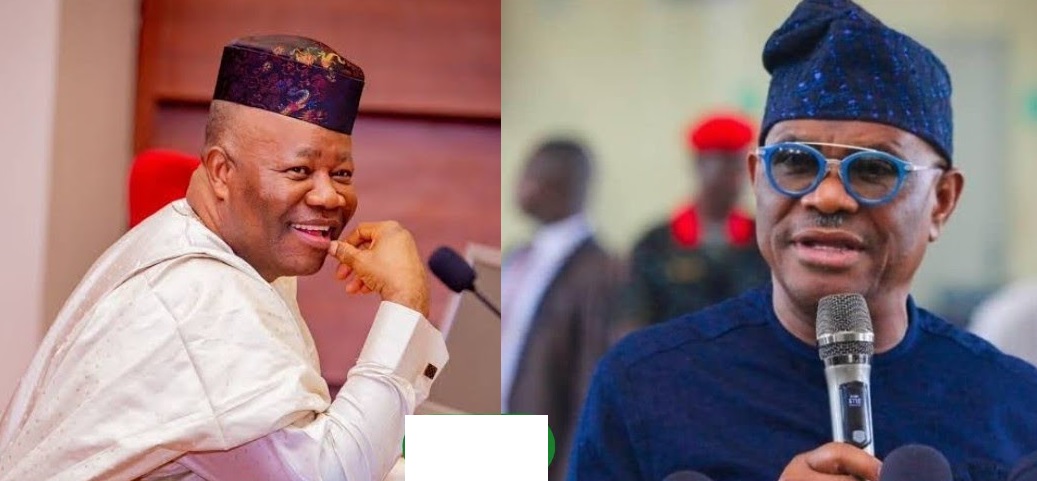
How Akpabio and Wike are shaping Tinubu’s 2027 path to victory in South-South zone
- /home/naijuinz/public_html/wp-content/plugins/mvp-social-buttons/mvp-social-buttons.php on line 27
https://naijablitznews.com/wp-content/uploads/2024/12/Akpabio-Wike-1000x481.jpg&description=How Akpabio and Wike are shaping Tinubu’s 2027 path to victory in South-South zone', 'pinterestShare', 'width=750,height=350'); return false;" title="Pin This Post">
- Share
- Tweet /home/naijuinz/public_html/wp-content/plugins/mvp-social-buttons/mvp-social-buttons.php on line 72
https://naijablitznews.com/wp-content/uploads/2024/12/Akpabio-Wike-1000x481.jpg&description=How Akpabio and Wike are shaping Tinubu’s 2027 path to victory in South-South zone', 'pinterestShare', 'width=750,height=350'); return false;" title="Pin This Post">
By Sufuyan Ojeifo
In the grand chessboard of Nigerian politics, the South-South zone has emerged as a theatre of intrigue, ambition, and transformation. Long held as the stronghold of the Peoples Democratic Party (PDP), this six-state belt comprising Akwa Ibom, Rivers, Edo, Delta, Bayelsa, and Cross River, has been defined by its oil wealth, complex ethnic calculus, and history of federal marginalisation. Yet, the tide is shifting. With 2027 approaching, a new alliance is redrawing the region’s political geography. At the helm are two battle-tested tacticians: Senate President Godswill Obot Akpabio and Federal Capital Territory Minister Nyesom Ezenwo Wike.
Their synergy is no accident. Forged from years of shared pragmatism and mutual respect, sharpened by political combat and cemented by President Bola Ahmed Tinubu’s strategic confidence in both men, the Akpabio-Wike axis is now Tinubu’s ace in a region that was once sceptical of the All Progressives Congress (APC). With each passing month, their influence deepens, their networks expand, and the South-South’s loyalty to Tinubu’s “Renewed Hope” agenda grows more visible.

■ Governor-kingpins turned federal titans
Akpabio’s rise to national prominence began in Akwa Ibom, where he governed from 2007 to 2015. His “Uncommon Transformation” agenda produced visible infrastructure, modernised education, and redefined the capital, Uyo. But it was not just the roads and buildings that endured. He cultivated a political machine anchored in loyalty, patronage, and performance. Even after switching to the APC in 2018, Akpabio remained a force. Today, as Senate President, he sits at the apex of legislative influence, blending state-level charisma with national clout.
Wike’s trajectory mirrored Akpabio’s in intensity, if not in tone. As Rivers governor from 2015 to 2023, he governed with a bulldozer’s energy and a rather colourful tongue, to coin a stylistic phrase. Flyovers, bridges, and public schools dotted the Port Harcourt skyline on his watch. But beyond infrastructure, Wike built a fearsome political machine. His infamous quip “As e dey pain dem, e dey sweet us” became a rallying cry, both combative and celebratory. Now ensconced in Abuja as FCT Minister, he wields federal power with the same swagger he honed in Rivers.
■ The Alliance: Born of fire, forged by realpolitik
Akpabio and Wike were not always allies. Their political paths criss-crossed with sparks. In 2021, they clashed publicly over Niger Delta Development Commission (NDDC) funds, a spat that underlined their mutual wariness. But both men are students of power. They understand the difference between friendship and alignment, between temporary quarrels and long-term stakes.
It was Tinubu’s deft orchestration during and after the 2023 elections that brought them fully into alignment. Akpabio, having weathered internal resistance, clinched the Senate Presidency with Tinubu’s blessing. Wike, fresh from his bruising battles within the PDP, accepted the FCT Ministry role, a position of unusual visibility and executive reach. Both moves were calculated. Both men were handed levers of federal influence and a mandate to reengineer the South-South.
■ Structures of influence, engines of mobilisation
In Akwa Ibom, Akpabio’s dominance remains palpable. Though no longer governor, his imprimatur still shapes political outcomes. But he has not limited himself to his home base. With Tinubu’s support, he has expanded into Edo, backing Monday Okpebholo as APC’s governorship standard bearer. It is a bold move. Edo is known for its political volatility and resistance to outside influence. But Akpabio’s intervention, far from being resented, has introduced coherence to APC’s strategy in the state.
Wike, meanwhile, remains the undisputed strongman of Rivers. His grip is institutional, emotional, and electoral. But he, too, is thinking beyond his borders. In Cross River, where APC already governs, Wike’s overtures to political elites have been welcomed. In Bayelsa, his growing presence is unmistakable. The recent federal projects and policy footprints traceable to his influence are not mere happenstance. They are tactical incursions.
Delta presents a more nuanced picture. Historically, a PDP territory, the state is now wobbling under the weight of internal realignments. Former governor James Ibori, long seen as a political heavyweight, is now shepherding loyalists towards Tinubu. Governor Sherrif Oborevwori and former governor Okowa, both once staunch PDP figures, are said to be warming up to APC structures. While Akpabio’s footprint in Delta is light, the broader Tinubu machinery, with Ibori’s navigation, is making the state increasingly receptive to the APC.
■ Performance meets patronage: Strategic federal roles
Wike has turned the FCT Ministry into a political theatre. Whatever one may feel about Wike’s personality, what one cannot deny is his passion to get tangible things done. As such, Abuja’s infrastructure is getting a facelift. But so too is Tinubu’s federal brand.
Roads, public buildings, and new policies bear Wike’s activist signature. In town hall meetings, on social media, and within elite circles, the message is the same: performance is the new propaganda. By centralising federal attention on Abuja, Wike is showing what APC governance looks like when driven by energy and urgency.
Akpabio, on his part, has used the Senate Presidency not merely for legislative function but for grassroots outreach. His N2 billion constituency intervention included minibuses, scholarships, grants, and institutional support across the South-South. His ability to push tertiary education bills and galvanise federal attention for South-South issues has earned him fresh respect. His statement that there would be “no opposition in 2027” may have raised eyebrows, but it also signalled intent: Tinubu’s path to re-election runs through consolidated zones, not contested ones.
■ Shifting political pulse: Communities react
Across the South-South, the Akpabio-Wike effect is being felt. In Akwa Ibom, even a PDP-elected governor like Umo Eno has decamped to the APC and endorsed Tinubu, citing national unity and pragmatism. In Delta, the underground acceptance of APC structures by traditional PDP actors signals an ideological drift. In Edo, the momentum behind Monday Okpebholo is energising new voters. Across the region, community-level feedback is turning from suspicion to curiosity, and from curiosity to cautious embrace.
The message is simple: Tinubu is present, his proxies are performing, and the South-South is watching.
■ Cracks in the alliance?
But even the most masterful alliance is not immune to stress. Wike’s style, brash and unapologetic, occasionally alienates more conservative voices. His battles with Rivers State Governor Siminalayi Fubara have drawn criticism, even from within the APC. Akpabio’s centralised approach to legislative control sometimes unsettles other regional stakeholders. And within the APC itself, murmurs of discomfort abound. Some loyalists are already voicing concerns about decampees “eating the food they didn’t cook.”
Tinubu’s balancing act is delicate. He must retain the loyalty of his South-South chess masters while keeping the party’s internal cohesion intact. He must deliver real dividends to validate the political realignments or risk disillusionment. The alliance is built on power, yes, but it must now translate into prosperity.
■ A Masterstroke or a mirage?
For now, the Akpabio-Wike synergy is Tinubu’s most potent weapon in the South-South. It is a political gambit that combines pedigree, performance, and proximity to the grassroots. It is a blend of old-school mobilisation and modern political calculation.
But it is also a structure that must be nurtured. Regional expectations are high. The hunger for representation is matched only by the thirst for results. Tinubu’s challenge is to make this alliance not just an electoral machine but a development vanguard.
The South-South is watching. In the chess game of Nigerian politics, Akpabio and Wike have made their opening gambits. The endgame may well determine not just Tinubu’s re-election but the lasting legacy of a region long poised for its moment at the centre.
For now, the pieces are in motion. The king has placed his confidence in two grandmasters. The board is set. And 2027 is the checkmate they seek. How will the game end? Only time, as always, will tell.

News
Ekiti APC Primary: Lawmaker Urges Party to Enforce Electoral Act Over Candidate’s Eligibility
By Gloria Ikibah
A member of the House of Representatives, Rep. Kolawole Akinlayo, has urged the leadership of the All Progressives Congress (APC) to strictly apply the provisions of the Electoral Act in resolving the controversy surrounding the party’s primary election for Ekiti North Federal Constituency II.
Akinlayo, who represents Moba/Ilejemeje/Ido Osi Federal Constituency in the House, made the appeal while speaking with journalists in Abuja on Sunday, following a petition he submitted to the APC National Chairman and the party’s National Assembly Appeal Committee over the outcome of the primary election held on 16 May.
The lawmaker argued that compliance with Section 88(1) of the Electoral Act, 2026, as well as the APC Constitution, is essential to safeguarding the credibility of the party’s internal democratic process ahead of the 2027 general elections.
He maintained that the rule of law should take precedence over political considerations, warning that any departure from the Electoral Act could weaken confidence in the party’s candidate selection process and expose the APC to avoidable legal disputes.
Akinlayo also challenged the eligibility of the aspirant declared winner of the primary, Kunle Ibrahim, contending that he did not meet the legal requirements to contest the election.
According to the lawmaker, Ibrahim was still serving as a Special Assistant in the Office of the Secretary to the Government of the Federation at the time the primary was conducted and remained on the government payroll until May 2026.
He insisted that the party should carefully review the facts surrounding the matter and ensure that its final decision is consistent with both the Electoral Act and its own constitution to protect the integrity of the nomination process.
Akinlayo argued that Ibrahim’s participation violated Section 88(1) of the Electoral Act, 2026, which provides that:
“A political appointee at any level shall not be a voting delegate or be voted for during party conventions, congresses or primaries of any political party for the purpose of the nomination of candidates for any election.”
Citing the Supreme Court’s decision in Tukur v. Mustapha (2023), the federal lawmaker contended that political appointees seeking elective office must first resign their appointments before participating in party primaries.
“The purported winner is not qualified to participate in the primary election by virtue of Section 88(1) and his participation, in the eyes of the law, is a nullity ab initio,” he argued.
Beyond the issue of eligibility, Akinlayo alleged that the primary election was marred by widespread irregularities in several wards across the constituency.
Akinlayo further alleged that the primary election was marred by widespread irregularities, including the absence of voter accreditation in some polling areas, inflated vote figures in others, voter suppression and disruption of the exercise in locations where he claimed to enjoy significant support.
He also accused certain local government and party officials of compromising the integrity of the process by serving as returning officers despite having vested interests in the outcome of the election.
Citing the alleged violations, the lawmaker called on the APC leadership to apply the relevant provisions of the Electoral Act by disqualifying Kunle Ibrahim from the contest on the grounds of ineligibility and recognising him as the lawful winner, having emerged second in the primary.
As an alternative, he urged the party’s National Assembly Appeal Committee to cancel the results from the affected wards and order a fresh primary election restricted to aspirants who meet the legal requirements.
The dispute has emerged as one of the earliest major internal challenges facing the APC ahead of the 2027 general elections, with the party expected to conclude its appeal process before forwarding the names of its candidates to the Independent National Electoral Commission (INEC).
The controversy has also renewed attention on Section 88 of the Electoral Act, 2026, which reflects provisions contained in the Electoral Act, 2022 concerning the participation of political appointees in party primaries. The issue has repeatedly come before the courts, with the Supreme Court affirming in Tukur v. Mustapha that political appointees must resign their appointments before contesting or participating in party primaries as either aspirants or delegates.
The decision of the APC’s appeal panel is expected to determine who eventually flies the party’s flag in the 2027 House of Representatives election for Ekiti North Federal Constituency II.
News
Saudi Arabia ‘s Aramco Helicopter Crashes, Kills 14
A helicopter crash in Saudi Arabia killed 14 Saudi citizens on Sunday, the kingdom’s official press agency reported, adding that the aircraft belonged to state oil giant Aramco.
The Saudi Press Agency, citing an official at the energy ministry, reported the helicopter crashed in Ras Tanura in the country’s east.
“The accident claimed the lives of all 14 passengers, all Saudi citizens,” the agency said, adding that an investigation was under way to determine the cause of the crash.
Aramco says it operates more than 60 aircraft, including helicopters serving more than 300 heliports in Saudi Arabia, making it one of the largest corporate fleets in the region.
The deadly accident comes as oil-rich Gulf nations seek to ramp up their output following Iranian attacks and the closure of the Strait of Hormuz, a vital waterway for the export of oil and gas.
The Gulf monarchy did not indicate the incident was in any way connected to a hostile attack.
During the Middle East war, Iranian attacks had targeted energy facilities in the Gulf.
Ras Tanura is home to one of the largest refineries in the Middle East, with a capacity of 550,000 barrels per day, and is critical to Saudi Arabia’s energy sector.
The refinery has been targeted several times, notably during an Iranian drone attack at the beginning of the conflict, which caused a fire and forced a partial shutdown.
Riyadh said in April that the weeks-long attacks had disrupted several production operations at key facilities, with refineries in Ras Tanura as well as Jubail, Yanbu and Riyadh targeted.
Saudi Arabia, the world’s leading crude exporter, produces a little over 10 million bpd.
AFP
News
SAD! Bandits’ bomb hits vehicle, kills one, injures many in Sokoto
An Improvised Explosive Device, IED, planted by alleged bandits along the Kurawa–Sabon Birni road in Sokoto State on Sunday hit a vehicle, killing one person and injuring many passengers.
The incident raised fresh concerns over the growing use of explosive devices by criminal groups operating in parts of the North-West.
The vehicle was said to be conveying passengers from surrounding communities to Sabon Birni when it ran over the explosive device, triggering a blast that severely damaged the vehicle and left several occupants injured.
A security analyst based in the area, Bashir Guyawa, disclosed the incident in a post on his Facebook page.
Guyawa described the incident as another reminder of the persistent security challenges confronting communities along the border axis.
He said the vehicle was on a routine passenger trip when the explosion occurred.
“The vehicle was conveying passengers early this morning on their way to Sabon Birni when the unfortunate incident happened,” he wrote.
-
News11 hours agoNDLEA operatives pin down N12.3bn Loud at Lagos port (Photos)
-
News19 hours agoNDC Vice Chairman, Assembly Candidate, Others Defect to APC After Court Nullifies Party Registration
-
News19 hours agoLagos Begins Unique ID Registration For Public, Private School Students
-
News11 hours agoFinally, Oyo Govt Lifts Curfew In 10 LGAs
-
Foreign19 hours agoVenezuela’s earthquake death toll hits 1,430, ‘worst in 123 years’
-
News11 hours agoLady attempts Guinness Record with 144-Hour Bible reading in Port Harcourt
-
News19 hours ago‘My Wife Sent Love Messages To Her Lover, Threatened Me With Knife For Dating Two Of My Church Members’
-
Sports11 hours agoSee fixtures as nine African nations make FIFA World Cup knockout stage

Warning: Undefined variable $user_ID in /home/naijuinz/public_html/wp-content/themes/zox-news/comments.php on line 49
You must be logged in to post a comment Login