
News
Obi, Oyegun, Atiku, others accuse Tinubu of using state arsenal to stifle opposition


- /home/naijuinz/public_html/wp-content/plugins/mvp-social-buttons/mvp-social-buttons.php on line 27
https://naijablitznews.com/wp-content/uploads/2025/12/ghjkh-665x600.jpg&description=Obi, Oyegun, Atiku, others accuse Tinubu of using state arsenal to stifle opposition', 'pinterestShare', 'width=750,height=350'); return false;" title="Pin This Post">
- Share
- Tweet /home/naijuinz/public_html/wp-content/plugins/mvp-social-buttons/mvp-social-buttons.php on line 72
https://naijablitznews.com/wp-content/uploads/2025/12/ghjkh-665x600.jpg&description=Obi, Oyegun, Atiku, others accuse Tinubu of using state arsenal to stifle opposition', 'pinterestShare', 'width=750,height=350'); return false;" title="Pin This Post">


…. Opposition Leaders Raise Alarm over Threat Against Nigeria’s Multi-Party Democracy
…. Accuse Tinubu govt of plot to annihilate opposition
…. Demand independent review body to examine public accounts of federal, state, LGs from 2015 to 2025
…. Propose embedding anti-graft operatives directly into government payment, expenditure processes at all levels
Anti-Corruption, Not Anti-Opposition: A Joint Statement by Opposition Leaders on the Growing Politicisation of State Institutions for Persecution of the Opposition
We are compelled by duty to nation and conscience to issue this statement to alert our compatriots and the international community to the unfortunate and gradual slide of our country into a state where key national institutions – particularly the Economic and Financial Crimes Commission (EFCC); The Nigeria Police; The Independent Corrupt Practices and Other Related Offences Commission (ICPC) are increasingly perceived as tools of political intimidation, selective justice and systematic persecution of opposition leaders.
Across our nation, there are mounting concerns that state power is being deployed not for prevention of economic crimes, but for persecution of perceived political adversaries, with the ultimate aim of weakening opposition voices and dismantling Nigeria’s multiparty democracy.
A Dangerous Agenda Unfolding
More than ever before in our democratic experience, Nigerians have witnessed what many now describe as a covert, undemocratic agenda: to ensure that all state governments fall under the control of the President’s party – not through transparent electoral contests, but by secretly intimidating opposition governors via the anti-corruption apparatus until they succumb and defect. Recent defections of opposition governors into the ruling party have reinforced public suspicion that political pressure, not ideological or personal persuasion, is driving this realignment. This pattern forms part of a broader project that targets not only elected leaders but also key opposition figures perceived as architects of emerging coalitions ahead
of the 2027 general election. We must warn that this project, if allowed to continue unchecked, poses a grave danger to Nigeria’s democratic future.
Weaponisation of the EFCC
There is a discernible pattern of persecution of the opposition by the EFCC with the sole objective of weakening same for the benefit of the ruling APC. This disturbing pattern mirrors a long-standing sentiment openly expressed years ago by a former National Chairman of the ruling APC, Adams Oshiomhole, who declared when receiving defectors from the PDP: “Once you have joined APC, all your sins are forgiven.” Whether intended as political rhetoric or not, this statement has come to symbolise a troubling reality: allegations against members of the ruling party are routinely perceived to be overlooked, while even unsubstantiated accusations against opposition figures are vigorously pursued and subjected to media trial.
A few recent examples reinforce this perception. Months ago, a minister was implicated in a financial scandal so blatant that only sustained public outrage forced her resignation. Yet, long after stepping down, she has neither been charged nor arraigned by the EFCC and is now actively involved in the President’s re-election campaign. Similarly, another minister remained in office despite the university he claimed to have attended publicly denying his academic certificate. He, too, resigned only after intense public pressure, Months later, no charges have been filed.
Such selective enforcement undermines the legitimacy of anticorruption efforts and erodes public trust. Furthermore, Nigerians are not blind to the sudden empowerment of certain political actors, including individuals appointed to federal executive positions after crossing from the opposition but still claim to be members of opposition party – whose unstated mandate, in the public’s eyes, appears to include the systematic destabilisation of opposition parties through the creation of factions, inducement and the exploitation of judicial processes, allegedly funded by state resources.
Erosion of EFCC’s Independence
The EFCC is a critical national institution, created to safeguard Nigeria’s economic integrity.
Yet today, many Nigerians fear that its independence is steadily being eroded. An agency designed for prevention and accountability risks becoming an instrument of political persecution, undermining both justice and democracy. The President must recognise that evident social and political injustice could snowball into mayhem as the nation approaches another election cycle. This trend must be halted immediately if the nation must be spared a major catastrophe.
OUR DEMANDS
Depoliticise EFCC: The operations of the EFCC must be urgently shielded from political interference and must not serve the whims and caprices of any President, party or political faction.
Return EFCC to Its Statutory Mandate: The Commission must refocus on genuine detection and prevention of economic crimes across board, not selective prosecution, media trials or intimidation of opposition figures. For the avoidance of doubt, the Functions and Powers of the Commission are expressly provided for under Sections 6 & 7 respectively.
Defend Multiparty Democracy: Nigerians must remain eternally vigilant to ensure that the President does not transform the country into a de facto one-party state – as witnessed in Lagos over the last 25 years, where opposition leaders were silenced, coerced or induced into irrelevance.
Embed Preventive Anti-Corruption Mechanisms: Relying on the Supreme Court ruling on the powers of the EFCC over all public accounts, for true prevention of financial crimes, anti-graft operatives should be embedded in all the payment processes of governments at all levels to ensure compliance with rules of transparency, accountability and probity in public financial transactions. Put differently, the EFCC must recognise and exercise their function as covering both pre and post expenditure. operatives must also be held accountable for any unreported but later detected economic and financial infractions in their respective areas of oversight. To further strengthen the EFCC, we propose that the EFCC Act should be amended for this purpose.
Establish an Independent Review Body: We call on the Attorney General, in consultation with the National Assembly, to set up an independent review body which should be granted full access to the public accounts of the federal, all states and all local governments covering from 2015 to 2025, with a mandate to conduct a transparent, comprehensive review of financial transactions and publish its findings. Such a review will expose the EFCC’s pattern of selective prosecution of opposition figures and reveal that many current officials of the federal government—and those of ruling-party-controlled states—should have long been prosecuted for economic and financial crimes, but were shielded due to their political affiliation. Based on its findings, the independent body should also propose amendments to EFCC’s enabling law to strengthen the agency for more effective and efficient prevention of financial crimes.
This proposed body is to be chaired by an eminent judge, and composed of the following:
Representatives from civil society organisations
Representatives of the Nigerian Bar Association
Representatives of Institute of Chartered Accountants of Nigeria
Representatives of Institute of Chartered Bankers
The Nigerian Financial Intelligence Unit
Representatives of anti-graft agencies
Representatives of the Police
Representatives of the DSS
Representatives of the Armed Forces
Representatives of all political parties with a seat in the National Assembly.
A Call to Defend Nigeria’s Democracy
We call on all patriotic Nigerians across party lines, professions, regions and faiths to stand firm. Our democracy is under threat through the deliberate and systematic weakening of opposition forces, with the EFCC as the central instrument in this troubling strategy.
In the coming weeks, we will provide more details, and also engage foreign partners of Nigeria’s anti-graft agencies and diplomatic missions, including United States, UK, Canada, EU, World Bank Office, United Nations, to express our deep concern about the EFCC increasingly becoming a willing tool in a broader scheme to weaken opposition in Nigeria, and also demand a reform of the anti graft agency.
Nigeria’s democracy demands our vigilance, courage and unity, as Edmund Burke, an Anglo-Irish statesman and philosopher, warned: “The only thing necessary for the triumph of evil is for good men to do nothing”.
We are equally guided by the enduring words of Martin Luther King Jnr: “Silence in the face of evil is itself evil ……In the end we shall remember not the words of our enemies, but the silence of our friends.” Now is the time for all of us to rise in defence of our cherished multiparty democracy, and indeed, in defence of the very soul of our nation.
We must make a deliberate choice not to be remembered by posterity for our Silence.
Nigeria belongs to all of us – not to a single party or a single leader.
Signed,
Sen. David Mark, GCON
Alh. Atiku Abubakar, GCON
Mallam Lawal Batagawara
Chief Bode George
Mr. Peter Obi, CON
Chief John Odigie-Oyegun

News
Day 4 of projects commissioning as President TInubu set to commission newly constructed Court of Appeal Building


President Tinubu will commission the newly constructed Court of Appeal (Abuja Division) Building today, 15/6/26 as FCT projects commissioning enters Day 4.
#FCTProjects2026
#RenewedHopeFCT
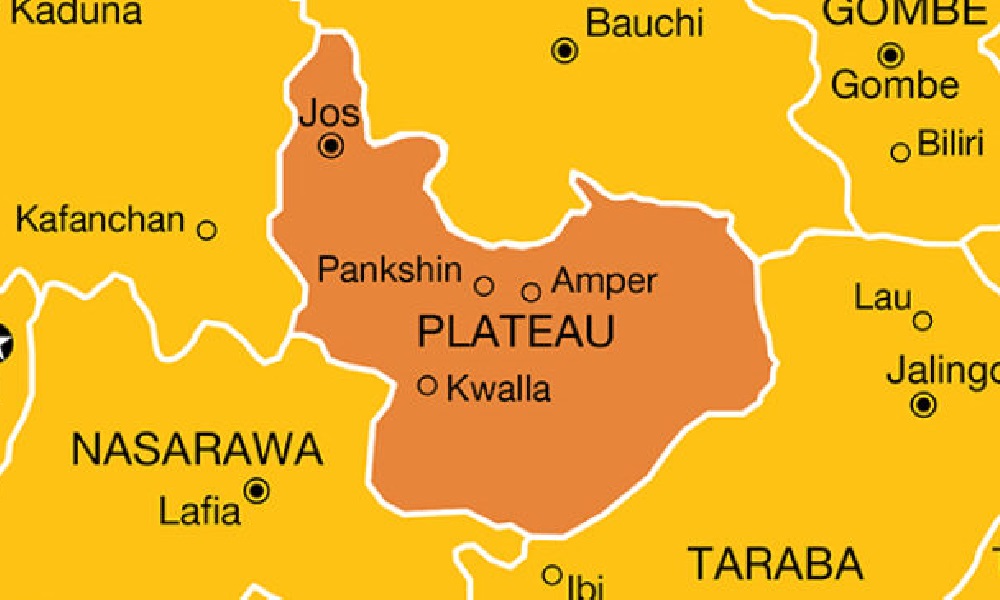
Plateau State commissioner for Health, Dr Nicholas Baamlong, has revealed that the state recorded 11 confirmed cases of cholera, five deaths and 53 suspected cases.
Baamlong, who disclosed this to journalists yesterday in Jos, said the confirmed and suspected cases were reported in Pushit, Mangu 1 and Mangu 2 communities in Mangu local government area (LGA).
According to him, the state Ministry of Health is intensifying public health interventions to contain the outbreak, prevent further spread and reduce its impact on affected communities.
He explained that the state had taken decisive actions to control the outbreak and protect its citizens via the deployment of additional Response Teams (RRTs) to the affected wards, scaling up of treatment centres and isolation capacity and the emergency procurement of Rapid Diagnostic Tests Kits, intravenous fluids and essential drugs.
The Commissioner further said that the ministry had activated an Incident Management System (IMS), for a comprehensive and multi sectorial response to the outbreak.
“The activation of the IMS ensures a coordinated, efficient, and accountable response structure in line with national and international emergency response frameworks,” he said.
Baamlong explained that cholera was an acute diarrhoeal disease caused by consuming food or water contaminated with the bacterium Vibrio cholerae.
He urged residents of Mangu LGA and neighbouring communities to remain vigilant and take preventive measures, including drinking safe water, maintaining proper hand hygiene, avoiding open defecation, and ensuring proper waste disposal.
He also advised residents to promply report suspected cases of cholera to the nearest healthcare facility for immediate attention.
While reaffirming the state government’s commitment to safeguarding the health and well-being of residents, Baamlong called on development partners and other stakeholders to support ongoing response efforts.(NAN)
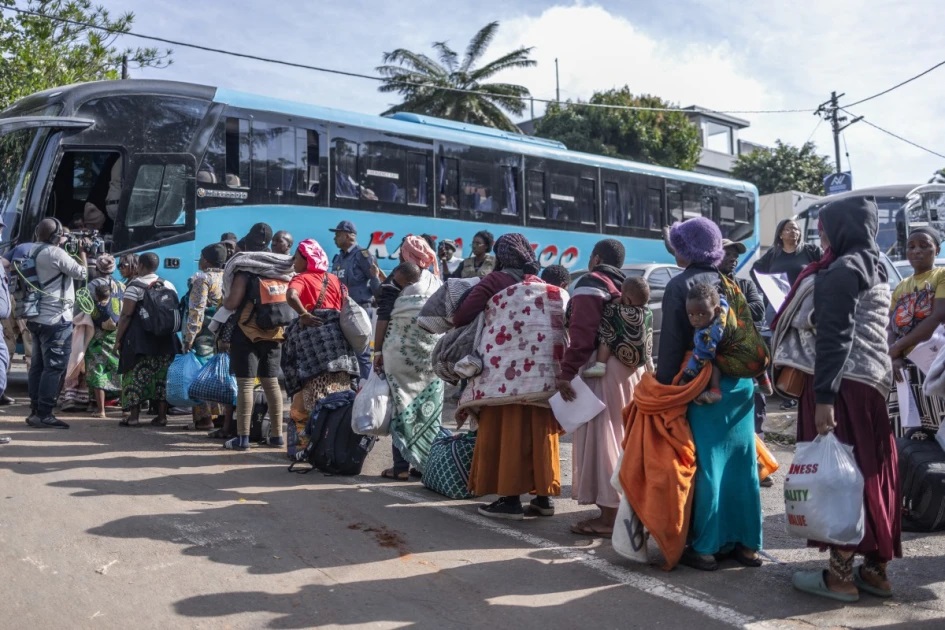
South Africa has repatriated 2,745 foreigners in the week after President Cyril Ramaphosa vowed tougher action against illegal immigration, the country’s home affairs minister said on Sunday.
One of Africa’s largest economies, South Africa has long attracted migrant workers from across the continent, both legally and illegally.
But saddled with an unemployment rate above 30 percent, it has experienced recurring spurts of anti-immigrant unrest, including fresh violence in recent weeks.
Mobs of South Africans carrying sticks, whips and shields have marched through parts of the country ordering foreigners with no residency papers to leave by June 30.
Growing security fears after businesses were looted and foreigners targeted have prompted citizens of Nigeria, Malawi, Ghana, Zimbabwe and Mozambique to accept voluntary repatriation organised by their governments.
“As of last night, the number we can report is 2,745 repatriations that have come in this period since the president spoke,” Home Affairs Minister Leon Schreiber told reporters.
“It is a moving target,” he said.
The government said most of those repatriated were in the country illegally.
They include Malawian nationals, about 7,000 of whom have been sheltering in an open field in the eastern port city of Durban, according to an inter-ministerial migration committee set up after the president’s address.
Eight buses commissioned by the Malawian government began moving its citizens on Sunday, with South Africa providing 10 additional buses to speed up deportations, the committee said.
Some 560 people, including about 200 children, took the journey on Sunday, Malawi Consul General Max Biwi said.
Among those boarding the first buses, some carried babies on their backs and small bags of belongings.
“I’m relieved we are finally leaving. It’s better than living in fear here,” said Fortunate Chilenje from Blantyre, Malawi’s commercial capital.
The 25-year-old had lived in South Africa for three years, she told AFP, adding that threats to leave had followed her even at the camp, one of the largest to emerge since the unrest began.
The government said on Sunday it did not operate refugee camps and had no intention of establishing them, even on a temporary basis.
Another passenger, Laina Nala from Mangochi in southern Malawi, said she simply wanted to be dropped as close to her home as possible, rather than continuing on to Blantyre.
“Blantyre is too far and expensive from there,” she said.
For Hassan Hasha, 27, a debt linked to his journey to South Africa still hung over his head.
He said he had barely stayed in South Africa for weeks before the anti-foreigner sentiment flared, but added: “I have resigned myself to going home”.
Last week, Ramaphosa acknowledged public concerns over illegal immigration but warned that the authorities would not tolerate anyone taking the law into their own hands.
Tensions escalated after two Mozambicans were killed following a May 29 march against illegal migrants in the Western Cape town of Mossel Bay. Mozambican authorities put the toll at five.
There are more than three million foreigners living in South Africa, or 5.1 percent of the population, according to the statistics agency.

Day 4 of projects commissioning as President TInubu set to commission newly constructed Court of Appeal Building

Cholera Outbreak: Plateau Records 5 Deaths, 11 Confirmed Cases

South Africa says 2,745 foreigners sent home in a week




-

 News19 hours ago
31.5kg cocaine trafficking: 11 Indian sailors, ship convicted, fined $6m
-
 Crime18 hours ago
NDLEA nabs businessman with 6.10kg cocaine starched in shirts, towels from Brazil+Photos
-

 Sports18 hours ago
PSG’s Barcola hands over transfer request as Aresenal, Liverpool show interest
-
 Foreign18 hours ago
Hormuz to reopen on Sunday after US-Iran sign deal-Trump
-

 Politics18 hours ago
New Delta Vision not a political project, but generational movement, Delta State’s ADC candidate Unuafe clarifies
-
 News17 hours ago
ECOWAS Parliament Convenes High-Level Dakar Summit to Drive Renewable Energy Push in Rural West Africa
-

 News16 hours ago
Deputy Speaker Pushes for Home-Grown Defence Industry, Stronger Financial Crackdown on Insecurity
-

 Opinion16 hours ago
Chinese Miners Are Not the Architects of Nigeria’s Banditry A Response to Farooq A. Kperogi’s “How Chinese Miners Fuel Nigeria’s Terrorist Banditry”