
News
Education Is Nigeria’s Lifeline In A Fiercely Competitive World – Gbajabiamila


- /home/naijuinz/public_html/wp-content/plugins/mvp-social-buttons/mvp-social-buttons.php on line 27
https://naijablitznews.com/wp-content/uploads/2026/02/IMG-20260216-WA0030-1000x600.jpg&description=Education Is Nigeria’s Lifeline In A Fiercely Competitive World – Gbajabiamila', 'pinterestShare', 'width=750,height=350'); return false;" title="Pin This Post">
- Share
- Tweet /home/naijuinz/public_html/wp-content/plugins/mvp-social-buttons/mvp-social-buttons.php on line 72
https://naijablitznews.com/wp-content/uploads/2026/02/IMG-20260216-WA0030-1000x600.jpg&description=Education Is Nigeria’s Lifeline In A Fiercely Competitive World – Gbajabiamila', 'pinterestShare', 'width=750,height=350'); return false;" title="Pin This Post">


…urge bold rethink as leaders gather to reshape the future of learning
By Gloria Ikibah
The Chief of Staff to the President and former Speaker 9th House of Representatives, Hon. Femi Gbajabiamila has said that education remains Nigeria’s surest path to survival and global relevance.
Addressing participants at a high-level stakeholder roundtable on the Future of Education in Nigeria, to commemorate the 2026 International Day for Education on Monday in Abuja, themed “Re-imagining the Future of Education in Nigeria: Collaborative Solutions for a Brighter Tomorrow”, Gbajabiamila stressed the urgent need to reposition the nation’s schools to meet the demands of a rapidly changing world.
The gathering, drew policymakers, educationists and development partners committed to reforming the sector.
He applauded the Speaker of the House of Representatives, Rt. Hon. Tajudeen Abbas, for spearheading the conference, describing the initiative as a clear demonstration of the legislature’s commitment to national progress through educational advancement.
Gbajabiamila maintained that education must be viewed as far more than just another arm of the economy. For a country with Nigeria’s size and ambitions, he argued, it represents the foundation of long-term stability, prosperity and international competitiveness.
“Education is the bridge between potential and productivity; between aspiration and achievement,” he said, stressing that no country can compete globally without sustained investment in learning.
Reflecting on his time as Speaker of the 9th House of Representatives, Gbajabiamila highlighted his role in championing the Students’ Loans Bill, an initiative designed to remove financial barriers that prevent capable young Nigerians from pursuing tertiary education.
The legislation, he noted, was driven by the principle that opportunity should rest on merit and ability rather than social standing or wealth.
He pointed out that within the first three months of the current administration, Bola Ahmed Tinubu gave assent to the bill, clearing the path for the creation of the Nigerian Education Loan Fund and signalling early intent to prioritise access to higher learning.
The development, he suggested, aligns squarely with the administration’s Renewed Hope Agenda, placing education at the heart of its broader reform strategy.
He also commended the 10th House of Representatives for intensifying oversight of tertiary education financing, backing measures to improve student welfare and advancing reforms aimed at strengthening transparency and accountability across the sector.
In his view, the legislature has demonstrated that its role extends beyond passing laws, positioning itself as a critical partner in steering Nigeria’s long-term development.
“As Chief of Staff to the President, you can always count on my support. Education will remain central to the Renewed Hope Agenda,” he said.
He urged participants to move beyond dialogue and generate actionable recommendations to improve funding efficiency, strengthen oversight, and ensure that existing laws reflect present realities.
“Nigeria’s brightest tomorrow will be built in the classrooms we strengthen today,” he added.
In her opening address, Special Adviser to the Speaker on International Cooperation and Educational Development, Abisoye Da Rocha-Afodu, traced the origins of the International Day of Education to its proclamation by the United Nations General Assembly in 2018, a move intended to affirm education as a basic human right.
She drew attention to the scale of Nigeria’s education crisis, noting that more than 20 million children remain out of school — the highest figure worldwide. Among the persistent obstacles, she listed inadequate infrastructure, low teacher morale and welfare, outdated curricula and limited access to digital tools, all of which continue to hamper progress.
The conference, she explained, was designed to convene legislators, policymakers, development agencies and key stakeholders to chart practical, lasting responses to these challenges. Stronger collaboration between government bodies, private enterprise and local communities was identified as critical to widening access to quality, inclusive learning, particularly for girls and people living with disabilities.
On safeguarding public resources, she indicated that the House is advancing legislative proposals aimed at ensuring regular scrutiny and transparent use of funds allocated to education programmes.
Also Chairman House Committee on Federal Polytechnic and Higher Technical Education, Rep. Fuad Laguda, said the conference offered an opportunity to assess Nigeria’s education system against international benchmarks.
He noted that funding remains one of the most pressing challenges confronting the sector, particularly polytechnics and higher technical institutions.
Laguda stressed that collaboration was essential to meaningful reform, pointing out that participants from diverse sectors gathered to build synergy and chart a common path forward.
He added that any nation seeking sustainable development must invest heavily in education, stressing that Nigeria must raise its ambitions if it hopes to compete effectively on the global stage.
Although the International Day of Education is marked globally on 24 January, the event was rescheduled for February owing to the National Assembly’s January recess. The adjusted timing was also intended to allow for deeper engagement ahead of Ramadan and to focus attention on pressing concerns around funding, security and accountability within the sector.

News
Day 4 of projects commissioning as President TInubu set to commission newly constructed Court of Appeal Building


President Tinubu will commission the newly constructed Court of Appeal (Abuja Division) Building today, 15/6/26 as FCT projects commissioning enters Day 4.
#FCTProjects2026
#RenewedHopeFCT

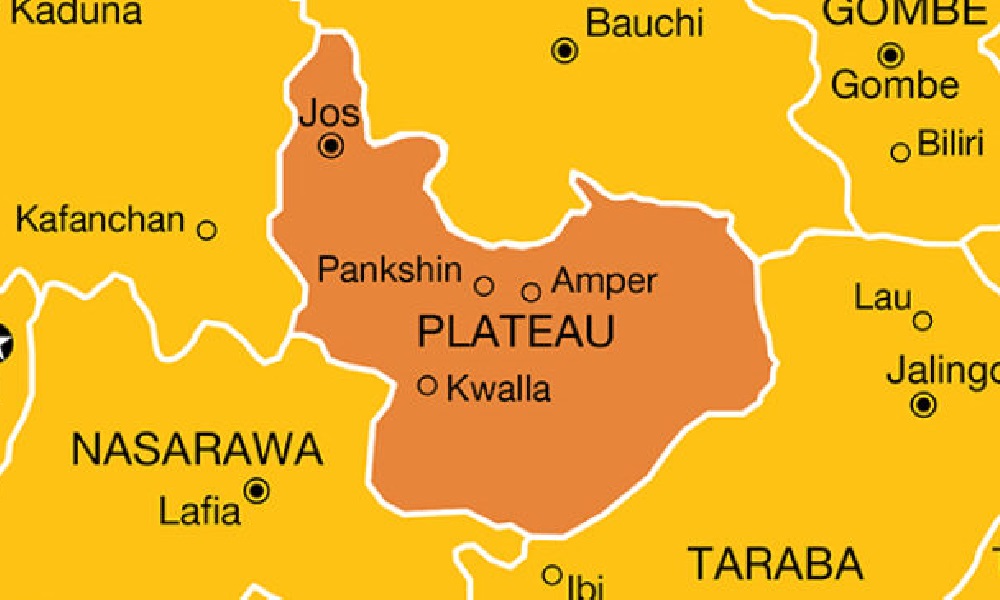
Plateau State commissioner for Health, Dr Nicholas Baamlong, has revealed that the state recorded 11 confirmed cases of cholera, five deaths and 53 suspected cases.
Baamlong, who disclosed this to journalists yesterday in Jos, said the confirmed and suspected cases were reported in Pushit, Mangu 1 and Mangu 2 communities in Mangu local government area (LGA).
According to him, the state Ministry of Health is intensifying public health interventions to contain the outbreak, prevent further spread and reduce its impact on affected communities.
He explained that the state had taken decisive actions to control the outbreak and protect its citizens via the deployment of additional Response Teams (RRTs) to the affected wards, scaling up of treatment centres and isolation capacity and the emergency procurement of Rapid Diagnostic Tests Kits, intravenous fluids and essential drugs.
The Commissioner further said that the ministry had activated an Incident Management System (IMS), for a comprehensive and multi sectorial response to the outbreak.
“The activation of the IMS ensures a coordinated, efficient, and accountable response structure in line with national and international emergency response frameworks,” he said.
Baamlong explained that cholera was an acute diarrhoeal disease caused by consuming food or water contaminated with the bacterium Vibrio cholerae.
He urged residents of Mangu LGA and neighbouring communities to remain vigilant and take preventive measures, including drinking safe water, maintaining proper hand hygiene, avoiding open defecation, and ensuring proper waste disposal.
He also advised residents to promply report suspected cases of cholera to the nearest healthcare facility for immediate attention.
While reaffirming the state government’s commitment to safeguarding the health and well-being of residents, Baamlong called on development partners and other stakeholders to support ongoing response efforts.(NAN)
South Africa has repatriated 2,745 foreigners in the week after President Cyril Ramaphosa vowed tougher action against illegal immigration, the country’s home affairs minister said on Sunday.
One of Africa’s largest economies, South Africa has long attracted migrant workers from across the continent, both legally and illegally.
But saddled with an unemployment rate above 30 percent, it has experienced recurring spurts of anti-immigrant unrest, including fresh violence in recent weeks.
Mobs of South Africans carrying sticks, whips and shields have marched through parts of the country ordering foreigners with no residency papers to leave by June 30.
Growing security fears after businesses were looted and foreigners targeted have prompted citizens of Nigeria, Malawi, Ghana, Zimbabwe and Mozambique to accept voluntary repatriation organised by their governments.
“As of last night, the number we can report is 2,745 repatriations that have come in this period since the president spoke,” Home Affairs Minister Leon Schreiber told reporters.
“It is a moving target,” he said.
The government said most of those repatriated were in the country illegally.
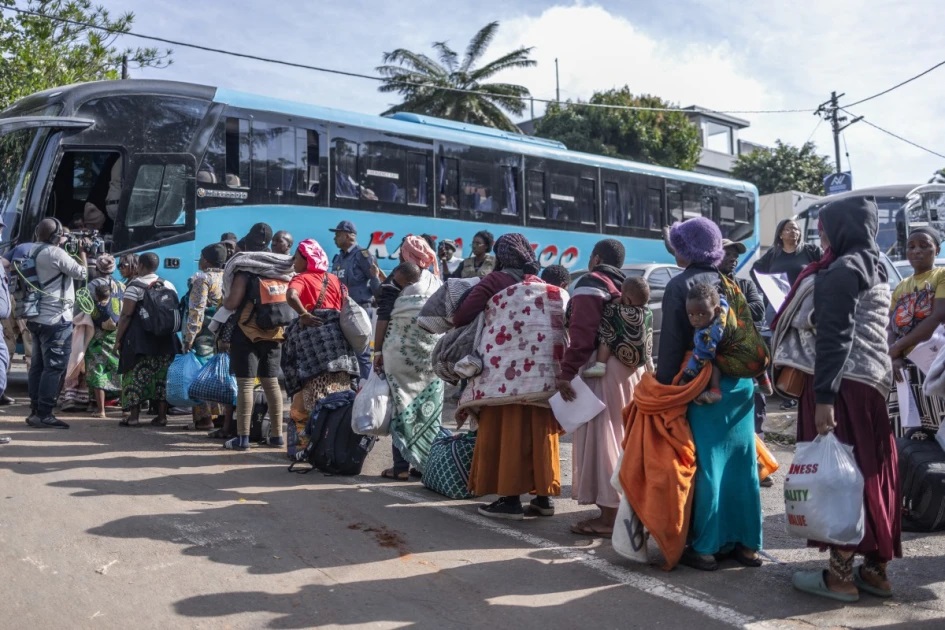
They include Malawian nationals, about 7,000 of whom have been sheltering in an open field in the eastern port city of Durban, according to an inter-ministerial migration committee set up after the president’s address.
Eight buses commissioned by the Malawian government began moving its citizens on Sunday, with South Africa providing 10 additional buses to speed up deportations, the committee said.
Some 560 people, including about 200 children, took the journey on Sunday, Malawi Consul General Max Biwi said.
Among those boarding the first buses, some carried babies on their backs and small bags of belongings.
“I’m relieved we are finally leaving. It’s better than living in fear here,” said Fortunate Chilenje from Blantyre, Malawi’s commercial capital.
The 25-year-old had lived in South Africa for three years, she told AFP, adding that threats to leave had followed her even at the camp, one of the largest to emerge since the unrest began.
The government said on Sunday it did not operate refugee camps and had no intention of establishing them, even on a temporary basis.
Another passenger, Laina Nala from Mangochi in southern Malawi, said she simply wanted to be dropped as close to her home as possible, rather than continuing on to Blantyre.
“Blantyre is too far and expensive from there,” she said.
For Hassan Hasha, 27, a debt linked to his journey to South Africa still hung over his head.
He said he had barely stayed in South Africa for weeks before the anti-foreigner sentiment flared, but added: “I have resigned myself to going home”.
Last week, Ramaphosa acknowledged public concerns over illegal immigration but warned that the authorities would not tolerate anyone taking the law into their own hands.
Tensions escalated after two Mozambicans were killed following a May 29 march against illegal migrants in the Western Cape town of Mossel Bay. Mozambican authorities put the toll at five.
There are more than three million foreigners living in South Africa, or 5.1 percent of the population, according to the statistics agency.

Day 4 of projects commissioning as President TInubu set to commission newly constructed Court of Appeal Building

Cholera Outbreak: Plateau Records 5 Deaths, 11 Confirmed Cases

South Africa says 2,745 foreigners sent home in a week




-

 News19 hours ago
31.5kg cocaine trafficking: 11 Indian sailors, ship convicted, fined $6m
-
 Crime18 hours ago
NDLEA nabs businessman with 6.10kg cocaine starched in shirts, towels from Brazil+Photos
-

 Sports19 hours ago
PSG’s Barcola hands over transfer request as Aresenal, Liverpool show interest
-
 Foreign19 hours ago
Hormuz to reopen on Sunday after US-Iran sign deal-Trump
-

 Sports13 hours ago
Real Madrid complete a Shocking Signing of Chelsea Superstar
-

 Politics18 hours ago
New Delta Vision not a political project, but generational movement, Delta State’s ADC candidate Unuafe clarifies
-
 News17 hours ago
ECOWAS Parliament Convenes High-Level Dakar Summit to Drive Renewable Energy Push in Rural West Africa
-

 News17 hours ago
Deputy Speaker Pushes for Home-Grown Defence Industry, Stronger Financial Crackdown on Insecurity